Subject
How light actually behaves when it meets matter and instruments. Refraction, lenses, microscopes, telescopes, and rainbows — the physics that shaped how we see and what we can see.
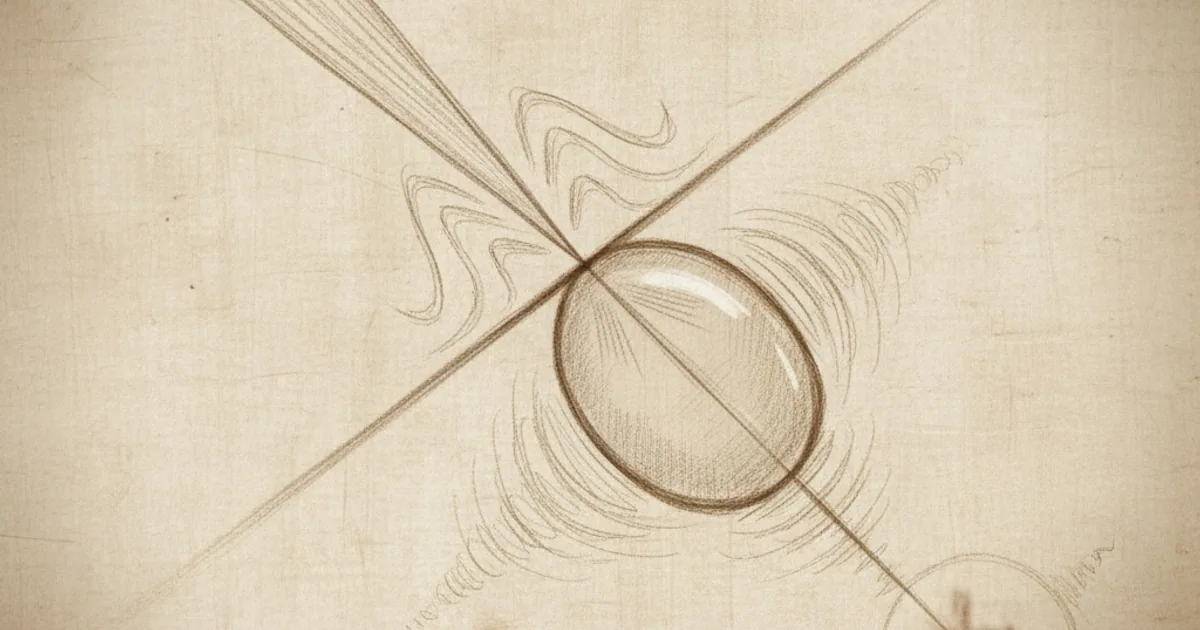
Optics is mostly the physics of three things light does when it meets matter:
Plus a few related effects (dispersion, polarization, interference). Combined, these explain every optical instrument: glasses, cameras, microscopes, telescopes, projectors, fiber optics, lasers, and the eye itself.
This article is the overview. The cluster goes deeper: how lenses actually work, how microscopes work, how telescopes work, and why rainbows have colors. For the wave-related side (sky color, Doppler, why straws look bent), see the light-sound-waves cluster.
A light ray hitting a smooth surface reflects at an angle equal to the angle it came in at, measured from the line perpendicular to the surface (the "normal"). This is the law of reflection — angle of incidence equals angle of reflection.
Smooth surfaces produce specular reflection (mirror-like, preserving the image). Rough surfaces produce diffuse reflection (scattered in many directions). Most everyday objects reflect diffusely — that's why you can see them from any angle, but they don't act as mirrors. Polished glass, water surfaces, and metal can reflect specularly.
Mirrors are based on reflection. A flat mirror reverses left-right (technically: reverses the direction perpendicular to its surface). A curved mirror — concave or convex — can focus or spread light, building an image at a specific location.
The reason most metals make good mirrors: their loosely-bound electrons easily absorb and re-radiate light, producing efficient reflection across the visible spectrum. Glass mirrors are typically silvered or aluminum-coated on one side; the glass is just a substrate.
When light passes from one transparent material to another (air to glass, water to air), it bends. The reason: light travels at different effective speeds in different materials, and a wavefront entering at an angle has parts in each material that travel at different speeds, so the direction of propagation changes.
The ratio of c (light speed in vacuum) to the speed in a material is the refractive index of that material (denoted n). Some common values:
The amount of bending follows Snell's law: n₁·sin(θ₁) = n₂·sin(θ₂), where θ is measured from the normal. Light entering a denser material (higher n) bends toward the normal; entering a less-dense material it bends away.
This is what makes lenses work. (See how lenses actually work.)
It also produces some everyday phenomena:
When light tries to go from a higher-n material to a lower-n material at a steep enough angle, it can't refract out — it reflects back into the denser material instead. This is total internal reflection (TIR).
The critical angle depends on the two refractive indices. For glass-to-air (n = 1.5 to 1.0), the critical angle is about 41.8°. For water-to-air, about 48.6°.
TIR is the basis of:
When light passes through a narrow opening — or past the edge of an object — it spreads out in a characteristic pattern. This is diffraction, and it's a direct consequence of light being a wave.
The amount of spreading depends on the ratio of the wavelength to the aperture size. For everyday objects (windows, doors), the aperture is much larger than the wavelength of visible light (~400-700 nm), so diffraction is negligible and light travels in straight lines. For tiny apertures or fine details, diffraction matters.
Practical consequences:
You can't resolve details smaller than approximately half the wavelength of the light you're using. This is the classical resolution limit, formalized by Ernst Abbe in 1873.
In quantitative form: minimum resolvable distance ≈ λ / (2 · NA), where NA is the numerical aperture of the optical system (essentially: how steeply rays converge to the focal point).
For visible light (λ ≈ 550 nm) and very high-quality objectives (NA up to ~1.4 with oil immersion), the resolution limit is around 200 nm. That's enough to see bacteria, organelles, and large protein complexes, but not individual proteins or atoms.
To go finer, you need shorter wavelengths:
The refractive index of a material isn't quite constant with wavelength — different colors of light bend by slightly different amounts when refracting. This is dispersion.
In glass, blue light has slightly higher refractive index than red, so it bends more. A prism separates white light into a spectrum because each color refracts at a slightly different angle, fanning out the colors.
Dispersion is responsible for:
A lens uses refraction at two curved surfaces to bend incoming rays so they converge to (or appear to diverge from) a focal point. The geometry determines where the image forms.
Two main types:
The thin lens equation: 1/f = 1/d_o + 1/d_i, where f is the focal length, d_o is the distance to the object, and d_i is the distance to the image. Knowing two, you can compute the third.
Multiple lenses combine: telescopes, microscopes, cameras, projectors all use sequences of lenses to produce a final image with the right magnification, brightness, and aberration corrections. Detail in how lenses actually work.
Real lenses aren't perfect. Several characteristic problems show up:
Eliminating aberrations is most of what makes high-quality lens design hard. Professional lenses combine many glass elements with carefully chosen shapes and materials. Some aberrations are corrected with multiple elements; some by clever software; some are unavoidable.
In electron optics (SEM, TEM), the same kinds of aberrations apply — astigmatism is a routine calibration issue, and aberration-corrected microscopes are a major research area. See SemSip's SEM optics calibration coverage for the practical side.
Light is a transverse electromagnetic wave — the electric field oscillates perpendicular to the direction of travel. The direction the field oscillates is polarization.
Polarizing filters block one polarization direction, transmitting the other. Crossed polarizers block essentially all light. Some applications:
Every optical instrument is a specific arrangement of refracting and reflecting elements:
If you'd like a guided 5-minute course on optics and how the instruments around you actually work, NerdSip can generate one.
Optics is the physics of how light interacts with matter — primarily reflection at surfaces, refraction at boundaries between different materials, and diffraction at apertures. Geometric optics (light as rays) handles most everyday instruments; wave optics (light as a wave) is needed when sizes approach the wavelength. The classical resolution limit (about half the wavelength) is what drives the use of shorter-wavelength sources — UV, X-rays, electrons — for finer detail. Every optical instrument is an arrangement of refracting and reflecting elements designed for a specific imaging purpose, and the limits of optical design (aberrations) are most of what makes high-quality optics expensive and demanding. The same principles extend to electron optics in scanning electron microscopy — covered in detail at SemSip.
A short editorial reading list. Pick whichever fits how you like to learn.


Comments 0
No comments yet. Be the first to share your thoughts.