
The setup
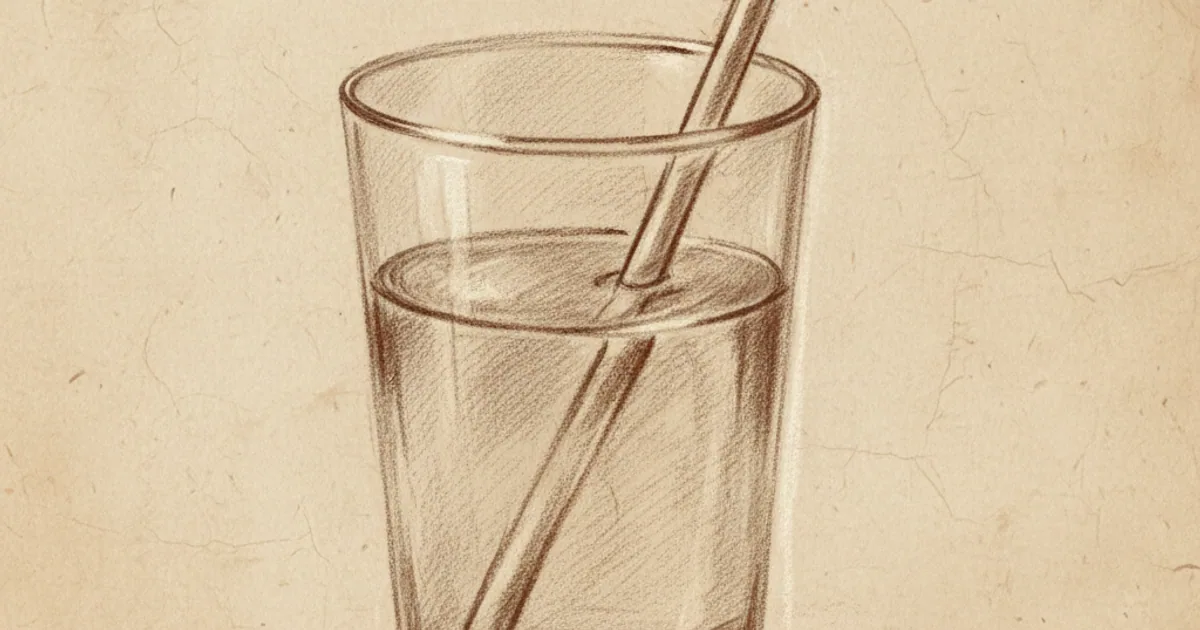
Put a straw in a glass of water. From the side, it looks like the straw breaks at the waterline — the submerged part appears displaced from the air part, as though the straw bends sharply at the surface.
The straw is perfectly straight. The trick is in how light gets from the straw to your eye.
The mechanism
Light travels at different speeds in different media. In a vacuum, it moves at exactly c (299,792,458 m/s). In water, it moves at about c/1.33 ≈ 225,000 km/s. In glass, even slower — around c/1.5.
That "1.33" or "1.5" is called the refractive index of the material. Higher refractive index = slower light = bigger bending effect when light crosses a boundary.
When a light ray passes from water into air, it speeds up. This speed change at the boundary causes the ray to bend. The bending follows Snell's law:
n₁ × sin(θ₁) = n₂ × sin(θ₂)
where n is the refractive index and θ is the angle from the normal (the perpendicular to the surface).
For the straw: light reflecting off the submerged part travels up through water, hits the air-water surface, then bends as it enters the air. Your brain, assuming straight-line travel of light, reconstructs the straw's position based on the incoming angle from above the water. That reconstructed position is shifted from where the straw actually is. Visually: the straw looks broken.
The cart-on-sand analogy
There's a useful mental picture due to Feynman.
Imagine a cart rolling on a hard surface, then hitting a region of sand. As the cart enters the sand, the wheel that hits the sand first slows down. The other wheel keeps moving fast briefly. The result: the cart turns slightly. As both wheels enter the sand, both slow, and they roll straight again — but now angled differently than before.
That's exactly how light behaves at a boundary. The part of the wavefront that hits the new medium first slows. The rest of the wavefront catches up at a slightly different angle. The wave continues into the new medium going in a slightly different direction.
The math comes out as Snell's law, but the physical mechanism is just "one side slows down before the other."
Why does light slow down in water?
Light is an electromagnetic wave; in vacuum it moves at c. In materials, photons interact with electrons. The simplified picture: each electron in the water (or glass) responds slightly to the passing electric field of the light, oscillating in step. That oscillation re-emits light, which combines with the original light. The net effect on the overall wave is a slower phase velocity.
Different materials have different electron configurations, so they slow light by different amounts. The refractive index summarizes the effect numerically. Water's 1.33 is moderate; diamond's 2.42 is unusually high, which is why diamonds sparkle (more bending at the surfaces, more total internal reflection).
This explanation is hand-wavy but captures the essence. The full quantum picture involves photon-electron coupling and dispersion, but for everyday purposes, "light slows in dense media" is enough.
Total internal reflection
A consequence: light traveling from a high-index medium to a low-index one bends away from the normal. As the angle from the normal gets steeper, the bending gets more extreme. Beyond a certain critical angle, the light can't escape into the lower-index medium at all — it reflects entirely back into the original medium.
This is total internal reflection. It's why:
- Fiber optics work. Light inside a glass fiber hits the cladding at shallow angles; the light can't escape into the surrounding air. It bounces along the fiber for kilometers with very low loss.
- A swimming pool surface looks mirror-like from underwater when you look upward at a shallow angle. The surface acts like a mirror because light can't exit; it just reflects.
- Diamonds sparkle. Their high refractive index means many internal reflections, each bouncing light back into the diamond, until eventually some path lets the light exit with bright separated colors.
Dispersion: white light becomes a rainbow
A subtle point: the refractive index isn't quite the same for all colors. Blue light slows slightly more than red light in most materials. This is called dispersion, and it's why a prism splits white light into a rainbow.
When sunlight enters a glass prism, each color bends by a slightly different amount. The colors separate as they pass through. By the time they exit, they're spread out into the familiar spectrum.
The same effect produces rainbows. Sunlight enters water droplets in the air, reflects off the back of the droplet, exits with the different colors at slightly different angles. The result: a curved arc of separated colors at roughly 42° from the antisolar point (the direction opposite the sun from your eye).
Dispersion is also why fiber-optic cables need careful design — different wavelengths arrive at slightly different times, smearing fast signals. Modern fibers use either special glass formulations or specific wavelengths to minimize this.
Other refraction effects you can see
A fish appears closer than it is. Light from the fish bends as it exits the water. Your brain reconstructs the fish's position based on the air-side angle, putting it shallower than it really is. Spear fishers learn to compensate.
A coin in a glass of water becomes visible when water is added. With the glass empty and the coin behind the rim, your line of sight is blocked. Fill the glass; refraction at the surface bends light from the coin so it now reaches your eye over the rim. The coin "appears" — actually it was always there, but you couldn't see it before.
Heat shimmer. Above hot pavement or a flame, air density varies, so refractive index varies. Light from objects beyond the hot zone bends randomly through the varying density, making the objects look wavy. Same mechanism in mirages — hot air near the ground refracts light from the sky to produce a "water" appearance.
Stars twinkle. Atmospheric turbulence causes refractive-index variations in patches of air above you. Light from distant stars passes through these patches and gets bent slightly different amounts moment to moment. The star's apparent position wobbles. Planets, much closer and presenting as small disks rather than points, don't twinkle as much because the wobble averages over the disk.
Want to keep building this kind of physics intuition? NerdSip can generate a personalized 5-minute course on optical illusions and refraction.
The takeaway
A straw in water looks bent because light slows down when it enters water, and the speed change at the air-water surface causes the light path to bend. Your brain assumes straight-line travel and reconstructs the straw's position based on the bent path — which produces the apparent break at the waterline. Same physics is behind rainbows, fiber optics, sparkly diamonds, mirages, fish appearing closer than they are, and stars twinkling. One mechanism — light bending at material boundaries — covers a remarkable range of everyday phenomena.

Comments 0
No comments yet. Be the first to share your thoughts.