
The two-stage idea
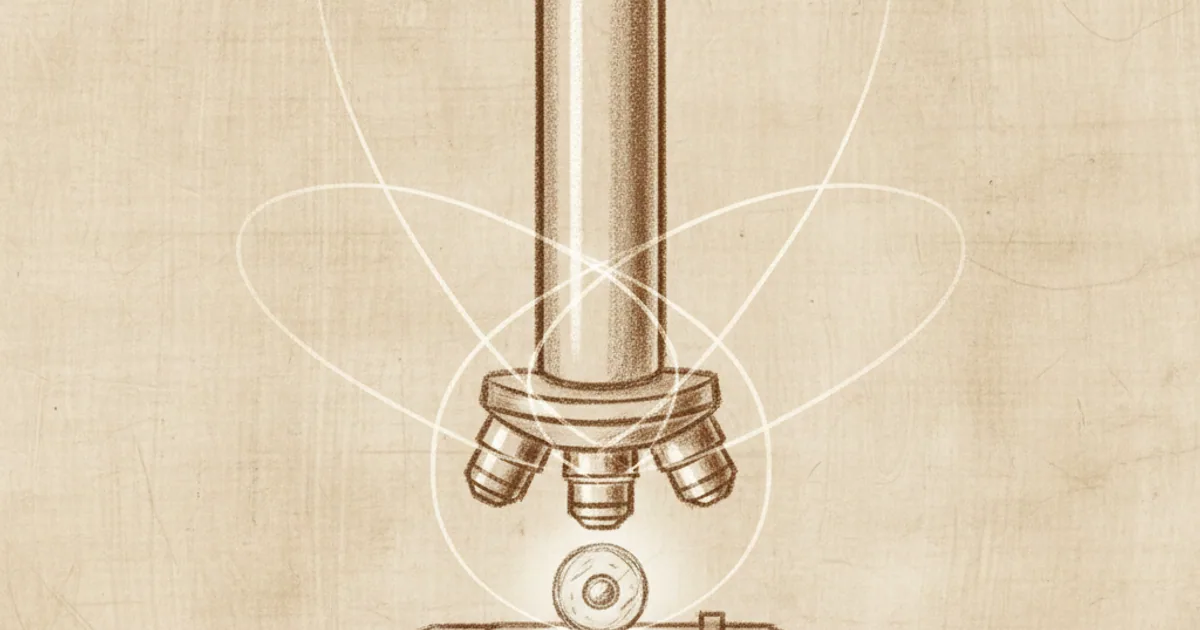
A simple magnifying glass can give you about 2-10x magnification. To go further, you need a compound microscope — two lens stages working together:
- An objective lens close to the sample, producing an enlarged real image inside the microscope tube.
- An eyepiece (ocular) that further magnifies that intermediate image, presenting a virtual image to your eye.
Total magnification = objective magnification × eyepiece magnification. A 40x objective with a 10x eyepiece gives 400x. A 100x oil-immersion objective with a 10x eyepiece gives 1000x.
This is the basic architecture of nearly every COMPOUND optical microscope from the 17th century to today. (Single-lens microscopes — like Antonie van Leeuwenhoek's famous instruments and many modern smartphone/digital inspection scopes — bypass the two-stage geometry by using one strong objective with direct visual or camera imaging.) Modern instruments add many refinements — corrected lenses, controlled illumination, contrast techniques — but the two-stage geometry is the foundation.
The objective: the most important component
The objective lens (or compound lens system) does most of the work. It sits close to the sample (working distance typically 0.1 mm to a few cm depending on magnification) and produces a real image in the optical tube above.
What an objective is optimized for:
- High magnification with controlled aberrations: typically 4x, 10x, 20x, 40x, 60x, 100x. Each requires careful aberration correction.
- High numerical aperture (NA): critical for resolution and brightness. (See FAQ for what NA means.)
- Specific working distance and tube length: standardized for parfocality (switching objectives keeps focus approximately).
- Specific medium: air objectives, water-immersion objectives, oil-immersion objectives. Different NA ceilings; oil immersion uses high-index oil between objective and sample for the highest NA.
- Specific illumination compatibility: phase contrast, DIC, fluorescence — each needs matched optics.
A high-quality 60x oil-immersion plan apochromat objective can cost €5,000-15,000. A research microscope's objective set often represents the bulk of the instrument's cost.
The eyepiece: secondary magnification
The eyepiece (ocular) is a simpler lens or lens pair that magnifies the intermediate image formed by the objective. Typical magnification: 10x or 20x. Multiple types:
- Huygens eyepiece: two-element. Older design, basic correction.
- Ramsden eyepiece: two-element. Some specialized uses.
- Plössl eyepiece: four-element. Common in astronomy and high-quality microscopes.
- Modern wide-field eyepieces: 4-6+ elements. Better aberration correction, wider field of view.
Modern microscopes increasingly use a trinocular head: two eyepieces for visual observation plus a port for a camera. The camera captures the intermediate image (or a relayed version of it) directly, bypassing the eyepiece for digital imaging.
Resolution: the fundamental limit
The single most important specification of a microscope isn't magnification — it's resolution, the minimum distance between two points that can be distinguished.
The Abbe diffraction limit (Ernst Abbe, 1873):
d_min ≈ λ / (2 · NA)
Where λ is the wavelength of light and NA is the numerical aperture of the objective.
For visible light (λ ≈ 550 nm) and excellent oil-immersion objectives (NA ≈ 1.4):
d_min ≈ 550 / (2 × 1.4) ≈ 200 nm
This is the practical resolution limit of light microscopy. About a fifth of a micrometer. Enough to see:
- Most bacteria (typically 0.5-5 μm).
- Major organelles in cells (nuclei, mitochondria, large vesicles).
- Individual eukaryotic cells in tissue.
- Some viruses (the largest — most viruses are below this limit).
NOT enough to see:
- Most viruses (typically 20-300 nm; many right at the limit).
- Individual proteins (typically 5-10 nm).
- Membrane structures at high detail.
- Individual molecules.
- Anything at atomic scale.
For finer detail, you need to change something fundamental:
- Shorter wavelength: UV microscopes (λ ~250 nm) get to ~100 nm resolution. X-ray microscopes (λ ~1 nm) can reach few-nm resolution but with severe sample restrictions.
- Different imaging method: super-resolution techniques (STED, PALM, STORM) use switchable fluorescent molecules to localize features below the diffraction limit. 2014 Nobel Prize.
- Different particle: electrons have de Broglie wavelengths thousands of times shorter than visible light. Electron microscopy can image individual atoms.
Numerical aperture: why oil immersion exists
The Abbe limit shows resolution improves with higher NA. NA is determined by:
NA = n · sin(θ)
Where n is the refractive index of the medium between lens and sample, and θ is the half-angle of the light cone the lens can capture.
For air (n = 1), sin(θ) can approach but not exceed 1, so NA caps at ~0.95. With oil (n ≈ 1.5), NA can reach 1.4 or 1.5.
This is why high-end microscopes use oil immersion: a drop of high-refractive-index oil between the objective lens and the sample (or cover slip). The oil fills the gap, allowing higher-angle rays to enter the objective without total internal reflection at the air-glass interface.
Practical implications:
- Oil immersion gives finer resolution AND brighter images (more light collected).
- Working distance is very short (~0.1-0.2 mm), requiring careful focusing.
- The oil must match the cover slip's refractive index (~1.515).
- Cleaning between samples is important; oil residue degrades performance.
Water-immersion (n = 1.33) and glycerin-immersion (n = 1.47) objectives are used for live cells in aqueous solution.
Contrast: making transparent samples visible
A complication: most biological samples are mostly transparent in visible light. Without some way to introduce contrast, the image is featureless.
Several contrast techniques:
Bright-field with stains: dye the sample with a chemical that absorbs specific wavelengths. The simplest and most common; the basis of standard histology slides. Different stains target different cellular structures (H&E, Gram stain, Giemsa, etc.).
Phase contrast (Zernike, 1953 Nobel): converts the small phase shifts that light picks up passing through transparent structures into intensity variations. Allows imaging of live unstained cells.
Differential interference contrast (DIC): produces pseudo-3D shaded images by interfering two slightly displaced versions of the same light. Beautiful and informative.
Fluorescence microscopy: tag specific molecules with fluorescent dyes (or genetic fluorescent protein constructs like GFP). Excite at one wavelength, observe emission at another. Specific molecules can be localized within cells.
Confocal microscopy: uses a pinhole to reject out-of-focus light, producing crisp 3D image stacks from sectioning through fluorescent specimens. Now the standard tool for biological imaging.
Multiphoton microscopy: uses nonlinear absorption of multiple infrared photons to excite fluorescence only at the focal point. Better penetration into thick samples (~mm into brain tissue).
Each technique adds complexity but solves specific sample-contrast problems.
Why electron microscopy?
If you want to see beyond the optical resolution limit and don't have a workable shorter-wavelength light source for your sample, the natural alternative is electron microscopy.
The key insight: matter has wave properties (de Broglie, 1924). The de Broglie wavelength of an electron with kinetic energy E is:
λ = h / √(2 · m_e · E)
For an electron accelerated to 60 keV (typical SEM voltage), λ ≈ 0.005 nm — about 10,000-20,000x shorter than visible light (which is around 400-700 nm). The Abbe limit drops correspondingly.
Two main types:
Scanning electron microscope (SEM): a focused electron beam is scanned across the sample surface. Emitted secondary or backscattered electrons are collected by detectors and used to build an image, point by point. Resolution: typically 0.5-5 nm depending on instrument. Excellent for surface topography of solid samples. Detailed technical coverage at SemSip.
Transmission electron microscope (TEM): electrons pass THROUGH an extremely thin sample (typically <100 nm). Transmitted electrons form an image, similar to optical microscopy in geometry but with electron lenses. Resolution: 0.1 nm or finer. Used for ultra-thin sections of cells, materials structure analysis, individual atoms.
Scanning transmission electron microscope (STEM): a hybrid — scans a focused electron probe through a thin sample, collecting transmitted and scattered electrons. Excellent for analytical work (composition mapping).
All electron microscopes use:
- An electron gun as the source (thermionic emission from a heated filament, or field emission from a sharp tip).
- A high vacuum (electrons scatter strongly in air).
- Electromagnetic lenses (magnetic fields shaped by current-carrying coils) to focus the beam.
- Detectors for the various emitted signals.
The optical analogy holds remarkably well: there's a "gun" (source), "condenser lenses" (focus the beam onto the sample), "objective lens" (focuses below the sample for TEM, focuses the beam into a fine spot for SEM), and "projector lenses" (relay the image to a detector).
Calibrating these electron-optical columns is a serious routine task — much more demanding than calibrating optical microscopes. Magnification calibration, astigmatism correction, aperture alignment, working distance calibration — see SemSip's SEM optics calibration coverage for the technical workflow.
Costs and practical realities
A short tour of practical microscopes:
- Student / hobby microscope: $50-200. 40x-400x. Basic but functional for the visible end of biology.
- Educational research microscope: $1,000-5,000. Good objectives, multiple contrast methods, camera-ready.
- Mid-range research microscope: $20,000-50,000. Confocal or fluorescence-ready, motorized stage, professional optics.
- High-end research microscope: $100,000-300,000+. Advanced confocal, multiphoton, light-sheet, super-resolution capability.
- Entry-level desktop SEM: $50,000-150,000.
- Research-grade SEM: $250,000-1.5M+.
- High-end TEM: $1M-5M+.
- Aberration-corrected TEM/STEM: $5M+.
Each price tier brings significantly better aberration correction, higher resolution, more flexible imaging modes, and (importantly for research) better reproducibility of measurements.
A note on biological microscopy
A vast amount of modern biology happens at the microscope:
- Histology: tissue sections stained and imaged under bright-field.
- Pathology: clinical diagnosis using microscopic analysis of biopsies.
- Cell biology: live-cell imaging of fluorescent-tagged proteins.
- Developmental biology: light-sheet microscopy of developing embryos.
- Neuroscience: multiphoton imaging of brain tissue with fluorescent indicators of neural activity.
- Microbiology: identification and counting of microorganisms.
- Materials science: SEM and TEM of crystal structures, defects, surfaces.
Modern microscopes are tools of working scientists more than tools of viewing. Most images are captured digitally, processed extensively, and analyzed quantitatively. The optical principles haven't changed since Abbe; the surrounding workflow has.
If you'd like a guided 5-minute course on microscopy and what each technique reveals, NerdSip can generate one.
The takeaway
A compound microscope uses two lens stages — an objective close to the sample and an eyepiece for further magnification — to produce magnified images. Total magnification multiplies. The fundamental resolution limit (Abbe diffraction limit) is about λ/(2·NA), which for visible light and the best objectives gives ~200 nm. To go finer, you need shorter wavelengths (UV, X-ray) or different particles (electrons), or super-resolution techniques. Electron microscopes — SEM, TEM, STEM — achieve atomic-scale resolution by using electron beams with de Broglie wavelengths thousands of times shorter than visible light, focused with electromagnetic lenses. The optical principles transfer; the engineering is dramatically different. For the practical side of electron-microscope optics — calibration, alignment, operation — see SemSip's deep technical coverage.

Comments 0
No comments yet. Be the first to share your thoughts.