
What "laser" actually means
The word LASER is an acronym: Light Amplification by Stimulated Emission of Radiation.
The key word is "stimulated." A laser exploits a specific quantum-mechanical process — stimulated emission — to produce light where every photon is identical to every other photon. Same frequency, same direction, same phase, same polarization. The result is a beam of light with properties no ordinary light source can match.
Lasers were invented in 1960 (Theodore Maiman, ruby laser). Within decades they transformed industries — communication, manufacturing, medicine, science. Today there are an estimated billions of lasers in use globally, from sub-milliwatt diode lasers in barcode scanners to multi-megawatt fusion-research lasers.
Three kinds of light-matter interaction
Albert Einstein worked out the quantum theory of light absorption and emission in 1916-17, identifying three distinct processes:
1. Absorption. A photon hits an atom in a low-energy state. The atom absorbs the photon's energy and transitions to a higher-energy state. The photon is gone.
2. Spontaneous emission. An atom in an excited state spontaneously decays to a lower-energy state, emitting a photon. The direction and timing are random. Most ordinary light (sunlight, incandescent bulbs, fluorescent bulbs, LEDs to some extent) is dominated by spontaneous emission. The emitted photons are uncorrelated.
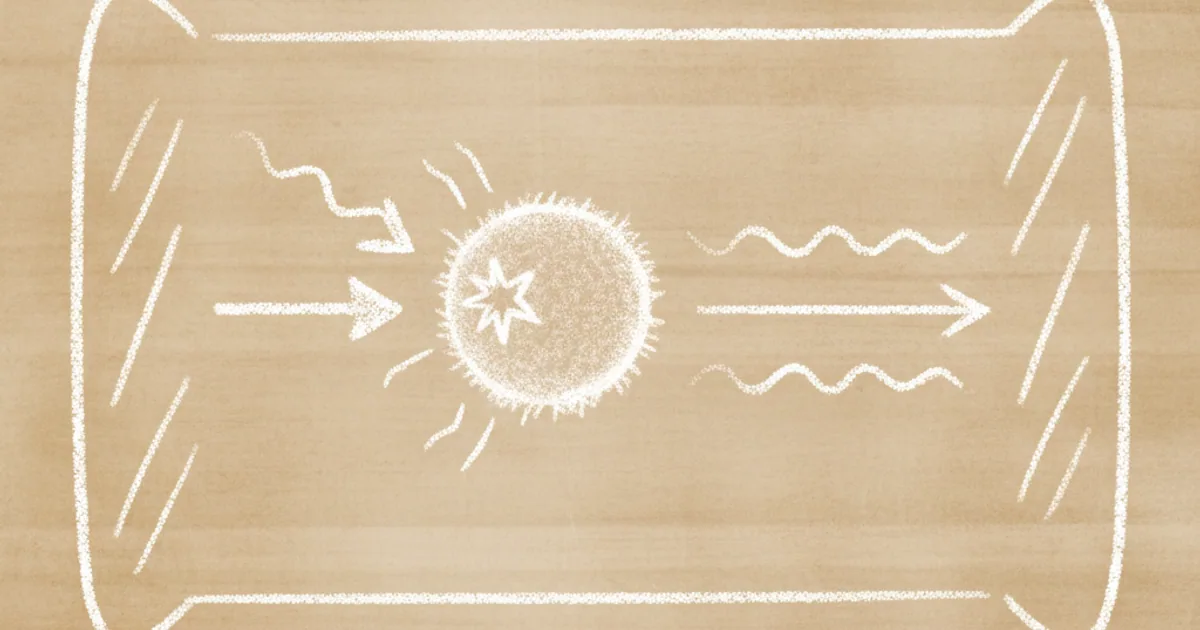
3. Stimulated emission. An atom in an excited state is hit by an incoming photon whose energy matches the energy difference to a lower state. The atom emits a second photon that's identical to the incoming one — same frequency, same direction, same phase, same polarization. Both photons travel onward together.
The first two were well-known. The third — stimulated emission — was Einstein's theoretical prediction. It seems exotic but follows directly from quantum mechanics applied to atoms and photons.
A laser is a device that maximizes stimulated emission and minimizes the other two processes — producing a beam dominated by stimulated-emission photons, all marching in step.
The three ingredients
To build a laser, you need:
1. A gain medium. A material whose atoms (or molecules) have the right energy levels — specifically, a transition that can produce light at the desired wavelength via stimulated emission. Different gain media produce different wavelengths.
2. A pumping mechanism. Something that puts energy into the gain medium, exciting atoms to the upper laser state. Without continuous pumping, the atoms quickly drain to lower states by spontaneous emission and lasing stops.
3. An optical cavity. Typically two mirrors facing each other, with the gain medium between them. Photons bounce back and forth, passing through the gain medium many times, stimulating more emission and amplifying the beam. One mirror is partially transparent (typically 99% reflective), letting some light out as the usable laser output.
Population inversion
For stimulated emission to dominate over absorption, you need more atoms in the excited state than in the lower state. This is called population inversion.
In thermal equilibrium, lower energy states are always more populated (Boltzmann distribution). To get inversion, you have to pump energy in actively. Once pumping stops, the population reverts to normal and lasing stops.
Population inversion is the central challenge of laser design. Different mechanisms work for different gain media:
Optical pumping: bright flashlamp or another laser excites atoms. Common in some solid-state lasers (ruby, Nd:YAG, Ti:sapphire).
Electrical discharge: high voltage ionizes a gas, exciting atoms by electron collisions. Common in gas lasers (helium-neon, CO₂, argon ion).
Direct electrical injection: in semiconductor diode lasers, electrons and holes are injected into the active region and recombine to produce photons. The dominant laser type by volume today — every laser pointer, fiber-optic transmitter, and CD/DVD/Blu-ray pickup uses a diode laser.
Chemical reaction: some lasers (HF, DF, COIL) use chemical reactions to populate the upper state. Used in some industrial and military applications.
The cavity: photons bouncing
Two mirrors facing each other, perfectly aligned, with the gain medium between them. The mirrors define the optical cavity (also called a resonator).
A spontaneously-emitted photon happens to travel along the mirror axis. It bounces back from the far mirror, passes through the gain medium, stimulates more emission of identical photons, bounces from the near mirror, passes through again, gathers more photons, and so on. Each pass amplifies the beam.
The mirrors are slightly imperfect — one is partially transparent. A small fraction of the beam leaks out each pass; this is the laser output. The rest stays in the cavity to keep stimulating more emission.
In steady state, gain (from stimulated emission) equals losses (from the output coupling and various inefficiencies). The cavity establishes a self-sustaining oscillation at the precise wavelength matching the atomic transition AND the cavity's resonance condition.
The properties that make laser light special
Stimulated emission produces light with three distinctive properties:
1. Coherence. All the photons are in phase. Wavefronts are smooth and continuous. This is why lasers can interfere with themselves over long distances and why holograms (which require coherent light) became possible only after the invention of the laser.
2. Monochromaticity. The wavelength is very narrowly defined. A typical laser's wavelength spread might be 10⁻⁹ of its central wavelength — a frequency precision parts-per-billion. Some specialized lasers reach parts-per-trillion.
3. Collimation. The beam stays narrow over long distances. A typical laser beam might diverge by less than 1 milliradian (0.057 degrees). A 1 mm beam at the start is still only ~1 cm wide after 10 m. (For comparison: a flashlight beam diverges by tens of degrees and spreads enormously even over short distances.)
These three properties together enable applications that ordinary light can't do:
- Holography (requires coherence).
- Spectroscopy at parts-per-billion precision (requires monochromaticity).
- Cutting and welding at narrowly-focused spots (requires collimation).
- Fiber-optic data transmission (requires all three).
- LIGO gravitational-wave detection (requires extreme coherence, monochromaticity, and stability).
Common laser types
Helium-neon (HeNe) lasers. Gas mixture excited by electrical discharge. Emit at 632.8 nm (red). Workhorse of laboratory and early commercial laser applications. Largely displaced by diode lasers in low-power applications but still used in metrology.
CO₂ lasers. CO₂ gas mixture. Emit at 10.6 μm (mid-infrared). Power output from watts to hundreds of kilowatts. Common for industrial cutting and welding of metal and plastic.
Ruby lasers. The original laser (1960), now mostly historical. Ruby crystal (Cr-doped sapphire) pumped optically. Emits at 694 nm (red).
Nd:YAG lasers. Neodymium-doped yttrium aluminum garnet crystal. Emits at 1064 nm (near-IR), often frequency-doubled to 532 nm (green). Common in laboratories, medical procedures, industrial marking.
Titanium:sapphire (Ti:Sa) lasers. Tunable from ~700-1000 nm. Used for ultrashort pulse lasers (femtosecond pulses for science and medical applications) and frequency combs (precision metrology).
Argon ion lasers. Emit at multiple visible wavelengths (488 nm and 514 nm prominently). Used in some scientific and biomedical applications. Power-hungry; being displaced by diode-pumped solid-state lasers.
Diode lasers (semiconductor lasers). The dominant laser type by volume. Tiny semiconductor structures emit light from electron-hole recombination across a p-n junction. Used in:
- Laser pointers (typically red diode lasers, 635-670 nm, or green via frequency-doubled diode-pumped IR).
- Fiber-optic communication (1310 nm and 1550 nm).
- CD/DVD/Blu-ray pickup (780/650/405 nm respectively).
- Laser printers and scanners.
- Some medical and industrial applications.
Fiber lasers. Lasing happens within a doped optical fiber. Very high efficiency, excellent beam quality, robust. Increasingly dominant for industrial cutting and welding, displacing CO₂ lasers in many applications.
Free-electron lasers (FEL) and X-ray FELs. Electrons accelerated through magnetic structures (undulators) emit coherent X-rays. Used for ultrafast imaging of molecular dynamics. LCLS (Stanford), European XFEL (Germany), and several others.
Excimer lasers. Gas mixtures (ArF, KrF, XeCl) producing UV light. Used in LASIK eye surgery, semiconductor lithography (193 nm ArF for current-generation chips; 13.5 nm EUV is a different technology).
What lasers do well
A short tour of laser applications:
Communication: optical fibers carrying data via laser pulses. Modern fibers transmit terabits per second per fiber over thousands of kilometers. Essentially the entire internet backbone is laser pulses.
Manufacturing: industrial cutting, welding, drilling, marking, additive manufacturing (3D metal printing). High-power lasers replaced many traditional tooling methods.
Medicine: LASIK eye surgery, photocoagulation for retinal repair, cosmetic procedures (hair removal, tattoo removal, skin resurfacing), kidney stone fragmentation, tumor ablation in some cases.
Metrology and measurement: distance measurement (LIDAR, lunar ranging), interferometry, atomic clocks, precision wavelength references.
Scientific research: optical tweezers (trapping single cells and molecules), laser cooling of atoms (reaching nanokelvin temperatures), spectroscopy, attosecond science, gravitational wave detection.
Consumer electronics: CD/DVD/Blu-ray pickup, barcode scanners, laser printers, projectors (laser projection TVs), some computer mice.
Entertainment: laser light shows, holographic art, laser-engraved products.
Military: target designation, rangefinding, directed-energy weapons (anti-drone systems, anti-missile systems under development).
LIGO and gravitational wave detection: lasers traveling 4 km through evacuated tubes, with the gravitational wave shifting the path length by 10⁻¹⁸ m. Required laser stability never previously achieved.
A note on laser safety
Lasers can damage eyes, even at relatively low powers. The eye's lens focuses incoming light onto the retina; a parallel laser beam stays parallel and gets focused to a tiny spot at very high power density. Even a 1 mW laser pointer focused on the retina can damage cells if it hits long enough.
Safety classes:
- Class 1: inherently safe under all reasonably foreseeable conditions.
- Class 1M: safe except with magnifying optics (binoculars, microscopes).
- Class 2: safe due to blink reflex (visible light below ~1 mW).
- Class 2M: like Class 2 but not safe with optics.
- Class 3R: small risk of eye damage; staring is harmful.
- Class 3B: eye damage possible from direct or specular reflection.
- Class 4: high power; eye damage from diffuse reflections; can burn skin.
Industrial and research lasers are routinely Class 4, requiring laser safety glasses, controlled environments, and trained operators. Consumer lasers (pointer, level, barcode) are typically Class 1, 2, or 3R, with regulatory limits.
Cheap laser pointers from unregulated sources are sometimes mislabeled — green "5 mW" pointers from online sellers have been measured at 100+ mW (Class 3B). Be cautious.
If you'd like a guided 5-minute course on how lasers work, NerdSip can generate one.
The takeaway
A laser exploits stimulated emission — a quantum process where an excited atom, hit by a photon of the right energy, emits a second photon identical to the first. Three components are needed: a gain medium (atoms that can be excited), a pumping mechanism (to maintain population inversion with more excited atoms than ground-state ones), and an optical cavity (typically two mirrors). The resulting beam is coherent, monochromatic, and collimated — properties no ordinary light source can match. Different gain media produce different wavelengths from far-infrared (CO₂ lasers) to ultraviolet (excimer) and beyond (X-ray free-electron lasers). Lasers underlie modern communication, manufacturing, medicine, metrology, and consumer electronics — billions of them in use globally, transforming industries from a 1960 lab curiosity into a fundamental tool of modern civilization.

Comments 0
No comments yet. Be the first to share your thoughts.