
The two jobs
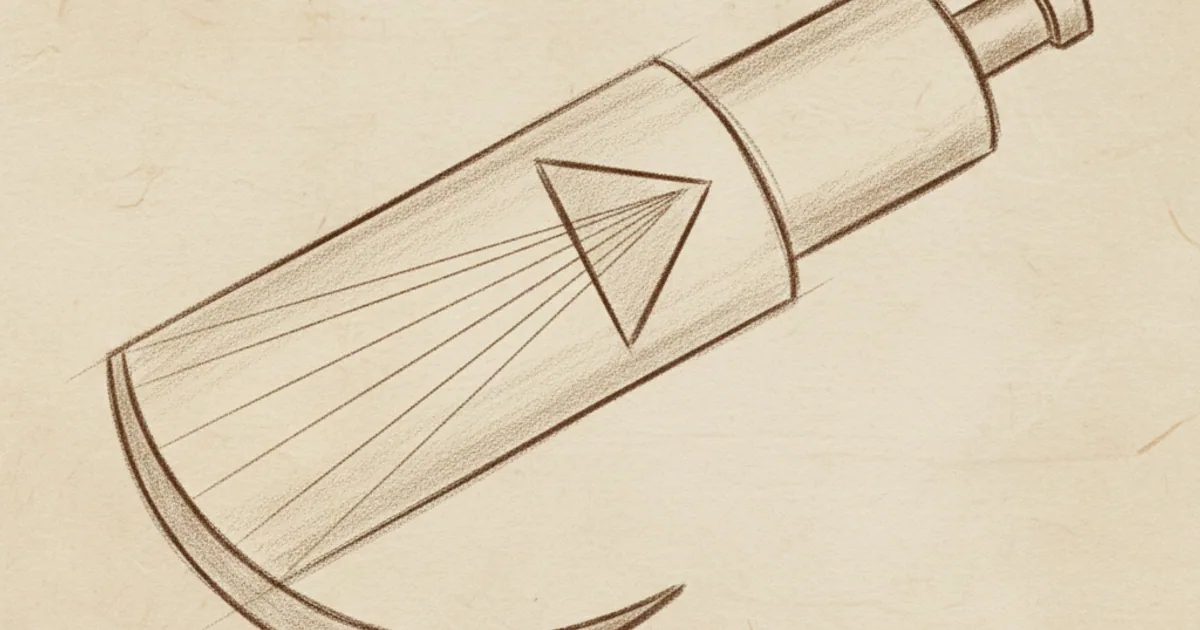
A telescope does two related but distinct things:
Collects light from a distant source. Faint objects produce few photons per second per square meter at Earth's surface; a telescope with a big collecting area gathers enough to register on a detector.
Forms a resolvable image by focusing those photons to a point (per source point). The resolution depends on the aperture and the wavelength.
Magnification is incidental — it's how much you enlarge the image after it's formed. Without enough light collection and resolution, magnification just produces big blurry blobs.
This is why telescopes are characterized by aperture (diameter of the main collecting element), not by magnification.
Refractors: telescopes built from lenses
The first practical telescopes (Galileo, ~1609) used lenses: a converging objective lens at the front gathered light and formed an intermediate image, which a small eyepiece magnified. This is a refractor.
Galileo's first telescopes had apertures of ~40 mm and magnifications of around 20-30x — enough to see the moons of Jupiter, the phases of Venus, mountains on the Moon, and sunspots. Revolutionary at the time.
Modern refractors use achromatic or apochromatic objective designs to correct chromatic aberration. Common amateur refractor apertures: 60-150 mm.
Advantages:
- Closed tube (no dust on optics).
- No central obstruction.
- Sharp, high-contrast images per mm of aperture.
- Low maintenance.
Disadvantages:
- Chromatic aberration unless using expensive multi-element designs.
- Lens must be supported at the edge (heavy lenses sag).
- Cost scales steeply with aperture.
- Practical aperture limit ~1 m (the Yerkes Observatory refractor, 1897, is still the largest practical refractor ever built).
Refractors dominate small-aperture amateur astronomy. They're rare in professional astronomy because large refractors are impractical.
Reflectors: telescopes built from mirrors
Isaac Newton (1668) built the first practical reflecting telescope. Instead of a lens, he used a curved mirror as the primary element. Newton's solution to chromatic aberration: reflection has no chromatic aberration at all.
Modern reflectors come in several configurations:
Newtonian: simplest design. A curved (typically parabolic) primary mirror at the bottom of the tube focuses light to a focal point near the top, where a small flat secondary mirror diverts it sideways to an eyepiece. Common in amateur astronomy.
Cassegrain: primary mirror has a central hole; a small convex secondary mirror reflects light back through the hole to a focal point behind the primary. More compact tube. Many large telescopes use Cassegrain or its variants.
Schmidt-Cassegrain: Cassegrain with a Schmidt corrector plate at the front to correct spherical aberration. Compact, popular in amateur astronomy.
Ritchey-Chrétien: Cassegrain variant with hyperbolic primary and secondary, correcting both spherical aberration and coma. The standard for professional research telescopes (Hubble, most major ground-based observatories).
Coudé focus: light from the secondary is directed via additional mirrors to a fixed location, often for instruments that are too heavy or sensitive to mount on the telescope.
Nasmyth focus: similar to coudé, with the focal point at the side of the telescope on the altitude axis, allowing heavy instruments.
Advantages of mirrors over lenses:
- No chromatic aberration.
- Mirror is supported from behind, allowing much larger sizes.
- Coated rather than solid; cheaper per unit area at large sizes.
Disadvantages:
- Central obstruction (secondary mirror blocks some light, reduces contrast slightly).
- Open tube (more sensitive to thermal currents, dust).
- Requires occasional realuminizing (mirror coating degrades).
- Collimation (alignment) can drift over time.
Reflectors are the dominant design for serious astronomy. Almost every major telescope built in the past century uses some reflecting design.
Aperture and resolution
Two key numbers:
Light gathering: proportional to mirror area = π·(D/2)². Doubling diameter quadruples light gathering. This is why aperture matters for faint objects.
Diffraction-limited resolution: minimum resolvable angle ≈ 1.22 · λ / D, where λ is the wavelength and D is the aperture diameter.
For visible light (λ ≈ 550 nm) and a 200 mm telescope:
- Resolution = 1.22 × 550 × 10⁻⁹ / 0.2 ≈ 3.4 × 10⁻⁶ rad ≈ 0.7 arcsec.
The Moon's angular diameter is ~30 arcmin = 1800 arcsec, so a 200 mm telescope could resolve about 1800/0.7 ≈ 2,500 separate features across the Moon's disk.
For a 1 m telescope: ~0.14 arcsec. For a 10 m telescope: ~0.014 arcsec.
Earth's atmosphere typically limits ground-based seeing to ~1 arcsec (the angular size of atmospheric turbulence cells), so big telescopes don't automatically translate to finer resolution at sea level. This is why mountaintop sites (Mauna Kea, La Palma, Cerro Paranal, Cerro Pachón) are preferred — thinner, more stable atmosphere.
For diffraction-limited performance, telescopes either:
- Go to space (Hubble, JWST, Roman).
- Use adaptive optics to correct atmospheric distortion in real time.
Adaptive optics: real-time atmospheric correction
Earth's atmosphere isn't optically uniform. Turbulent eddies cause refractive-index variations that bend incoming light. The result: stars twinkle, planetary images shimmer, and ground-based telescopes can't reach their diffraction limit.
Adaptive optics corrects this in real time:
- A wavefront sensor measures the distortion of incoming light — using either a bright reference star or a laser-generated "guide star" (a laser shot up into the sodium layer of the upper atmosphere creates an artificial bright point).
- A deformable mirror (with hundreds to thousands of actuators behind a thin reflective surface) is adjusted in real time to apply the inverse of the measured distortion.
- The corrections happen at hundreds to thousands of Hz, keeping pace with atmospheric changes.
Modern ground-based 8-10 m telescopes with adaptive optics achieve images comparable to or better than Hubble (2.4 m, no atmosphere) in some bands. The technique has revolutionized ground-based astronomy.
Some major telescopes
Hubble Space Telescope (1990, 2.4 m). Above the atmosphere, sees visible/UV/near-IR. Iconic images of nebulae, galaxies. Still operating after multiple servicing missions.
Keck I and II (1993, 1996, Mauna Kea, 10 m each). Segmented mirror design, demonstrated the feasibility of large segmented mirrors.
Very Large Telescope (2000s, Cerro Paranal, Chile, four 8.2 m units). Can interferometrically combine signals from all four telescopes for higher effective resolution.
Gran Telescopio Canarias (2007, La Palma, 10.4 m). The largest single optical telescope at completion.
James Webb Space Telescope (2021, 6.5 m primary, hexagonal segments). Infrared specialist at the L2 Lagrange point. Operating temperature ~50 K. Has produced unprecedented images of early galaxies, exoplanet atmospheres, and nearby star-forming regions.
Extremely Large Telescope (ELT) (under construction, Cerro Armazones, Chile, 39 m primary). Will be the largest optical telescope ever built. ESO currently projects first light around 2028.
Thirty Meter Telescope (TMT) (planned, location contested). 30 m primary.
Giant Magellan Telescope (GMT) (under construction, Las Campanas, Chile, 25 m effective).
For comparison: Galileo's telescope (1609) was ~40 mm. From 40 mm to (eventually) 39,000 mm over about 420 years — the light-gathering power scales as the area, so the ratio is close to a million.
Different wavelengths, different telescopes
The "telescope" concept extends across the electromagnetic spectrum:
- Radio telescopes (1 mm to 30 m wavelength): huge parabolic dishes (Arecibo was 305 m before its 2020 collapse; FAST in China is 500 m). Aperture synthesis (combining signals from arrays) creates effective apertures of kilometers (Very Large Array, ALMA).
- Microwave telescopes: similar to radio. Many cosmic microwave background experiments use this band.
- Infrared telescopes: special detectors and cooled optics. Most modern professional telescopes have IR capability.
- Visible/UV: traditional telescope territory.
- X-ray telescopes: can't use normal lenses or mirrors (X-rays just pass through). Use grazing-incidence "Wolter optics" — mirrors at extreme glancing angles. Examples: Chandra, XMM-Newton.
- Gamma-ray telescopes: even harder to focus. Use Compton scattering or "coded mask" techniques. Examples: Fermi, Cherenkov detection arrays for high-energy gammas (HESS, MAGIC).
Astronomy now spans about 18 orders of magnitude in wavelength, from kilometers (radio) to ~10⁻¹⁵ m (gamma rays). Each band reveals different physics: radio for cold gas and pulsars; IR for dust-obscured star formation and exoplanets; visible for stars; UV for hot young stars; X-ray for black holes and supernova remnants; gamma-ray for the most extreme energies.
Space vs ground
Trade-offs:
Ground-based telescopes:
- Can be much larger (no launch mass limits).
- Cheaper per unit aperture.
- Upgradeable.
- Limited by atmosphere (partly mitigated by adaptive optics and site selection).
- Limited to wavelengths the atmosphere transmits (visible, some IR/UV, radio, etc.).
Space telescopes:
- No atmospheric distortion.
- Access to all wavelengths (X-ray, UV, far-IR, gamma — atmosphere blocks these).
- Stable thermal environment.
- Smaller (mass limited by launch capability).
- Vastly more expensive per unit aperture.
- Hard or impossible to service.
The largest space telescope (JWST) is 6.5 m. The largest ground telescopes (under construction) will reach 39 m. The future will use both, complementarily.
Amateur telescopes
A short tour for the practical hobbyist:
- 60-80 mm refractor: ~€100-300. Good for Moon, planets, brighter open clusters. Limited for galaxies and nebulae.
- 100-150 mm refractor or 150-200 mm reflector: ~€300-800. Substantial step up. Many deep-sky objects visible.
- 200-300 mm reflector (Dobsonian or similar): ~€500-2,000. Serious amateur instrument. Many faint nebulae and galaxies visible from dark sites.
- GoTo mount with computer alignment: ~+€500-3,000. Automated pointing.
- Astrophotography setup: $2,000+. Requires equatorial mount, camera, autoguider, processing software.
Light pollution matters enormously. A small telescope under dark skies often outperforms a large telescope under heavy light pollution. Dark-sky sites in rural areas show vastly more than even the best telescopes in cities.
If you'd like a guided 5-minute course on telescopes and what each design is best for, NerdSip can generate one.
The takeaway
A telescope's primary purpose is gathering light from distant faint sources and forming a resolvable image. Aperture (diameter of the main element) determines both light collection and diffraction-limited resolution; magnification is secondary. Refractors use lenses; reflectors use mirrors. Reflectors dominate professional astronomy because mirrors have no chromatic aberration, can be made much larger, and are cheaper at large sizes. Earth's atmosphere limits ground-based resolution, partially mitigated by adaptive optics (real-time corrective deformable mirrors) and bypassed by space telescopes (Hubble, JWST). Modern professional telescopes reach 8-10 m on the ground today, with 25-39 m instruments under construction. Astronomy now spans 18 orders of magnitude in wavelength, with different telescope designs optimized for each band — each revealing different physics across the universe.

Comments 0
No comments yet. Be the first to share your thoughts.