Subject
Why the sky is blue, why an ambulance changes pitch as it passes, why a straw looks bent in water — wave physics is hiding in plain sight.
A pebble dropped in a pond. A voice carrying across a room. A radio signal reaching a satellite. Sunlight crossing 150 million km of space. An earthquake spreading across continents. An electron probability distribution.
These have nothing obvious in common — different media, different speeds, different scales. But mathematically, they all obey the same equations. They're all waves.
A wave is a disturbance that propagates through space, carrying energy from one place to another — without permanently moving the medium. The water doesn't travel with the ripple; it just oscillates up and down. Air doesn't travel with a sound; molecules just push and pull on their neighbours. The wave moves; the stuff stays.
This article is the orientation. The deeper articles in the cluster cover why the sky is blue, the Doppler effect, why sunsets are red, and why straws look bent in water. All five are about the same basic phenomenon, applied differently.
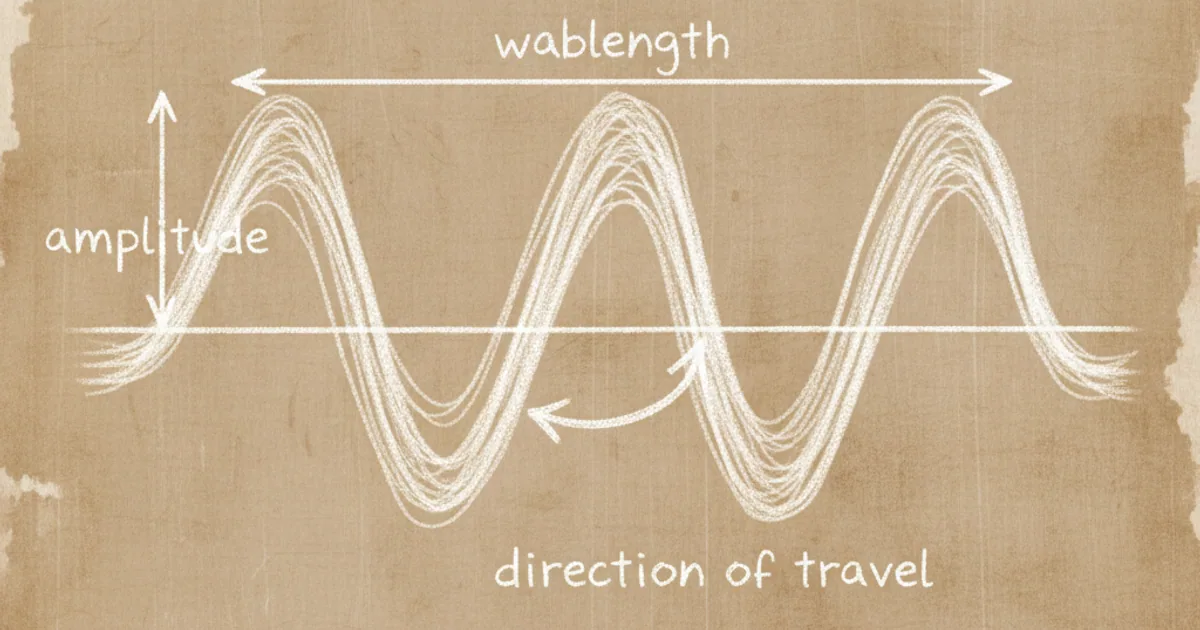
Every wave has four headline properties:
Wavelength (λ). The distance between two consecutive peaks. Long wavelengths feel low (deep bass notes, radio waves, infrared); short wavelengths feel high (treble, X-rays, gamma rays).
Frequency (f). How many cycles pass a fixed point per second. Measured in hertz (Hz). High frequency = short wavelength (for a given speed).
Speed (v). How fast the wave moves through its medium. Sound in air: 343 m/s. Light in vacuum: 299,792,458 m/s. The speed is set by the medium and the wave type.
Amplitude. How big the disturbance is — how high the peak, how low the trough. Amplitude carries the energy: doubling the amplitude quadruples the energy.
The three numerical properties (wavelength, frequency, speed) are related by one equation:
v = f × λ
For a fixed wave type in a fixed medium, the speed is constant. Frequency and wavelength then trade off inversely.
Waves come in two big families.
Mechanical waves require a medium — something physical that can be disturbed. Sound needs air or water or solid material. Water waves need water. Seismic waves need the Earth's crust. In vacuum, mechanical waves can't exist; there's nothing to disturb.
These split into two sub-types:
Electromagnetic waves don't need a medium. The 'disturbance' is the electric and magnetic fields themselves, oscillating in vacuum. Light, radio, microwaves, infrared, ultraviolet, X-rays, gamma rays — all electromagnetic, all traveling at the same speed in vacuum (the speed of light), differing only in wavelength.
The electromagnetic spectrum spans from kilometer-wavelength radio waves through nanometer-wavelength X-rays — a factor of 10²⁰ in wavelength. All the same physics; different frequencies.
Because they all obey the same equations, waves of every kind do the same things:
Reflection. When a wave hits a barrier, some of it bounces back. Sound off a wall (echo). Light off a mirror. Water waves off a sea wall. Same effect, three different scales.
Refraction. When a wave crosses from one medium to another with different speed, it bends. Light slowing down entering water. Sound speeding up entering warmer air. This is the topic of why straws look bent in water.
Diffraction. Waves spread around the edges of obstacles or through openings. You can hear someone around a corner (sound diffracts around the doorway). A water wave passing through a narrow gap fans out. Light does this too, but the effect is tiny at everyday wavelengths.
Interference. Two waves at the same place add together — peaks of one with peaks of the other reinforce (constructive); peaks of one with troughs of the other cancel (destructive). This is the basis of the double-slit experiment in quantum mechanics, of noise-cancelling headphones, of why your WiFi has dead spots in certain rooms.
Doppler effect. A moving source compresses waves in the direction it moves and stretches them behind. This is covered in detail in the Doppler effect article.
Scattering. Waves bouncing off small particles, with the bounce strength depending on the wavelength. This is why the sky is blue (see why the sky is blue).
Every one of these effects happens for every type of wave. The proportions change with wavelength, but the physics is identical.
Mathematically, every kind of wave obeys some version of the wave equation:
∂²ψ/∂t² = v² ∇²ψ
In words: the rate at which the disturbance accelerates at a point is proportional to how curved the disturbance is at that point. This deceptively simple equation appears in:
The fact that this same equation describes so many different physical systems is one of the deepest unifications in physics. When you understand the physics of a guitar string, you've effectively understood the physics of light.
A pure wave is a simple sine: one frequency, one wavelength. Real waves — voices, music, ocean swells, light from the sun — are almost never pure. They're sums of many sine waves at different frequencies and amplitudes.
Fourier analysis (Joseph Fourier, 1822) showed that any repeating signal can be written as a sum of pure sine waves. This decomposition is what enables:
Fourier analysis is one of the most consequential ideas in applied math. Once you can decompose a signal into its frequency components, you can do anything with it.
Want to internalize wave physics deeper? NerdSip can generate a personalized 5-minute course on waves and their everyday applications.
When a wave is confined — bouncing back and forth between boundaries — it can form standing waves: patterns where certain points (nodes) never move, and others (antinodes) oscillate maximally.
This is what makes musical instruments work. A guitar string vibrates in specific modes determined by its length and tension. A wind instrument's tube has its own resonant frequencies. Bells, drums, tuning forks — all rely on standing-wave patterns.
Standing waves also explain resonance: pushing a wave at exactly the right frequency, energy keeps adding up. This is how a swing set works (push at the right time, amplitude grows), and how a singer can shatter glass by hitting its resonant frequency. It's also why the Tacoma Narrows Bridge collapsed in 1940 — wind at the wrong frequency drove it into resonance.
A wave is a disturbance that propagates through space, carrying energy without permanently moving the medium. Every wave has wavelength, frequency, amplitude, and speed, related by simple math. The same wave equations apply to sound, light, water ripples, seismic waves, and quantum probability distributions — which is why physics has so many parallel concepts across very different phenomena. The other articles in this cluster focus on specific everyday effects: why the sky is blue (Rayleigh scattering), why sirens change pitch (Doppler), why sunsets are red (more scattering), and why straws look bent in water (refraction). Once you see them as one phenomenon, the world organizes itself differently.
A short editorial reading list. Pick whichever fits how you like to learn.


Comments 0
No comments yet. Be the first to share your thoughts.