
More than seasoning
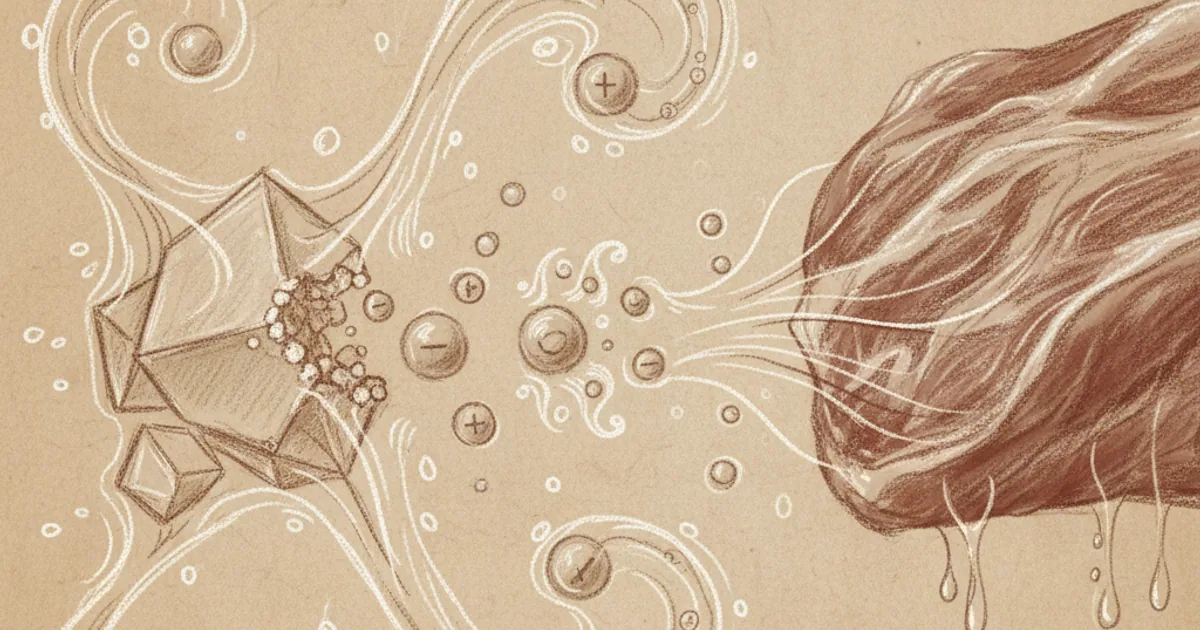
"Salt" in cooking is shorthand for sodium chloride (NaCl). It dissolves in water into two ions — sodium (Na⁺) and chloride (Cl⁻) — and from there it does several different things at once, all important.
Most cooks know salt "makes food taste better." Few realize that the same teaspoon of salt is simultaneously:
- Drawing water out of cells through osmosis.
- Denaturing proteins, changing texture.
- Suppressing bitter taste while enhancing sweet and umami.
- Inhibiting microbial growth (preserving food).
- Modifying how doughs and batters develop.
- Strengthening gluten in bread.
- Slowing yeast fermentation.
- Altering boiling and freezing points of water (slightly).
Each of these effects matters in different situations. Salt isn't a single tool; it's several tools wearing the same outfit.
Osmosis: salt as a water mover
When salt is on one side of a semipermeable membrane and water on the other (or in lower salt concentration), water moves toward the higher salt concentration. This is osmosis, and it's the cell membrane's response to ion concentration differences.
In practical kitchen terms:
Salt on the surface of meat draws water out of the cells near the surface. This is why a salted steak develops moisture on top within minutes. With enough time (40+ minutes), the salt dissolves in that surface moisture, becomes a brine, and gets reabsorbed by the meat. The protein structure has been altered by then (next section), so it holds onto the moisture even after cooking. Net effect: drier surface (better for browning), more uniform internal seasoning.
Salt on cucumbers, eggplant, watermelon draws water out for the same reason. Sometimes you want this (drying out vegetables before frying so they crisp instead of steaming). Sometimes you don't (salting tomatoes too far in advance turns them watery).
Salt in brining solutions works in the same direction but with the water-meat ratio reversed. Brining (soaking meat in 3-5% saltwater) lets meat absorb water and salt together, increasing juiciness. Common for pork chops, chicken, turkey.
Salt on greens for salad is why you should dress and salt right before serving. Salt pulls water out of leaves and wilts them quickly.
The rate of osmosis depends on the concentration difference, the surface area, and the membrane permeability. Higher salt = faster water movement. Smaller pieces = more surface area = faster effect. Cell wall structure matters — leafy greens wilt fast, whole melons take hours.
Protein denaturation: salt as a structure changer
Salt ions can interact with protein molecules, disrupting some of the bonds that hold proteins in their folded shape. The result is denaturation — proteins partially unfold, then refold into new arrangements.
In meat, salt:
- Dissolves muscle proteins on the surface, especially myosin. The dissolved proteins form a thin sticky layer that browns well during cooking.
- Unfolds and re-folds collagen and other connective proteins, allowing them to hold more water than they would natively.
- Reduces moisture loss during cooking by ~10-30% in salted vs unsalted meat at the same cooking time.
This is the chemistry behind "dry brining" — salting meat in advance and letting it sit. Despite the name, it's not really drying the meat; it's modifying the protein structure so it ends up holding moisture better.
In bread, salt:
- Strengthens gluten by tightening the protein cross-links. Salted dough is stronger and more elastic than unsalted dough.
- Slows yeast by partly inhibiting fermentation, allowing slower controlled rise and more flavour development.
- Improves crust by encouraging Maillard reaction (salt at the surface).
Pizza, focaccia, and bread bakers care about salt levels (typically 2% of flour weight) because too little produces flat and tasteless bread; too much slows yeast too much.
In cheese, salt:
- Sets the curd structure by helping proteins coalesce.
- Inhibits unwanted bacteria while allowing desired ones.
- Affects moisture, texture, and rind formation during aging.
In emulsions, salt sometimes:
- Helps stabilize (in mayonnaise, by adjusting protein behavior).
- Or destabilizes (high salt levels can break some emulsions by changing protein hydration).
Taste: salt as a flavour modulator
Salt does multiple things to our perception of flavour. It's not just "salty taste."
Suppresses bitterness. Sodium ions interfere with our perception of bitter flavours. A small amount of salt on grapefruit reduces bitterness; salt in coffee mellows bitter notes; salt on bitter greens (kale, dandelion) makes them more palatable. The mechanism involves sodium's interaction with bitter taste receptors.
Enhances sweetness. Salt brings out the perceived sweetness of foods, especially when the food contains acid or is otherwise complex. Salted caramel works because the salt makes the sugar taste sweeter. Salt in chocolate desserts intensifies the chocolate. A pinch of salt in fruit pies.
Amplifies umami. Soy sauce works partly because it combines salt with amino acids that taste savoury. Salt also makes the umami in mushrooms, tomatoes, aged cheeses, fish sauce, miso, and similar ingredients more vivid.
Suppresses sour to some extent. Lightly salting an acidic dish (citrus dressing, vinegar-based sauce) can take the edge off sharpness while preserving the brightness.
Provides salty taste itself. The primary effect most people notice, but actually one of several.
The combined effect: salt doesn't just add salty flavour — it sculpts the entire flavour profile of a dish. Under-salted food tastes flat in many dimensions, not just lacking "salty."
Preservation: salt as a microbe-stopper
Salt has been used for food preservation for at least 7,000 years (some of the earliest preserved fish in salt are from the Mediterranean and the Middle East).
The mechanism:
- High salt concentrations draw water out of microbial cells, effectively dehydrating them.
- Water activity (the availability of water to support microbial growth) drops sharply as salt concentration rises.
- Most spoilage and pathogenic microbes can't grow when water activity drops below ~0.85 — corresponding to roughly 18-20% salt by weight in some food matrices.
Salted foods historically included:
- Cured meats: ham, bacon, pancetta, prosciutto, salt cod. Salt + drying + time.
- Pickled vegetables: cucumbers, cabbage, peppers, beans in brine. Salt creates the right environment for lactic acid bacteria while suppressing spoilage.
- Fish preservation: salted, dried, pickled fish for long sea voyages and inland trade.
- Cheese: salt is part of nearly every cheese recipe, controlling moisture and microbial activity during aging.
- Salted butter: traditionally for preservation.
Modern refrigeration has reduced the necessity, but salt-cured foods remain popular for their flavour and texture, not just preservation.
Boiling pasta and other myths
Common claim: "salt your pasta water so it boils faster, like the ocean."
Reality: salt actually raises the boiling point very slightly. A 1% salt solution boils about 0.2 °C higher than fresh water. The effect on cooking time is negligible.
Why salt pasta water then? Flavour. Pasta absorbs some of the cooking water, and salty water makes the pasta itself taste seasoned. Most pasta recipes specify ~1-2% salt by water weight — about 10-20 g per litre.
What salt does NOT do in pasta water:
- Doesn't significantly speed cooking.
- Doesn't keep pasta from sticking (oil doesn't either; stirring does).
- Doesn't significantly damage pots (very high salt concentrations can corrode some metals over long exposure, but normal cooking levels are fine).
When and how to salt
Practical timing matters more than total amount for many dishes:
Salt meat in advance. 40 minutes to 24+ hours for steaks, several hours to 24 hours for chicken, 24-48 hours for large roasts. Salt diffuses into the interior, the protein structure modifies, and the surface dries for better browning. This is "dry brining."
Salt vegetables right before cooking if you want them to release water (eggplant before frying, cucumbers before salting in a salad). Salt LATE if you want them crisp without water release (lettuce, fresh salads).
Salt pasta water and bean cooking water generously. ~1-2% salt by water weight.
Salt soups and stews progressively. Add some early to dissolve into the liquid, then taste and adjust late. Salt also concentrates as liquid reduces; under-salt early in long-cooked dishes.
Egg-white foams: salt is a minor variable. Older cookbooks warn against salting egg whites before whipping; modern food-science work suggests the effect at typical kitchen levels is small. A pinch of salt may slightly reduce foam stability but doesn't prevent whipping. The far more important issues are no trace of fat (yolk, oil residue on bowl) and a clean, dry whisk. Sugar, added late, stabilizes the foam much more than salt destabilizes it.
Don't salt cheeses, cured meats, or pre-salted ingredients aggressively. They're already seasoned; their salt content reaches the final dish.
Salt during cooking, not just at the table. Salt added during cooking integrates into the dish's flavour structure. Salt at the table only seasons the surface.
Use the right salt for the job. Kosher salt for general cooking and curing (large crystals, easier to control by sight). Fine table salt for baking (where exact weight matters). Sea salt or flaky salt for finishing (where texture on the bite matters).
A note on iodized salt
Iodization of salt has been one of the most successful public health interventions of the 20th century — iodine deficiency causes thyroid problems (goiter, cretinism). But iodization is not universal in modern markets. In the US, iodization is voluntary, and many popular kosher and sea-salt brands are NOT iodized. Most countries have iodization programs but cover varies. Check the label of your specific salt to know whether it's iodized.
For cooking purposes:
- Iodized salt and non-iodized salt taste essentially identical at normal cooking concentrations.
- Iodized salt is fine for almost all cooking. Some pickling and brining traditions prefer non-iodized; taste differences are subtle.
- If you only use non-iodized salt at home and don't get iodine from seafood, dairy, eggs, or seaweed, you may need to ensure iodine intake from other sources.
Salt and your health
Sodium intake is real public-health concern, but the issue is overwhelmingly processed and restaurant food, not the salt added at home.
- WHO recommends adults consume below 2,000 mg sodium per day (~5 g salt).
- US recommendations are below 2,300 mg.
- Average intake in many countries is 3,000-5,000+ mg per day.
- Most of that comes from processed food (bread, cured meats, sauces, soups, snacks, restaurant meals), where salt is added far in excess of home cooking.
Home cooking gives you control. Salting your own food deliberately uses far less salt than buying the same food pre-made. Reducing processed food is the productive lever; not salting your home cooking is mostly counterproductive (you'll dislike the food and eat less of it, or compensate with more processed food).
If you'd like a guided 5-minute course on salt chemistry and how to use it well in your cooking, NerdSip can generate one.
The takeaway
Salt does multiple things at once. By osmosis, it moves water across cell membranes, drying or hydrating depending on direction. By denaturing proteins, it changes how meat holds moisture, how dough develops, how cheese sets. By interacting with taste receptors, it suppresses bitter, enhances sweet and umami, and provides its own taste. By suppressing microbes, it preserves food. By modifying protein structures, it strengthens gluten and slows yeast. The skill of cooking is largely the skill of using salt deliberately — at the right time, in the right amount, for the right effect.

Comments 0
No comments yet. Be the first to share your thoughts.