Subject
Everything in your kitchen is chemistry. Browning, rising, salting, fermenting, gluten — once you see the reactions, recipes start to make sense as physics rather than rules.
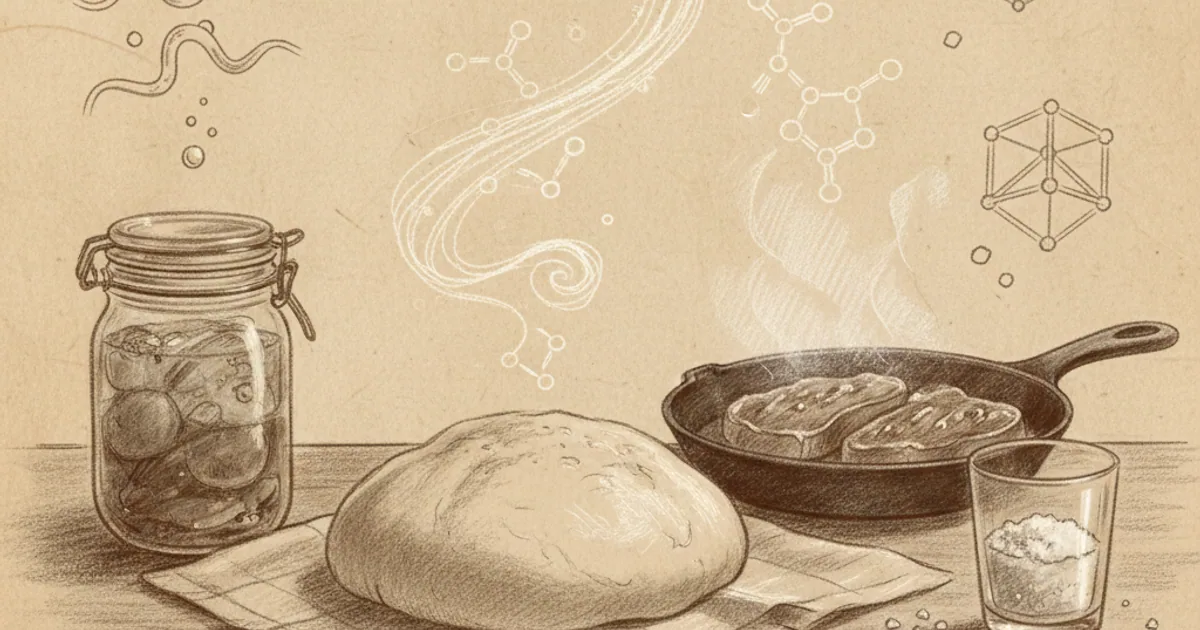
Everything happening in a kitchen is chemistry. When you sear a steak, you're driving the Maillard reaction — amino acids and sugars rearranging into hundreds of new flavour compounds. When bread rises, you're watching yeast metabolize sugars into CO₂ and ethanol, trapped by gluten proteins. When you whisk vinegar and oil into a salad dressing, you're forcing two normally-immiscible liquids to coexist as a temporary emulsion. When you fold egg yolks into a cream sauce, proteins denature and lock the structure in place.
Once you see what's actually happening, recipes start to read differently. You stop following them as rules and start understanding them as orchestrated chemistry. You can adapt, substitute, troubleshoot.
This article is the overview. The cluster articles cover the major reactions in detail: the Maillard reaction, why bread rises, what salt actually does, and what gluten actually is.
Cooking is mostly four reactions, repeated in different combinations:
When proteins and sugars meet heat above 140 °C (285 °F), they rearrange into hundreds of new flavour and colour compounds. This is the Maillard reaction — the brown crust on a steak, the golden tone of bread, the colour of roasted coffee, the flavour of toasted bread, the surface of fried onions.
Caramelization is the related but distinct reaction where sugar alone (no protein) decomposes under heat into new compounds — the colour and flavour of caramel, toffee, dulce de leche, the dark edges of roasted vegetables.
Both reactions need:
Too much: bitter, burnt, acrid. Too little: pale, flavourless surface. The sweet spot is golden-to-deep-brown, depending on what you're cooking.
Proteins are long folded molecules. Heat (or acid, alcohol, or mechanical force) unfolds and tangles them, locking the structure in place. This is denaturation, and it's how most "cooked" foods become "cooked":
Once denatured, proteins generally can't return to their original shape. You can't un-cook an egg. This is irreversibility you can taste.
Starch granules in flour, rice, potato, corn are tightly packed molecules of amylose and amylopectin. When heated in water (above ~60-80 °C, depending on the starch), the granules absorb water, swell, and burst, releasing their molecules into the surrounding liquid.
This is gelatinization, and it's what:
Different starches gelatinize at different temperatures and produce different textures. Cornstarch makes clearer, snappier sauces. Wheat flour makes opaque, slower-thickening sauces. Tapioca gives chewy texture.
If you over-cook gelatinized starch, the molecules can break down further and the sauce thins again — which is why old gravy reheats poorly.
Two normally-immiscible liquids (water-based and oil-based) can be forced to coexist as tiny droplets of one suspended in the other, stabilized by an emulsifier. This is emulsification:
Stability matters. A mayonnaise stays emulsified for weeks if made well; a vinaigrette breaks in minutes. The difference is the emulsifier — what's holding the oil and water apart.
Breaking an emulsion (oil and water separate) is reversible if you can identify why it broke (too cold? too much oil too fast? not enough emulsifier?) and start over.
Add fermentation as a slow-time fifth reaction. Microorganisms (yeast, bacteria, molds) metabolize sugars or proteins, producing CO₂, alcohol, acids, and hundreds of flavour compounds. Time is the key variable: hours to years.
Almost every traditional food culture has a long catalog of fermented foods. Cooking is mostly a few hours; fermentation is days to years. Both produce flavour and texture; the chemistry is different.
You have four main levers for steering kitchen reactions:
Heat. The amount, the rate, and the duration. Higher temperatures speed reactions roughly exponentially (a 10 °C increase often doubles reaction speed). Different reactions have different optima: Maillard wants 140-200 °C, custard wants 80-85 °C, fermentation wants 20-30 °C for most cultures.
Water content. Dry surface enables browning. Liquid medium enables starch gelatinization. The balance between surface and interior moisture determines crust-vs-tender ratio. Brining adjusts water content of meat.
Acid. Lowers pH. Denatures proteins (ceviche is fish "cooked" by acid). Sets pectin in jams. Stabilizes some emulsions. Brightens flavours. Balances sweetness. Acidic ingredients: lemon, vinegar, wine, fermented foods, dairy products.
Salt. Multiple roles: pulling water out of cells (osmosis), denaturing proteins, suppressing bitterness, amplifying sweetness, balancing other flavors, preserving food, modifying gluten development in bread. See what salt actually does.
The bonus lever: time. Maillard browning needs minutes; fermentation needs days; aging cheese needs months. Time is often the missing variable in disappointing cooking.
Let's see all five reactions in one dish — homemade burgers on a roll.
The bun, from yeast bread:
The patty:
The cheese:
The sauce (mayo + ketchup):
The pickle:
Five reactions on one plate, each contributing flavour and texture. That's most of cooking.
Common kitchen failures and their fixes:
Most kitchen problems are one of: not hot enough, not dry enough, not long enough, or not enough of an ingredient. Naming the chemistry helps name the fix.
For chemistry to work predictably, the inputs need to be predictable.
A small kitchen scale (under €20) makes a bigger difference to bread than any other tool. A reliable instant-read thermometer (under €40) makes a bigger difference to meat than any pan.
If you'd like a guided 5-minute course on kitchen chemistry and what each ingredient is doing, NerdSip can generate one.
Cooking is mostly four-and-a-half reactions: browning (Maillard and caramelization), protein denaturation, starch gelatinization, emulsification, and (over longer time) fermentation. You steer with four levers — heat, water, acid, and salt — plus time. Once you can name the reaction you're trying to produce, recipes become understandable rather than mysterious, and adaptation becomes possible. The cluster articles cover the specific reactions in detail. The general principle: every cooking instruction makes chemical sense if you know what to look for.
A short editorial reading list. Pick whichever fits how you like to learn.


Comments 0
No comments yet. Be the first to share your thoughts.