
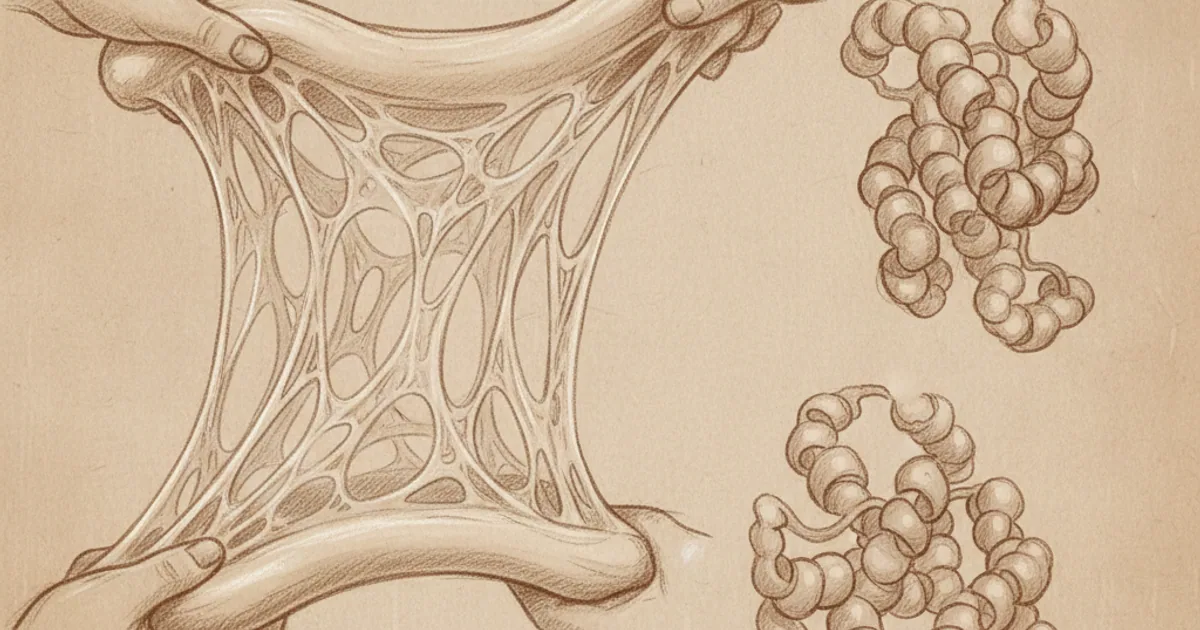
A specific protein network
"Gluten" isn't a single substance. It's a network of two proteins — gliadin and glutenin — that forms when wheat flour is mixed with water.
Gliadin and glutenin exist in flour as separate molecules. When you add water and start mixing, they hydrate and begin to interact. Disulfide bonds (between sulfur atoms in the protein chains) and hydrogen bonds (weaker but numerous) connect the two proteins into a continuous elastic mesh. The more you knead, the more these connections form and align.
The result has unusual properties for a food substance:
- Stretchy (from gliadin's relatively short, flexible chains).
- Strong (from glutenin's longer, cross-linked chains).
- Elastic (it returns to roughly its original shape after stretching).
- Plastic (it can hold a new shape if stretched and rested).
Plus a critical secondary property:
- Gas-trapping. The mesh is fine enough that small CO₂ bubbles can't escape, but flexible enough to expand as the gas accumulates.
That last property is why bread rises (covered in why bread rises). Gluten + yeast = leavened bread. Without gluten, the yeast still produces gas but it just bubbles out, leaving flat dough. Without yeast (or chemical leavening), gluten still develops but without anything to make it expand.
What gluten does in different foods
Bread. Strong gluten network traps yeast-produced gas, expanding as the dough rises. Kneading develops the network. After baking, gluten sets into rigid permanent structure, giving the chewy texture of crusts and crumb.
Pasta. Gluten gives pasta its characteristic bite. Strong wheat varieties (durum wheat for dried pasta) have especially good gluten formation. Fresh egg pastas use weaker flours and rely on egg proteins for additional structure. The chewiness of well-cooked pasta comes from gluten.
Pizza dough. Like bread but with longer fermentation and stronger gluten development for chewy elastic crust.
Cakes and pastries. Gluten is usually UNWANTED here. Cake batters are mixed minimally to prevent gluten development; cake flour has lower protein. Gluten makes cakes tough and dense.
Pie crust, pastry dough. Tricky — you want a little gluten for structure, not much. Pie crust is mixed cold with fat coating the flour particles, which limits how much gluten can form. Over-mixed pie crust is leathery.
Cookies. Varies by cookie type. Chewy cookies have more developed gluten; tender cookies have less. Cookies with melted butter and longer mixing have more gluten development.
Noodles in Asian cooking. Many noodle styles depend on specific gluten properties. Some (Lanzhou hand-pulled noodles) require extremely developed elastic gluten. Others (rice noodles) avoid wheat entirely.
Croissants and laminated pastries. Strong gluten layers alternated with butter, producing the characteristic flaky layered structure when baked.
How kneading actually works
The gluten network doesn't appear spontaneously. It forms through mechanical action:
Mixing. Flour and water are combined. Proteins begin to hydrate. Some gluten formation, but mostly randomly oriented.
Kneading. The dough is folded, stretched, pressed, repeated. Each manipulation:
- Aligns protein molecules in similar directions.
- Promotes cross-linking between gliadin and glutenin.
- Creates new bonds as proteins come into contact with each other.
The result is a progressively more organized, more elastic, stronger network.
Resting (autolyse, bulk fermentation). Even without active kneading, the network continues to develop slowly. Long-rested doughs develop gluten through time rather than mechanical work, often producing more open and irregular crumb structure.
How much kneading depends on the bread type:
- Pizza dough: 5-10 minutes of vigorous kneading for fast doughs, less for slow-fermented.
- Sandwich bread: 8-12 minutes typically.
- Brioche, enriched doughs: longer (the fat in the dough hampers gluten formation, requiring more work).
- No-knead breads (Jim Lahey's famous method): no kneading at all — gluten develops through 12-18+ hours of fermentation.
Over-kneading is possible but mostly relevant to mechanized commercial production. Home kneading typically can't go too far; the bigger risk is under-kneading.
What affects gluten development
Flour protein content. Higher protein = more potential gluten. Bread flour (12-14%) > all-purpose (10-12%) > cake flour (8-9%).
Hydration. Water is needed for gluten to form. Higher hydration enables more gluten development, but also makes dough harder to handle. Artisan breads often use 70-85% hydration (vs ~60% for standard).
Mixing/kneading. Mechanical work develops gluten.
Time. Slow fermentation develops gluten without kneading.
Salt. Strengthens gluten. Salted doughs are firmer and more elastic. (See what salt actually does.)
Acid. Mild acid (lemon juice, vinegar, sourdough acidity) can slightly strengthen gluten. Strong acid breaks it down.
Fat. Coats flour particles, preventing gluten formation. Doughs with lots of fat (pie crust, pastries) develop limited gluten. Brioche dough needs more work to develop gluten despite the butter.
Sugar. Competes with proteins for water, limiting gluten formation. Sweet doughs develop less gluten.
Temperature. Warm dough develops gluten faster but yeast also works faster. Cold dough (refrigerated overnight rise) develops gluten slowly with deeper flavour.
Bran in whole wheat. The hard particles cut through gluten strands, weakening the network. This is why 100% whole wheat bread tends to be denser; bakers add vital wheat gluten or use bread improvers.
Different wheats, different gluten
Wheat has multiple species and varieties, with different gluten characteristics:
Common bread wheat (Triticum aestivum). The vast majority of modern wheat. Variable protein content depending on variety and growing conditions.
Durum wheat (Triticum durum). High protein (~14%), specifically adapted for pasta. Particularly good for dried pasta because the gluten holds up to drying.
Spelt, einkorn, emmer, kamut. Ancient wheat varieties. Different gluten profiles, sometimes touted as "easier to digest" (though scientific evidence is mixed). Still contain gluten and unsuitable for celiac.
Red vs white wheat. Refers to bran colour. Both have similar gluten properties; bran differences affect flavour and appearance.
Hard vs soft wheat. Hard wheats have higher protein and harder grains; soft wheats are lower-protein and softer. Hard wheats are for bread; soft for cakes and pastries.
Winter vs spring wheat. Winter wheat is planted in fall, harvested in summer. Spring wheat is planted and harvested both in spring/summer. Different protein characteristics and growing conditions; both have multiple varieties.
Celiac disease and gluten sensitivity
About 1% of people worldwide have celiac disease — an autoimmune disorder where gluten triggers an immune response that damages the small intestine villi, leading to malabsorption of nutrients. Symptoms vary widely — digestive issues, fatigue, anemia, neurological symptoms, skin rashes. Diagnosis requires blood tests and intestinal biopsy.
For people with celiac, gluten must be completely avoided — including trace amounts. Even shared cooking surfaces or kitchen utensils can transfer enough gluten to cause damage. The autoimmune response happens whether or not symptoms are felt; long-term untreated celiac increases risks of intestinal cancer and other problems.
Non-celiac gluten sensitivity (NCGS) is a less defined condition where people experience symptoms after eating gluten without celiac's autoimmune component. Estimates of prevalence range from 1-6% but are debated. Some research suggests other components of wheat (FODMAPs, amylase trypsin inhibitors) may be responsible in many cases rather than gluten specifically.
Wheat allergy (different from celiac) is a true allergic reaction to wheat proteins, more common in children. Symptoms range from mild to severe (anaphylaxis).
For people without any of these conditions, gluten is simply a normal food protein. The popularity of gluten-free diets among people without celiac or genuine sensitivity is largely driven by marketing rather than scientific evidence. Some studies show that processed gluten-free products are often LOWER in fiber and higher in sugar than their wheat-based counterparts.
If you suspect gluten issues, get tested before going gluten-free — testing is much harder once you're already avoiding gluten.
Gluten-free baking
Without gluten, baking has to use other strategies to provide structure and bind the dough:
Other flours: rice, sorghum, corn, oat (certified gluten-free), tapioca, almond, buckwheat, chickpea, teff. Each has different properties; recipes often blend several.
Gums: xanthan gum and guar gum are commonly used. They form viscous networks that mimic some of gluten's gas-trapping ability.
Eggs: provide protein structure that helps replace gluten in some recipes.
Psyllium husk: forms a gel-like network with water, used in many modern gluten-free breads.
Cellulose and starches: add structure and texture.
Modern gluten-free breads have improved dramatically since the 2000s as bakers worked out the right blends. Some are now nearly indistinguishable from wheat bread; others are still noticeably different.
If you'd like a guided 5-minute course on gluten and bread chemistry, NerdSip can generate one.
The takeaway
Gluten is a network of two proteins — gliadin and glutenin — that forms when wheat flour meets water. Kneading and time develop the network into an elastic, gas-trapping structure that gives bread its rise and chewy texture, gives pasta its bite, and provides structure for many baked goods. The amount of gluten developed depends on the flour, hydration, mixing, time, and other factors. About 1% of people have celiac disease (autoimmune reaction) and need to avoid gluten entirely; others have varying degrees of sensitivity; most people have no issue. Knowing what gluten does — and when you want more or less of it — is one of the central skills of baking.

Comments 0
No comments yet. Be the first to share your thoughts.