
The big idea
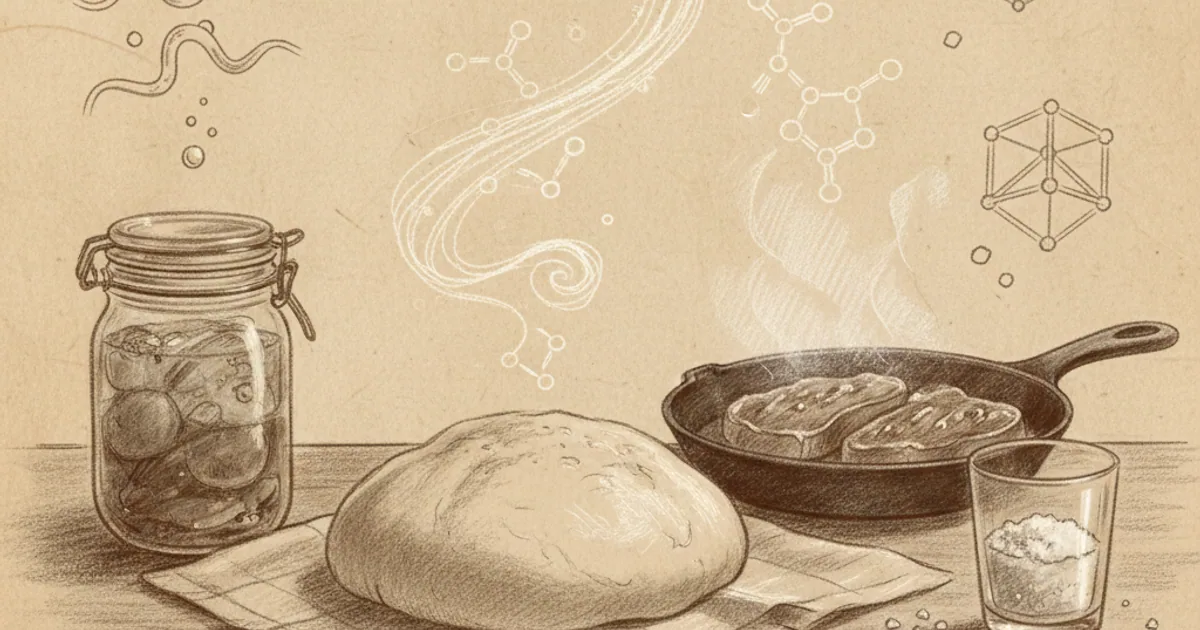
Everything happening in a kitchen is chemistry. When you sear a steak, you're driving the Maillard reaction — amino acids and sugars rearranging into hundreds of new flavour compounds. When bread rises, you're watching yeast metabolize sugars into CO₂ and ethanol, trapped by gluten proteins. When you whisk vinegar and oil into a salad dressing, you're forcing two normally-immiscible liquids to coexist as a temporary emulsion. When you fold egg yolks into a cream sauce, proteins denature and lock the structure in place.
Once you see what's actually happening, recipes start to read differently. You stop following them as rules and start understanding them as orchestrated chemistry. You can adapt, substitute, troubleshoot.
This article is the overview. The cluster articles cover the major reactions in detail: the Maillard reaction, why bread rises, what salt actually does, and what gluten actually is.
The four big reactions
Cooking is mostly four reactions, repeated in different combinations:
1. Browning (Maillard + caramelization)
When proteins and sugars meet heat above 140 °C (285 °F), they rearrange into hundreds of new flavour and colour compounds. This is the Maillard reaction — the brown crust on a steak, the golden tone of bread, the colour of roasted coffee, the flavour of toasted bread, the surface of fried onions.
Caramelization is the related but distinct reaction where sugar alone (no protein) decomposes under heat into new compounds — the colour and flavour of caramel, toffee, dulce de leche, the dark edges of roasted vegetables.
Both reactions need:
- High temperature. Maillard becomes noticeable above roughly 120-140 °C and accelerates with heat; caramelization of common sugars starts higher (sucrose around 160 °C). Both run faster at higher temperatures.
- Dry surface — water keeps the surface at 100 °C, where neither reaction proceeds significantly. This is why you pat meat dry before searing.
- Time — both reactions take seconds to minutes, not instants.
Too much: bitter, burnt, acrid. Too little: pale, flavourless surface. The sweet spot is golden-to-deep-brown, depending on what you're cooking.
2. Protein denaturation
Proteins are long folded molecules. Heat (or acid, alcohol, or mechanical force) unfolds and tangles them, locking the structure in place. This is denaturation, and it's how most "cooked" foods become "cooked":
- Egg white turning from clear to opaque white at ~60 °C.
- Egg yolk thickening between ~65-70 °C, set above 70 °C.
- Custard thickening as egg proteins set around 80-85 °C.
- Meat firming as muscle proteins denature and contract above ~60 °C.
- Fish flaking as collagen and muscle proteins set above ~55 °C.
- Milk curdling when acid denatures casein proteins (this is how cheese starts).
- Cream turning to whipped cream when air bubbles get stabilized by partially denatured milk proteins.
Once denatured, proteins generally can't return to their original shape. You can't un-cook an egg. This is irreversibility you can taste.
3. Starch gelatinization
Starch granules in flour, rice, potato, corn are tightly packed molecules of amylose and amylopectin. When heated in water (above ~60-80 °C, depending on the starch), the granules absorb water, swell, and burst, releasing their molecules into the surrounding liquid.
This is gelatinization, and it's what:
- Thickens gravy and roux-based sauces.
- Makes risotto creamy as starch leaches out.
- Turns raw rice grains soft and sticky.
- Sets pudding and cornstarch-thickened pie filling.
- Gives bread its crumb structure once baked.
- Makes potato starch useful as a thickener in Asian sauces.
Different starches gelatinize at different temperatures and produce different textures. Cornstarch makes clearer, snappier sauces. Wheat flour makes opaque, slower-thickening sauces. Tapioca gives chewy texture.
If you over-cook gelatinized starch, the molecules can break down further and the sauce thins again — which is why old gravy reheats poorly.
4. Emulsification
Two normally-immiscible liquids (water-based and oil-based) can be forced to coexist as tiny droplets of one suspended in the other, stabilized by an emulsifier. This is emulsification:
- Mayonnaise: oil droplets suspended in egg-yolk + lemon juice + water. Stabilized by lecithin (a phospholipid) in egg yolk.
- Vinaigrette: oil droplets in vinegar, briefly stable when shaken; separates because no emulsifier is added (some recipes add mustard, which contains emulsifiers).
- Hollandaise: butter droplets in egg-yolk + lemon juice. Yolk is the emulsifier; gentle heat is required to set the proteins enough to hold the emulsion without breaking.
- Butter: water droplets in fat (an "inverse emulsion") stabilized by milk proteins.
- Cream: fat droplets in water.
- Cheese: protein-fat-water emulsion.
Stability matters. A mayonnaise stays emulsified for weeks if made well; a vinaigrette breaks in minutes. The difference is the emulsifier — what's holding the oil and water apart.
Breaking an emulsion (oil and water separate) is reversible if you can identify why it broke (too cold? too much oil too fast? not enough emulsifier?) and start over.
The fifth: fermentation
Add fermentation as a slow-time fifth reaction. Microorganisms (yeast, bacteria, molds) metabolize sugars or proteins, producing CO₂, alcohol, acids, and hundreds of flavour compounds. Time is the key variable: hours to years.
- Bread: yeast producing CO₂ and ethanol; ethanol evaporates in baking, CO₂ leaves the holes.
- Beer, wine: yeast producing ethanol from grain sugars or grape sugars.
- Yogurt: bacteria converting milk sugar (lactose) into lactic acid, which denatures milk proteins to set the texture.
- Cheese: bacterial acidification + rennet enzymes denaturing milk proteins, plus aging.
- Sauerkraut, kimchi: lactic acid bacteria fermenting cabbage sugars to acid, preserving the vegetable and producing complex flavours.
- Soy sauce, miso, fish sauce: long fermentation breaking proteins down into amino acids and flavour compounds.
- Vinegar: acetic acid bacteria converting ethanol to acetic acid.
Almost every traditional food culture has a long catalog of fermented foods. Cooking is mostly a few hours; fermentation is days to years. Both produce flavour and texture; the chemistry is different.
The four levers
You have four main levers for steering kitchen reactions:
Heat. The amount, the rate, and the duration. Higher temperatures speed reactions roughly exponentially (a 10 °C increase often doubles reaction speed). Different reactions have different optima: Maillard wants 140-200 °C, custard wants 80-85 °C, fermentation wants 20-30 °C for most cultures.
Water content. Dry surface enables browning. Liquid medium enables starch gelatinization. The balance between surface and interior moisture determines crust-vs-tender ratio. Brining adjusts water content of meat.
Acid. Lowers pH. Denatures proteins (ceviche is fish "cooked" by acid). Sets pectin in jams. Stabilizes some emulsions. Brightens flavours. Balances sweetness. Acidic ingredients: lemon, vinegar, wine, fermented foods, dairy products.
Salt. Multiple roles: pulling water out of cells (osmosis), denaturing proteins, suppressing bitterness, amplifying sweetness, balancing other flavors, preserving food, modifying gluten development in bread. See what salt actually does.
The bonus lever: time. Maillard browning needs minutes; fermentation needs days; aging cheese needs months. Time is often the missing variable in disappointing cooking.
A worked example
Let's see all five reactions in one dish — homemade burgers on a roll.
The bun, from yeast bread:
- Gluten developed by hydration and kneading. See gluten article.
- Yeast fermentation producing CO₂ and ethanol, trapped by gluten. See bread rising article.
- Starch gelatinization during baking, setting the crumb.
- Maillard browning on the crust. See Maillard article.
The patty:
- Salt drawing some water out, dissolving proteins on the surface for better browning. See salt article.
- Maillard browning on the seared surface — the burger crust.
- Protein denaturation throughout the interior as the centre temperature rises.
- Fat rendering as some intramuscular fat melts and lubricates.
The cheese:
- Originally fermented (milk → curds via bacterial acidification or rennet).
- Now melting via protein denaturation under heat.
The sauce (mayo + ketchup):
- Mayo is an emulsion: oil droplets in egg yolk + lemon, stabilized by lecithin.
- Ketchup contains caramelization products from cooked tomatoes plus acid from vinegar.
The pickle:
- Lactic acid fermentation (or vinegar curing) preserving the cucumber and adding sourness.
Five reactions on one plate, each contributing flavour and texture. That's most of cooking.
When chemistry fails (and how to recover)
Common kitchen failures and their fixes:
- Steak grey, not brown. Surface too wet. Pat dry. Higher heat. Don't crowd the pan.
- Custard scrambled. Too hot, too fast. Lower heat, stir constantly, finish at 80-85 °C, not above.
- Mayonnaise broken. Oil added too fast. Start over with new yolk; slowly add the broken mixture as if it were the oil.
- Risotto gluey. Too much stirring at the wrong time, or too much starch released. Reduce final stir.
- Bread dense. Insufficient gluten development, dead yeast, or too little time. See why bread rises.
- Sauce too thin. Starch under-gelatinized, broken, or recipe under-thickened. Add more starch slurry; cook longer; reduce.
- Stew tough. Cut needs more time. Collagen takes hours at simmer to convert to gelatin. Don't simmer at boil; keep it gentle.
Most kitchen problems are one of: not hot enough, not dry enough, not long enough, or not enough of an ingredient. Naming the chemistry helps name the fix.
Why measurements matter (and when they don't)
For chemistry to work predictably, the inputs need to be predictable.
- Bread, pastry, candy: very sensitive. Use a scale. Weight, not volume. Temperature-controlled. Bakers measure flour to the gram for a reason.
- Sauces, soups, braises: less sensitive. Volume measures are fine. Taste and adjust matters more than precision.
- Sautéing, roasting: technique matters more than measurement. Heat, time, dryness.
A small kitchen scale (under €20) makes a bigger difference to bread than any other tool. A reliable instant-read thermometer (under €40) makes a bigger difference to meat than any pan.
If you'd like a guided 5-minute course on kitchen chemistry and what each ingredient is doing, NerdSip can generate one.
The takeaway
Cooking is mostly four-and-a-half reactions: browning (Maillard and caramelization), protein denaturation, starch gelatinization, emulsification, and (over longer time) fermentation. You steer with four levers — heat, water, acid, and salt — plus time. Once you can name the reaction you're trying to produce, recipes become understandable rather than mysterious, and adaptation becomes possible. The cluster articles cover the specific reactions in detail. The general principle: every cooking instruction makes chemical sense if you know what to look for.

Comments 0
No comments yet. Be the first to share your thoughts.