
What it is
In 1912, French chemist Louis-Camille Maillard described a chemical reaction between amino acids (the building blocks of proteins) and reducing sugars (glucose, fructose, and similar) when they're heated together. The reaction produces a cascade of new compounds — hundreds of them — that account for most of the colour and flavour we associate with "browned" food.
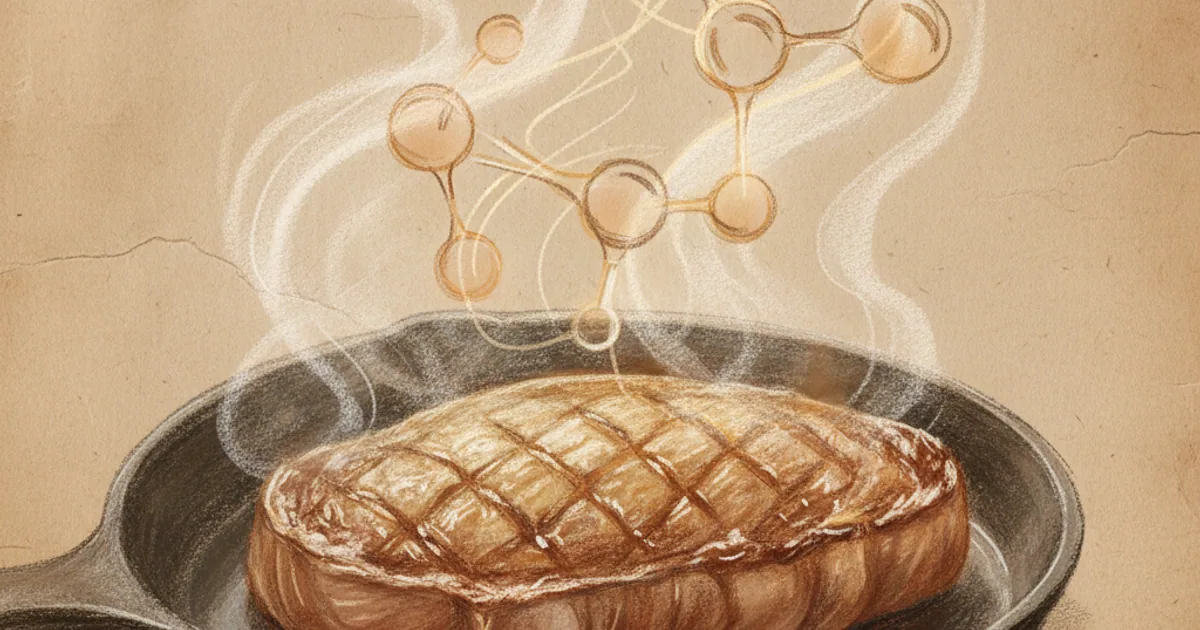
A seared steak. Toasted bread. Roasted coffee. Caramelized onions. Crispy bacon. The Maillard reaction is happening in all of them.
Maillard's research was a footnote in his career — he was actually interested in kidney disease and protein chemistry. But the reaction he described turns out to be one of the most important in cooking, and the one with the most far-reaching effects on what food tastes like.
What's actually happening
The reaction is genuinely complex. Modern food chemistry recognizes it as a multi-step cascade rather than a single reaction. The simplified outline:
Stage 1: Condensation. An amino acid (from a protein) reacts with a reducing sugar (one with a free carbonyl group, like glucose or fructose). The amino group attaches to the sugar, forming an unstable intermediate. This stage is reversible and happens below browning temperatures.
Stage 2: Amadori rearrangement. The intermediate rearranges into a more stable form (an Amadori compound). Still no significant colour or strong flavour yet.
Stage 3: Fragmentation and recombination. This is where the action is. At higher temperatures (>140 °C / >285 °F), the Amadori compound breaks apart and the pieces recombine in many ways. Hundreds of new molecules form — aldehydes, ketones, furans, pyrazines, melanoidins, and others. Each contributes specific aroma and flavour notes.
Stage 4: Melanoidin formation. Continued reactions produce the brown polymers (melanoidins) responsible for the visible browning.
The end products are what give Maillard browning its character:
- Pyrazines — roasted, nutty flavour notes.
- Furans — caramel, sweet, slightly burnt notes.
- Thiols and thioethers (when sulfur amino acids are involved) — savoury meat, roasted coffee aromas.
- Melanoidins — the brown polymers that give visible colour.
Different amino acid + sugar combinations produce different flavour profiles. This is why roasted coffee, seared steak, and toasted bread have distinct but related "browned" qualities — they're producing related but different Maillard products.
What it needs
For the Maillard reaction to proceed at useful rates:
1. Temperature: roughly 120-140 °C / 250-285 °F and up. Below this range, the reaction proceeds slowly enough that browning is barely noticeable on normal cooking timescales. The reaction rate increases sharply with heat, roughly doubling every 10-20 °C, until very high temperatures where decomposition starts to outpace useful reaction. 140 °C is a useful rule-of-thumb threshold for "browning starts to happen at a useful rate" — it's not a hard cutoff.
2. Dry surface. Water on the surface caps the local temperature at 100 °C (boiling point) until the water evaporates. As long as the surface is wet, Maillard barely happens. This is why patting meat dry before searing dramatically improves browning.
3. Amino acids AND reducing sugars. Pure protein with no sugar browns slowly. Pure sugar browns via caramelization, not Maillard. Most foods contain both; some need extra help (a sprinkle of sugar on meat can accelerate Maillard; honey on glazed ham boosts the reaction).
4. Time. Seconds to minutes for a steak; minutes for bread crust; hours for slow-roasted aromatic vegetables; even years in aged cheese (slow Maillard at room temperature, producing some of the complex flavour in aged hard cheeses).
5. Slightly alkaline pH. Maillard is faster at higher pH. This is why pretzel dough is dipped in alkaline solutions (traditionally lye, now usually baking soda) — the alkalinity accelerates the surface browning. Adding a pinch of baking soda to onions speeds caramelization. Adding it to meat marinade can over-do it (taste becomes soapy).
Why dry matters so much
The water rule deserves emphasis because it's the most common mistake:
When you put a wet steak in a hot pan, the water evaporates first. While that happens, the surface stays at ~100 °C — well below the Maillard temperature. The pan loses heat to vapor production. By the time the surface is dry enough to brown, you've already overcooked the interior or burnt the parts that did dry first.
Solutions:
- Pat the surface dry with paper towels just before cooking.
- Salt in advance (an hour to a day before): salt initially draws water out, but then the protein structure rearranges and reabsorbs much of it. The surface ends up DRIER than unsalted.
- Use very hot pan (~230 °C / 450 °F) so the brief evaporation period is short.
- Avoid crowding the pan. Multiple cold pieces drop the pan temperature and create steam that traps moisture.
- Don't move the food early. Once water leaves the surface, browning starts. Disturbing the contact resets the process.
This is why steakhouse steaks have a deep crust — they sear at very high heat, on a dry surface, undisturbed.
Caramelization is different
The Maillard reaction is sometimes confused with caramelization. They're related but distinct.
Caramelization is sugar alone, no protein. Sucrose, glucose, fructose decomposing under heat into different compounds.
- Pure sugar candy.
- Caramel colour and sauce.
- The deep brown edges of roasted carrots, onions, sweet potatoes (which are mostly sugar + water).
- The colour and flavour of dark beer (some caramelization of malt sugars during kilning).
Caramelization needs higher temperatures than Maillard — sucrose starts around 160 °C; some sugars work at lower temperatures. The flavour palette is different too: pure caramel is buttery, slightly bitter, sweet, sometimes nutty. No savoury notes (because no amino acids).
In real food, both reactions usually happen together:
- Bread crust: Maillard from proteins + sugars, caramelization from added sugars or those produced by amylase enzymes.
- Roasted onions: caramelization dominates (lots of sugar, less protein) but some Maillard too.
- Seared meat: mostly Maillard (lots of amino acids, some sugar).
The combined result is browning that's richer and more complex than either reaction alone.
What goes wrong
Things that interfere with Maillard:
Too wet. Steam, not brown. Pat dry; sear hot; don't crowd.
Too hot for too long. Past golden-brown, the reaction continues into bitter and acrid territory. Pyrazines that were pleasant become harsh. Aromatic compounds shift to "burnt" notes. Eventually, charring.
Acidic environment. Acid slows Maillard (the reaction prefers slightly alkaline conditions). A lemon-juice marinade slows the browning on meat. This is sometimes desired (tenderizing) but you'll pay in less crust.
Too cold. A 100 °C oven won't brown bread (water-vapor temperature caps the surface at 100 °C). For practical browning rates on most foods, 160-230 °C delivers reliable results — exact temperatures vary by food, moisture, and method.
Acrylamide concern. When starchy foods (potatoes, bread, biscuits, coffee, cereals) are heated above about 120 °C, Maillard-related chemistry can produce acrylamide — a compound classified as a probable human carcinogen by the IARC. Acrylamide forms across a range of heating conditions in starchy foods, not only past visible burning, but levels rise sharply with darker browning and longer high-heat exposure. The EU sets indicative levels for food producers; FDA guidance for home cooking is to "cook to a golden yellow rather than a dark brown" for starchy foods.
Why it makes food taste so good
The Maillard reaction is uniquely positioned to produce flavours humans find compelling because:
Hundreds of compounds. A single Maillard reaction produces dozens to hundreds of different flavour molecules. The combined effect is far richer than any single compound.
Savoury overlap. Many Maillard products are umami-adjacent — they overlap with the savoury, meaty, broth-like flavours we evolved to recognize as protein-rich nutrition.
Volatility. Many Maillard products are highly volatile, meaning they vaporize at cooking temperatures and reach your nose, producing strong aroma. Roasted coffee aroma is largely driven by Maillard-derived compounds, alongside contributions from sugar degradation, lipid changes, and other roasting chemistry.
Evolutionary association. Browned food was a marker of cooked food in our evolutionary history, signaling food was warm, microbially safer, and easier to digest. We may have inherited preferences for these flavours partly through co-evolution with cooked-food diets.
Cultural reinforcement. Most cuisines emphasize browned components in some way — roasted, seared, fried, toasted, baked. The Maillard reaction is central to nearly every culinary tradition's flavour palette.
Practical Maillard hacks
A few tricks based on Maillard chemistry:
Sprinkle a tiny amount of sugar on the surface of meat to accelerate Maillard if you've got a short sear window.
Use baking soda sparingly. A tiny pinch in a marinade alkalizes the surface and speeds browning. Too much makes things taste soapy and produces metallic flavour.
Brown your butter first. Heating butter past its melting point produces Maillard reactions in the milk solids (browned butter / beurre noisette). Wonderful flavour for sauces, baked goods, vegetables.
Roast at the right temperature. Vegetables roasted at 200-220 °C develop better browning than at 180 °C. Some recipes are too low.
Toast spices and nuts. Brief dry-pan toasting at medium heat brings out Maillard-flavoured aromatic compounds in spices and nuts — wildly better than using them raw.
Toast flour for roux. Browned flour (cooked dark in butter or oil before adding liquid) produces deeper-flavoured gumbos, gravies, and sauces.
Toast pasta. Toasting dry pasta briefly in oil before adding liquid (as in some risotto-style pasta dishes) introduces Maillard notes.
Char vegetables intentionally. Direct flame contact on onions, bell peppers, eggplant develops Maillard + char flavours simultaneously. Foundational to many Mexican, Middle Eastern, and Southeast Asian dishes.
If you'd like a guided 5-minute course on Maillard browning, NerdSip can generate one.
The takeaway
The Maillard reaction is a cascade of chemical reactions between amino acids and reducing sugars, accelerating above 140 °C and producing hundreds of new flavour and colour compounds. It needs heat, dry surface, time, both amino acids and reducing sugars, and ideally slightly alkaline pH. It's what makes seared meat, bread crust, roasted coffee, fried onions, and most browned foods taste the way they do. Control it by managing surface moisture, temperature, and time. Past golden-brown, the same chemistry turns bitter and produces acrylamide — so "golden, not dark" is both the flavour and the health recommendation.

Comments 0
No comments yet. Be the first to share your thoughts.