
The prediction
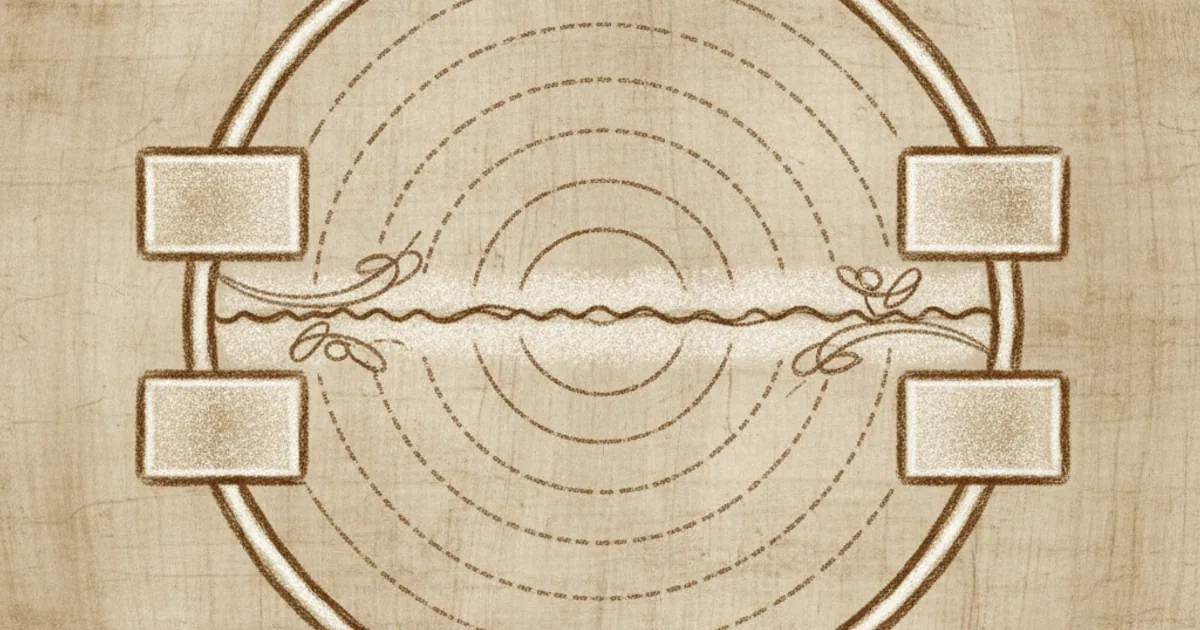
In 1962, Brian Josephson — a 22-year-old graduate student at Cambridge — predicted something remarkable: if you place two superconductors very close together, separated by a thin barrier, Cooper pairs should be able to tunnel coherently through the barrier. The supercurrent through this junction would depend on the phase difference between the macroscopic wavefunctions of the two superconductors, not on temperature or voltage.
The DC Josephson effect:
I = I_c · sin(φ₁ - φ₂)
Where I_c is a critical current characteristic of the junction, and (φ₁ - φ₂) is the phase difference between the two superconductors.
The AC Josephson effect:
d(φ₁ - φ₂)/dt = 2eV/ℏ
Where V is the voltage across the junction. A constant voltage produces a phase difference that winds up linearly with time — and from the DC equation, this means the current oscillates at a frequency:
f = 2eV/h ≈ 483.6 MHz/μV
Both effects were experimentally confirmed in 1963 — about a year after Josephson's prediction — by Philip Anderson and John Rowell at Bell Labs using Pb-oxide-Pb junctions. Josephson won the 1973 Nobel Prize (shared with Leo Esaki and Ivar Giaever, who discovered other tunneling phenomena).
The Josephson effect is one of the clearest experimental signatures of macroscopic quantum coherence. The pair wavefunction has a definite phase that extends across the junction, and the supercurrent reflects the cosine of the phase difference. There's no classical analog.
How the junction works
Physically, a Josephson junction is one of three types:
SIS junction (Superconductor-Insulator-Superconductor): two thin superconducting films separated by a thin insulator (typically AlOx, 1-2 nm thick). Most common type in modern quantum-computing applications.
SNS junction (Superconductor-Normal-Superconductor): a thin layer of normal metal between two superconductors. Used in some SQUIDs and in early voltage standards.
SS' junction (variable cross-section): a constriction in a single superconductor that's narrow enough to act as a weak link. Used in some sensor applications.
In all three, Cooper pairs can tunnel through the barrier coherently as long as the barrier is thin enough (a few nanometers for SIS, larger for SNS and SS' constrictions). The macroscopic wavefunctions on the two sides have well-defined phases φ₁ and φ₂; the supercurrent depends on the difference.
The key length scale: in a Josephson junction, the wavefunction extends into the barrier region with a decay length set by the superconductor's coherence length ξ — which varies dramatically by material. In clean aluminum, ξ is around 1-2 μm; in dirty niobium, around 40 nm; in cuprate high-Tc materials, only a few nm. The barrier needs to be much thinner than ξ for coherent tunneling to be appreciable, so the junction-fabrication tolerances vary by orders of magnitude across materials.
The Josephson voltage standard
The AC Josephson effect provides a remarkably precise relationship between voltage and frequency:
V = (h/2e) · f = Φ₀ · f
Where Φ₀ = h/2e is the magnetic flux quantum. This relationship is exact in principle — it depends only on fundamental physical constants h and e, not on any material parameters of the specific junction.
In 1990, CIPM recommended a conventional value of the Josephson constant K_J-90 = 2e/h to use as a practical voltage standard worldwide. This wasn't a formal SI redefinition; the SI volt was only tied exactly to h and e in the 2019 SI revision, which fixed the elementary charge and Planck constant as exact values — making K_J = 2e/h exact by definition.
Numerically: a microwave frequency of ~70 GHz applied to a Josephson junction produces a voltage of ~145 μV (not millivolts) per junction. Modern voltage standards use series-connected arrays of tens of thousands of junctions to produce calibrated voltages up to ~10 V with relative standard uncertainties of about 10⁻¹⁰ to 10⁻¹¹ — among the most precise electrical standards ever built.
SQUIDs: turning the Josephson effect into a sensor
A SQUID (Superconducting QUantum Interference Device) uses Josephson junctions in a superconducting loop to detect magnetic flux with extreme sensitivity.
The basic dc SQUID: a superconducting ring with two Josephson junctions on opposite sides. Bias the ring with a current and measure the voltage across it. As you apply a magnetic flux Φ through the ring:
- Flux quantization requires the wavefunction phase change around the loop to be 2π × (Φ/Φ₀).
- The phase change is shared between the two junctions.
- The total supercurrent through the SQUID oscillates as Φ varies, with period Φ₀.
The voltage across the SQUID oscillates as a function of applied flux, with a periodicity of one flux quantum. By measuring the voltage, you can detect flux changes smaller than a single Φ₀.
Modern SQUIDs achieve sensitivities of:
- Flux: ~10⁻⁶ Φ₀ per √Hz (millionth of a flux quantum, per √Hz of bandwidth).
- Magnetic field: ~10⁻¹⁵ T (femtotesla) per √Hz when paired with a pickup coil.
For comparison: Earth's magnetic field is ~5 × 10⁻⁵ T (50 μT). A SQUID magnetometer can detect magnetic fields a billion times weaker than this.
SQUID applications
The unprecedented magnetic-field sensitivity of SQUIDs enables several specialized applications:
Magnetoencephalography (MEG): imaging brain activity by detecting the magnetic fields produced by neuronal electrical currents. Brain magnetic fields are ~10⁻¹³ T at the scalp — femtotesla scale. MEG provides millisecond time resolution (faster than fMRI) for studying brain function. Used in neuroscience research, epilepsy surgical planning, and dementia studies. Several hundred MEG systems operate worldwide.
Magnetocardiography (MCG): similar idea for the heart. Detects magnetic fields from cardiac currents. Used in some specialized cardiac diagnostics.
Geophysical prospecting: detecting buried magnetic anomalies for mineral exploration. SQUID arrays towed behind aircraft or boats can map subsurface magnetic structures.
Nondestructive testing: detecting cracks and stresses in metallic structures via magnetic anomalies.
Dark matter searches: certain dark matter candidates (axions, dark photons) would produce extremely weak magnetic signatures. SQUID magnetometers are part of several axion-search experiments.
Quantum metrology: precision measurement of fundamental constants.
Geological time measurement: rocks preserve magnetic information from when they formed; sensitive magnetometry maps these "paleomagnetic" records to study Earth's history.
For all of these, the SQUID's combination of femtotesla sensitivity and macroscopic-quantum stability is irreplaceable.
Superconducting qubits
In the past two decades, the Josephson junction has become a foundational element of quantum computing. The basic insight: a Josephson junction provides a strong nonlinearity in the current-voltage relationship. Combined with circuit capacitance and inductance, this nonlinearity creates a quantum harmonic oscillator with anharmonic energy levels.
The lowest two energy levels of such a system can be used as the |0⟩ and |1⟩ states of a qubit. The energy spacing (typically ~5-10 GHz, or ~0.2 K equivalent temperature) lets the system be controlled with microwave pulses and isolated from thermal noise (operating temperature ~10-50 mK).
Several superconducting qubit designs exist:
Charge qubit: relies on the discrete charging energy of a small superconducting island. Original design (early 2000s); largely superseded by less noise-sensitive variants.
Transmon: the dominant modern design. A charge qubit with large shunting capacitance that makes it less sensitive to charge noise. Used by IBM, Google, Rigetti, and most other major players. Achieves coherence times typically 50-200 μs in production processors, with state-of-the-art demonstrations exceeding 300 μs and millisecond-scale lifetimes reported in some specialized designs.
Flux qubit: based on a superconducting loop with three Josephson junctions, where the state is determined by flux in the loop.
Fluxonium: a more recent design with potentially longer coherence times.
XMon, GMon: variants used by Google.
A modern quantum processor (IBM Quantum, Google Quantum AI) contains anywhere from tens to over a thousand Josephson-junction qubits with engineered couplings between them. IBM's Condor chip (2023) reached 1121 qubits; subsequent processors and competitors span hundreds to over a thousand qubits. The system is cooled to ~10-20 mK in dilution refrigerators. Microwave control lines deliver pulses for gate operations.
Despite enormous engineering progress, current superconducting quantum computers are still in the "Noisy Intermediate-Scale Quantum" (NISQ) era — useful for benchmarks but not yet routinely useful for solving practical problems faster than classical computers. Typical two-qubit gate error rates are in the 10⁻³-10⁻⁴ range; demonstrations with quantum error correction have shown logical error rates below 10⁻³ per logical gate. Achieving large-scale fault-tolerant computing requires further reduction of physical error rates plus efficient error-correcting codes. This is the central challenge of the field.
For background on quantum computing more broadly, see what quantum computing actually is.
Macroscopic quantum tunneling
The Josephson effect is sometimes called "macroscopic quantum tunneling" because it involves Cooper pairs (composite particles representing macroscopic many-electron states) tunneling through a classical barrier.
This is distinct from but related to ordinary quantum tunneling (see quantum tunneling explained). Ordinary tunneling involves a single particle's wavefunction extending through a barrier. Macroscopic quantum tunneling involves the COLLECTIVE wavefunction of many paired electrons doing the same thing — but as a single coherent quantum object spanning the macroscopic superconductor.
It's one of the few cases where genuine quantum tunneling can be observed and measured at circuit scales. This is part of what makes Josephson junctions so useful — they extend quantum behavior to engineering-accessible regimes.
Implementation details
Modern Josephson junction fabrication:
Thin-film deposition: superconducting layers (typically aluminum, niobium, or aluminum with niobium contact pads) are deposited via sputtering or evaporation onto a silicon substrate.
Oxidation step: a thin layer of aluminum is exposed to oxygen at controlled pressure to grow an AlOx barrier 1-2 nm thick.
Capping layer: another superconducting layer is deposited on top of the AlOx.
Photolithography: patterns of junctions are defined on the wafer.
Etching and cleanup: junctions are isolated and packaged.
The critical current I_c of each junction is determined by:
- The barrier thickness and area.
- The superconducting gap of the films.
- The junction's specific geometry.
Modern fabrication achieves reproducible I_c values across wafers, with junction sizes from ~100 nm to many micrometers. Research-grade processes are now used in commercial-scale quantum-computing hardware.
Energy and timescales
Some characteristic numbers:
- Josephson energy E_J ≈ ℏ·I_c/(2e). For I_c ~10 μA, E_J ≈ 3.3 × 10⁻²¹ J (frequency scale ~5 THz). For I_c ~0.1 μA, E_J ≈ 70 GHz × ℏ — closer to qubit-relevant scales.
- Charging energy E_C = (2e)²/(2C). For C
1 pF, E_C ≈ 5 × 10⁻²⁶ J (frequency scale ~80 MHz). For smaller C (1 fF) E_C reaches ~80 GHz × ℏ. - Operating temperature: 10-50 mK in dilution refrigerators. k_B·T at 10 mK is
1.4 × 10⁻²⁵ J — typically about an order of magnitude smaller than the qubit transition energy (5 GHz × ℏ ≈ 3 × 10⁻²⁴ J). - Microwave control: typically 4-8 GHz carrier frequency; single- and two-qubit gate pulses are ~10-100 ns duration.
- Coherence times: typically 50-200 μs in modern transmons; longer in state-of-the-art devices.
- Gate operations: tens of nanoseconds typical for native gates.
The qubit operations happen fast compared to the coherence time, allowing many operations before the quantum state decoheres. The challenge is to maintain coherence while running enough operations to do useful computation.
The takeaway
A Josephson junction is two superconductors separated by a thin barrier through which Cooper pairs can tunnel coherently. The supercurrent depends on the macroscopic phase difference of the two superconductors (DC Josephson effect); applied voltage causes the phase to wind up linearly, producing oscillating current at a frequency proportional to voltage (AC Josephson effect). The AC effect provides the SI voltage standard via the exact relationship V = Φ₀·f. SQUIDs use superconducting loops with two Josephson junctions to detect magnetic flux changes smaller than a single flux quantum, achieving femtotesla magnetic-field sensitivity — used in MEG brain imaging, geophysics, dark matter searches. Modern superconducting quantum computers (IBM, Google, others) use engineered Josephson junctions as artificial atoms — the dominant qubit technology for current NISQ-era quantum processors. The phenomenon is genuine macroscopic quantum tunneling — quantum mechanics at engineering-accessible scales.

Comments 0
No comments yet. Be the first to share your thoughts.