
As of 2026-05-23. Quantum computing is a fast-moving field; specific qubit counts, error rates, and algorithm milestones may shift. The principles and rough timelines should remain relevant for several years.
The core idea
A classical computer manipulates bits — physical states that are either 0 or 1. Every operation moves bits around, ANDs them, ORs them, NOTs them, and so on. Modern CPUs do billions of these operations per second.
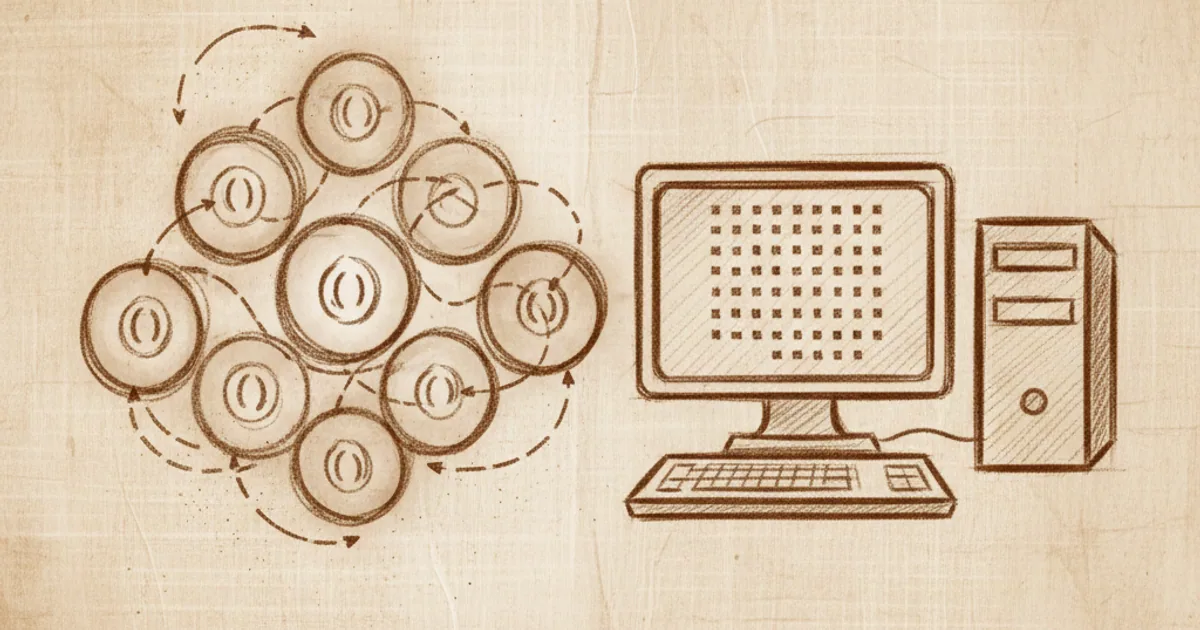
A quantum computer manipulates qubits — physical quantum systems (like single atoms, photons, or superconducting circuits) that can be in superpositions of 0 and 1, and that can be entangled with each other.
A single qubit can be in any superposition α|0⟩ + β|1⟩, where α and β are complex numbers with |α|² + |β|² = 1. When measured, the qubit gives 0 with probability |α|² or 1 with probability |β|². But before measurement, both possibilities coexist in the qubit's state.
Two qubits can be in superpositions of all four basis states |00⟩, |01⟩, |10⟩, |11⟩. Three qubits: all eight states. n qubits: a superposition over 2ⁿ states.
This is what gives quantum computers their potential: with n qubits, the state space has 2ⁿ dimensions. For n = 50, that's about a quadrillion (10¹⁵) possibilities. For n = 300, that's more states than there are particles in the observable universe.
But — and this is critical — the quantum computer doesn't actually try all 2ⁿ possibilities at once. The popular misconception "quantum computers try all answers simultaneously" is wrong. Quantum computers manipulate amplitudes (complex numbers attached to each possible state), and clever algorithms make the desired answer's amplitude large while the others' amplitudes cancel through interference. When you measure, you get one outcome — the algorithm makes sure it's the right one (with high probability) for a well-chosen problem.
What quantum computers are good at (and what they're not)
This is the most important section to understand.
Quantum computers are exponentially faster than classical computers on a few specific problems:
- Shor's algorithm (factoring large integers). Factoring is the basis of RSA and most public-key cryptography. Quantum computers can factor in roughly polynomial time; classical computers need roughly exponential time. This is why quantum computing threatens existing public-key cryptography.
- Quantum simulation of physical systems. Simulating quantum systems on classical computers is hard — the state space grows exponentially with system size, hitting practical limits at 30-50 quantum particles. Quantum computers naturally simulate quantum systems, with applications to chemistry (drug design, catalyst optimization, materials science, battery research), and condensed matter physics.
- Grover's algorithm (unstructured search). Quadratic (not exponential) speedup for searching through unstructured data. Useful but less dramatic than Shor's.
- Certain optimization problems. Some specific optimization tasks have known quantum algorithms with potential advantages. The picture is messier than chemistry simulation — many promising-sounding optimization speedups haven't held up under careful analysis.
Quantum computers are NOT exponentially faster on:
- General-purpose computation (web browsers, OS, applications).
- Linear algebra at typical sizes (though some niche speedups exist).
- Most machine learning training (despite some hype).
- Sorting, searching structured data, most database operations.
- Video processing, image rendering, gaming.
The famous result by Daniel Bernstein and Tanja Lange: quantum computers don't speed up most problems. They're not a universal accelerator. They're a specialized device for a specific (and important) class of problems.
This is the most important fact about quantum computing, and the most underemphasized in popular coverage.
How a qubit is physically realized
Quantum computers are still in the early stages of hardware development. Several different physical platforms are being pursued:
Superconducting qubits. Macroscopic quantum oscillators built from Josephson junctions on superconducting circuits. Operated at ~10 mK (just above absolute zero). Used by IBM, Google, Rigetti, Quantinuum (partly), and several others. Strong industrial backing; the most mature platform by qubit count. Limitations: short coherence times, sensitive to environmental noise.
Trapped ions. Individual atoms (typically calcium, ytterbium, or beryllium ions) held in electromagnetic traps and manipulated with lasers. Used by IonQ, Quantinuum, and others. Pros: very long coherence times, very high gate fidelity. Cons: gate operations are slower; scaling to many qubits is harder.
Neutral atoms. Like trapped ions but for neutral atoms held in optical tweezer arrays. Recent rapid progress — Atom Computing, QuEra, and Pasqal have demonstrated hundreds-to-thousands-of-qubit systems. Promising platform, still maturing.
Photonic qubits. Photons in optical circuits. PsiQuantum and Xanadu are leading commercial efforts. Pros: room-temperature operation, natural for communication. Cons: gates are probabilistic, requires error correction overhead.
Topological qubits. Theoretical qubits encoded in topological states of matter; expected to be inherently error-resistant. Microsoft has been pursuing this for years. As of 2026, demonstrating actual topological qubits remains a research-frontier challenge; commercial impact is uncertain.
Spin qubits in silicon. Individual electrons or atomic spins in silicon, leveraging semiconductor manufacturing. Pursued by Intel, IMEC, several academic groups. Progress slower than other platforms but potentially scalable if it works.
Each platform has trade-offs. The eventual winner (or winners) isn't clear yet.
Where the field is, as of 2026
A snapshot of recent milestones:
- IBM: deploying systems with up to 1,000+ physical qubits; emphasizing utility-scale demonstrations on real problems.
- Google: continuing on superconducting platform; demonstrated quantum advantage on random circuit sampling (2019, repeated 2024 with stronger evidence).
- Quantinuum: trapped-ion systems with very high gate fidelity; commercial cloud access.
- IonQ: trapped-ion systems with public cloud access; emphasizing reliable operations over raw qubit count.
- Atom Computing, QuEra: neutral-atom systems scaling to many hundreds-thousands of qubits.
- PsiQuantum: building a million-qubit photonic system on a long timeline.
Hundreds to a few thousand physical qubits is the current rough scale. But:
Physical qubits ≠ logical qubits. Each physical qubit has high error rates (typical gate error ~10⁻³ to 10⁻⁴). For most useful algorithms, you need error-corrected logical qubits, which encode information across many physical qubits using quantum error correction codes. The overhead is large — currently around 1000:1 physical-to-logical ratio in some implementations. For a useful algorithm needing 1,000 logical qubits, you'd need ~1 million physical qubits.
Current systems are in the "Noisy Intermediate-Scale Quantum" (NISQ) era (term coined by John Preskill, 2018). NISQ devices have hundreds to thousands of noisy physical qubits without full error correction. They can demonstrate quantum advantage on artificial benchmarks but can't yet solve commercially valuable problems beyond classical reach.
Most experts estimate 5-15 years before fully error-corrected quantum computers with thousands of logical qubits become available. Major investments by IBM, Google, government programs, and venture capital are accelerating progress, but the technical challenges remain substantial.
What quantum computers can already do (a little)
Some applications are being explored on current NISQ-era systems:
Chemistry simulation: small molecule energies, simple reaction simulations. Useful for understanding methods but not yet beating classical methods on commercially important problems.
Optimization: quantum approximate optimization algorithm (QAOA) and variants on small instances. Some promising results, much remaining controversy about classical comparability.
Machine learning: hybrid quantum-classical training and inference for small models. Some demonstrations, no clear advantage yet over classical machine learning on practical tasks.
Specific benchmarks: random circuit sampling, instantaneous quantum polynomial-time sampling, gaussian boson sampling. These are problems chosen specifically to be hard for classical computers; they have no known practical applications but serve as demonstrations of quantum advantage.
Real-world useful quantum computing is starting in:
- Cryptography research: post-quantum cryptography standards already being deployed.
- Drug discovery: very early-stage pilots; not yet ready for commercial deployment.
- Battery and materials research: similar early stage.
- Optimization for finance, logistics: pilots with mixed results.
The honest assessment: quantum computers haven't yet solved a single problem that classical computers cannot solve and that has clear commercial value. They've demonstrated computational advantage on benchmarks; practical advantage on important problems is still emerging.
Cryptography and the post-quantum transition
This is the area where quantum computing's impact is most certain.
Current public-key cryptography (RSA, ECC) rests on the hardness of factoring and discrete logarithms — both vulnerable to Shor's algorithm running on a sufficiently large quantum computer. When fully error-corrected quantum computers with thousands of logical qubits exist, current encryption will become breakable.
The world is responding:
Post-quantum cryptography (PQC): encryption algorithms believed to resist quantum attack. Based on different mathematical hard problems (lattice problems, hash functions, code-based cryptography). NIST's PQC standardization began in 2016 (call for proposals), with algorithm selection in 2022. In August 2024, NIST finalized three standards: FIPS 203 (ML-KEM, based on CRYSTALS-Kyber, for key establishment), FIPS 204 (ML-DSA, based on CRYSTALS-Dilithium, for signatures), and FIPS 205 (SLH-DSA, based on SPHINCS+, as a backup signature scheme). A fourth standard based on FALCON (FN-DSA) was in draft. These are now being implemented in real systems.
Migration timeline: years to decades. Internet infrastructure, government systems, financial systems, and embedded devices all need to migrate. The migration is happening but it's slow.
"Harvest now, decrypt later": adversaries can already record encrypted data today and decrypt it once quantum computers are sufficient. For long-lived secrets (state secrets, certain medical and financial records), this is a real concern motivating immediate migration.
Hybrid approaches: many systems are deploying hybrid encryption combining classical and post-quantum methods, providing security against both classical and quantum attackers during the transition.
What's not changing soon
Despite the hype, quantum computers are unlikely to:
- Replace classical computers for everyday tasks.
- Make all encryption obsolete tomorrow. Even if a quantum computer factored RSA-2048 today, the impact would be devastating for some systems but most consumer security uses other layers. The transition to post-quantum cryptography is well underway.
- Provide general AI breakthroughs. Some quantum-machine-learning algorithms exist, but for the foreseeable future, AI advances will come from classical computing (with possible niche quantum acceleration in specific subroutines).
- Be in your phone or laptop. The cooling and engineering requirements are substantial; quantum computers will likely remain in datacenters accessible via cloud.
A note on quantum communication
Distinct from quantum computing, quantum communication uses quantum effects to transmit information with provable security properties.
Quantum key distribution (QKD): two parties share encryption keys via the quantum state of photons. Any eavesdropper attempting to measure the photons disturbs the state in detectable ways. Commercial QKD systems exist; some banks and government agencies have deployed them.
Quantum internet: a future network of quantum-connected nodes for distributing entanglement and quantum information. Several pilot networks operate (in China, Europe, US). Useful for synchronization, distributed quantum computing, and high-precision sensing across geographic distances.
China launched a QKD satellite (Micius) in 2016 and demonstrated intercontinental QKD links. The EU has been deploying terrestrial QKD networks. The US has multiple research efforts.
This is a complementary field to quantum computing — same underlying physics, different applications, different timelines. Some pieces of "quantum internet" infrastructure are already commercially deployed.
If you'd like a guided 5-minute course on quantum computing, NerdSip can generate one.
The takeaway
A quantum computer uses qubits — quantum systems that can be in superpositions of 0 and 1 and that can be entangled with each other. For specific problem classes (factoring, quantum simulation, certain search and optimization problems), quantum computers offer exponential advantages over classical computers. For most everyday computing, they don't help. As of 2026, working systems have hundreds to over a thousand physical qubits but lack the error correction needed for many practical applications; fully error-corrected quantum computers with thousands of logical qubits are likely 5-15 years away. The most certain near-term impact is on cryptography: current public-key encryption will eventually become breakable, motivating an ongoing transition to post-quantum cryptography — NIST's PQC project began in 2016 with finalized standards published in August 2024. Quantum computers will likely be specialized accelerators in datacenters, not replacements for classical computing — much as GPUs accelerate specific workloads alongside CPUs today.

Comments 0
No comments yet. Be the first to share your thoughts.