
A subtle distinction
A material with truly zero electrical resistance would have a peculiar magnetic property: any magnetic field that's there when the material becomes a perfect conductor stays there indefinitely. Try to change the field, and induced currents (with zero resistance) flow to oppose the change — and since they don't decay, they persist forever, keeping the field locked in.
This is what you'd expect from a hypothetical "perfect conductor" that's just a normal conductor with infinitely improved electron mobility.
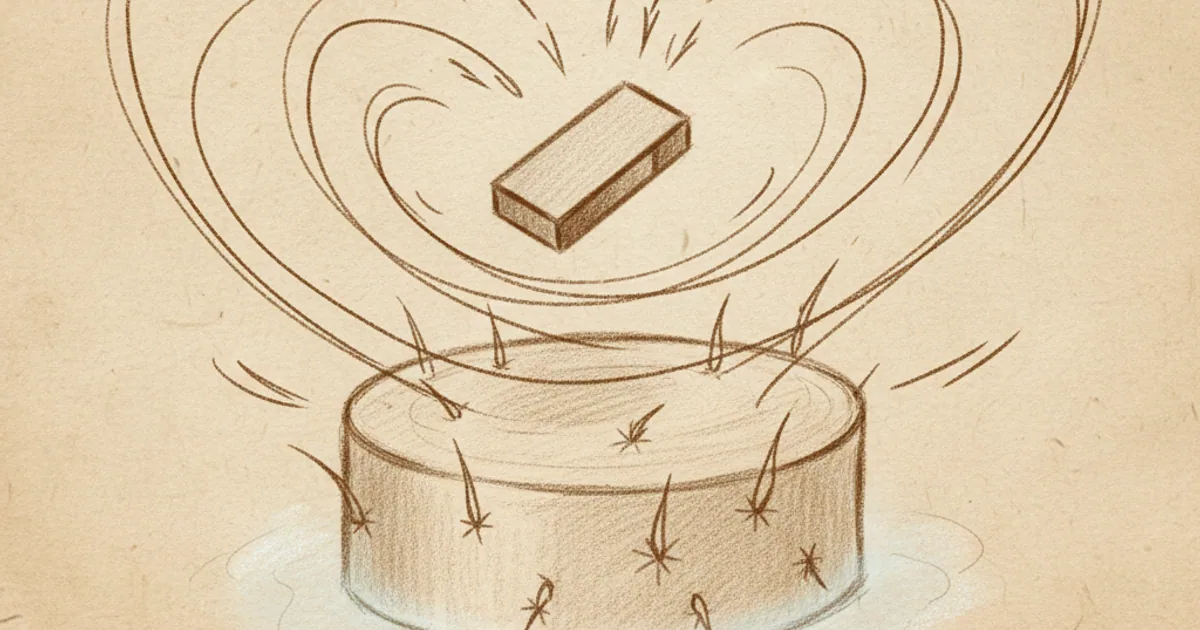
Real superconductors do something different. Cool a superconductor in a magnetic field. As it crosses below Tc, the field is actively expelled from the bulk. Whether the field was present before cooling makes no difference — the superconductor pushes it out either way.
This is the Meissner effect (Walther Meissner and Robert Ochsenfeld, 1933). It's the experimental signature that distinguishes a real superconductor from a hypothetical perfect conductor, and it's a direct consequence of the macroscopic quantum state of paired electrons.
How the expulsion works
A superconductor maintains zero magnetic field inside its bulk by setting up surface currents whose magnetic field exactly cancels any applied external field.
When an external field B_ext is applied:
- The macroscopic wavefunction couples to the electromagnetic field in a way that's described mathematically by the London equations (Fritz and Heinz London, 1935) or, more rigorously, by the Ginzburg-Landau theory.
- These equations predict that the field inside the superconductor decays exponentially over a characteristic distance called the London penetration depth λ, typically tens to hundreds of nanometers depending on the material.
- The screening currents flow on the surface, within a thin layer of thickness ~λ.
Outside the penetration depth — that is, in the bulk — the field is essentially zero. The internal B is reduced not just to "small" but to "vanishingly small" beyond λ from the surface.
The energy required to set up the screening currents and exclude the field comes from the difference in energy between the superconducting and normal states. Below Tc, the superconducting state has lower energy (by an amount proportional to the gap Δ squared). The system "pays" some of this energy to exclude the field.
If the applied field is too strong (above the critical field Hc), it becomes energetically cheaper to give up superconductivity than to keep excluding the field. Above Hc, the material reverts to a normal metal.
Why the Meissner effect rules out "perfect conductor"
The Meissner effect is what conclusively distinguishes a superconductor from any classical interpretation as a perfect conductor.
Imagine cooling a sample in a magnetic field:
Perfect conductor (hypothetical, classical): The field is preserved as the material crosses some hypothetical transition to zero resistance. The current state of the material at low temperature INCLUDES the trapped field. If you remove the external field, induced currents keep the trapped field in place.
Real superconductor: As the material crosses below Tc, the field is EXPELLED. The end state has B = 0 in the bulk regardless of whether the field was present at high temperature. Remove the external field, and the screening currents stop — there was no trapped field to maintain.
This active expulsion can't be explained by classical zero-resistance arguments. It requires the macroscopic quantum coherent state to be set up — and that state has lower energy without the field inside it.
The London brothers' equations captured this phenomenologically in 1935. Ginzburg and Landau extended it to a macroscopic quantum theory in 1950. BCS theory provided the microscopic derivation in 1957.
Type I and Type II
Not all superconductors expel field the same way.
Type I superconductors
The "classical" behavior: completely expel field below a single critical field Hc. Above Hc, superconductivity is destroyed abruptly.
Materials: most pure elemental superconductors — lead, mercury, tin, aluminum. Generally low Tc (below ~10 K) and low Hc (below ~0.2 T).
Properties of Type I:
- Complete Meissner state below Hc.
- Sharp transition to normal at Hc.
- Limited engineering use because of low Hc.
Type II superconductors
Have TWO critical fields, Hc1 and Hc2:
- Below Hc1: full Meissner state. Complete field expulsion.
- Between Hc1 and Hc2 (mixed state): magnetic flux partially penetrates the bulk as discrete vortices. Each vortex is a thin tube of normal-state material carrying exactly one quantum of magnetic flux Φ₀ = h/2e ≈ 2.07 × 10⁻¹⁵ Wb. The bulk between vortices remains superconducting.
- Above Hc2: superconductivity is destroyed.
Materials: nearly all alloys and compounds, all high-Tc cuprates, iron-based superconductors, Nb-Ti, Nb₃Sn, MgB₂, hydride superconductors. Typically much higher critical fields than Type I (up to 100+ T for some compounds at low temperature).
Type II superconductors enable practically all useful applications because their high Hc2 allows operation at high fields.
Flux quantization: a macroscopic quantum signature
The magnetic flux through any closed loop in a superconductor is quantized in units of the flux quantum:
Φ₀ = h / (2e) ≈ 2.067 × 10⁻¹⁵ Wb
The "2e" in the denominator reflects that the relevant charge carriers are Cooper pairs (each carrying charge 2e), not single electrons.
Physical consequence: if you have a superconducting ring with some trapped flux, the flux value isn't arbitrary — it's always an integer multiple of Φ₀. You can demonstrate this by carefully measuring the flux through small superconducting rings.
In Type II superconductors, when flux penetrates as vortices, each vortex carries exactly one Φ₀. This makes vortex physics intrinsically quantum-mechanical at macroscopic scales — you can image individual flux quanta with sufficient resolution (using SQUID microscopy or magnetic decoration techniques).
Vortex pinning: how to make Type II useful
Type II superconductors with mixed-state vortex penetration have a practical problem: if vortices can move freely (in response to applied current, for example), they dissipate energy and the material acts as if it has resistance.
Vortex pinning is the engineering art of immobilizing the vortices so they don't move. Pinning is done by:
- Crystal defects: dislocations, grain boundaries, second-phase precipitates.
- Engineered nanostructures: artificial pinning centers introduced during material processing.
- Chemical inhomogeneities: zones of suppressed superconductivity that attract vortex cores.
In commercial Type II superconducting wires (NbTi, Nb₃Sn), the material processing is specifically designed to create distributed pinning centers. A well-engineered NbTi wire can carry tens of thousands of amperes per square millimeter at the operating field, because vortex motion is suppressed by pinning.
Without pinning, Type II superconductors couldn't carry useful currents at high fields. With pinning, they're the backbone of every superconducting magnet system.
Magnetic levitation
A small permanent magnet placed above a cooled superconductor levitates stably. The physics:
Above a Type I superconductor: only the Meissner-effect repulsion acts. The magnet experiences a force pushing it away from the surface. But there's nothing constraining horizontal motion — the magnet can drift sideways and fall off the edge.
Above a Type II superconductor: things are more interesting. The magnet's field penetrates the superconductor in some specific vortex pattern. The vortices get pinned at defects (the pinning is set up when the magnet is placed and the superconductor cooled). After pinning:
- Trying to MOVE the magnet sideways would require the vortices to move with it, which costs energy (the vortices are pinned in place).
- Trying to MOVE the magnet UP would change the field pattern, also costing energy.
- The magnet is "locked" in its current position by the pinned vortices.
This is flux pinning, and it produces stable levitation — the magnet can even hang BELOW the superconductor (gravity pulls it down, but the pinned vortices resist motion in any direction).
The classic demonstration: cool a YBCO disc in liquid nitrogen with a magnet placed above. The magnet levitates and can be locked into specific positions. Demonstrations show magnets following the superconductor around (it tracks where the magnet was when cooled), and "quantum levitation" videos circulate widely — and if those clips ever made you want the real explanation behind the magic, that itch is worth following all the way down.
This is the basis of:
- Magnetic bearings: frictionless rotation without contact.
- Magnetic levitation transport: see below.
- Stable magnetic field positioning: in some experimental physics.
Maglev trains
Two main maglev technologies, with different physics:
Electromagnetic suspension (EMS): not superconducting. Uses conventional electromagnets in the train and feedback control to maintain a precise small gap (typically 10-15 mm) above the rail. Examples: Transrapid (Germany, deployed in Shanghai), South Korean and Chinese systems.
Electrodynamic suspension with superconducting magnets: uses superconducting magnets in the train and induced eddy currents in a "guideway" with conductive coils. The train must be moving fast enough (~100 km/h) for the induced currents to be strong enough to lift the train, so it rolls on wheels at low speed and transitions to magnetic levitation at higher speeds. Larger gap (typically 10 cm) than EMS. Example: Japan's Chuo Shinkansen (under construction; will use SCMaglev). Test runs have demonstrated 603 km/h (2015 world record).
The Chuo Shinkansen uses superconducting magnets cooled by liquid helium aboard the trains. The expected commercial speed is around 500 km/h between Tokyo and Nagoya, then later Osaka — significantly faster than conventional high-speed rail (320 km/h or so).
Why superconducting magnets specifically? They can produce the strong magnetic fields needed for levitation at the gap distance, with negligible power consumption once charged. Conventional electromagnets would consume megawatts continuously.
Superconducting magnets in MRI and accelerators
The other main applications of superconducting magnetic field-control:
MRI scanners: typically 1.5-3 T main field, sometimes 7 T for research, 10+ T for ultra-high-field research. Use NbTi superconducting solenoids cooled by liquid helium. The magnet is charged once at installation and operates in "persistent mode" — the current loops back through a superconducting switch, with no external power supply needed. Field stability is exquisite (drift below 0.1 ppm per year). Recent industry estimates put the global installed base around 70,000-80,000 MRI scanners by the mid-2020s.
Particle accelerators: the LHC at CERN uses 1232 dipole magnets (each 14.3 m long) producing 8.3 T, plus quadrupoles and higher-order multipoles. All superconducting (NbTi, cooled to 1.9 K with superfluid helium). Steers and focuses two counter-rotating proton beams at 6.8 TeV each.
Fusion reactors: ITER's superconducting magnet system is the largest ever built, with 18 toroidal-field coils producing 11.8 T peak field. Designed to confine plasma at 150 million K.
MRI under construction: 27 T whole-body human MRI scanners are being developed using high-temperature superconductors (REBCO tapes). Higher fields enable better resolution and chemical specificity.
Wind generators: experimental high-power offshore wind generators using REBCO superconductors. Compact, lightweight, more efficient than conventional generators.
In all these cases, the underlying physics is the same: zero-resistance current loops producing strong, stable, uniform magnetic fields with negligible ongoing power input.
A note on cooling
The cooling requirement is the main practical limitation of superconductor applications.
- Liquid helium (4.2 K): used for conventional superconductors (NbTi, Nb₃Sn). Helium is expensive and increasingly scarce; modern systems use closed-cycle helium recovery to minimize consumption.
- Liquid nitrogen (77 K): much cheaper and more available. Sufficient for high-Tc cuprates (Tc > 77 K). Used for some power applications and some research.
- Cryocoolers: small mechanical refrigerators reaching cryogenic temperatures from electrical power. Increasingly used in modern superconducting systems.
If room-temperature ambient-pressure superconductors existed (an active research goal), the cooling cost would drop to zero — transformative for energy, transmission, electronics, and medical imaging. As of mid-2026, this remains a goal.
The takeaway
The Meissner effect is the active expulsion of magnetic field from the bulk of a superconductor below Tc. It distinguishes superconductors from hypothetical "perfect conductors" — a true superconductor pushes field out regardless of whether it was present before cooling. Type I superconductors show pure Meissner behavior with sharp transitions at Hc; Type II allow partial flux penetration as quantized vortices between Hc1 and Hc2, where vortex pinning is critical for practical current-carrying applications. Combined with flux pinning, this enables stable magnetic levitation, MRI magnets, particle accelerators, fusion magnets, and maglev trains. The cooling requirement remains the main practical limitation; room-temperature ambient-pressure superconductors would transform this. The Meissner effect and flux quantization are both direct macroscopic signatures of the underlying quantum coherence of the superconducting state.

Comments 0
No comments yet. Be the first to share your thoughts.