
The discovery that broke the rules
In April 1986, Johannes Georg Bednorz and Karl Alexander Müller at IBM Zurich submitted a paper titled "Possible high-Tc superconductivity in the Ba-La-Cu-O system" to Zeitschrift für Physik. Reviewing was slow; the paper went mostly unnoticed initially.
Their result: a copper-oxide ceramic, LaBaCuO, showed signs of superconductivity at temperatures up to about 35 K — well above the previous record (~23 K for Nb₃Ge).
Within months of the paper appearing, labs around the world replicated the result and pushed it further:
- January 1987: YBa₂Cu₃O₇ (YBCO) shows Tc ≈ 92 K — above the boiling point of liquid nitrogen (77 K).
- 1988: BSCCO (BiSrCaCuO) at Tc ≈ 110 K.
- 1993: HgBa₂Ca₂Cu₃O₈₊δ at Tc ≈ 134 K (ambient pressure), up to 164 K under pressure.
Bednorz and Müller received the 1987 Nobel Prize in Physics — the fastest Nobel ever awarded for a discovery (less than 18 months from publication to prize).
The discovery was revolutionary for two reasons:
Practical: Tc above 77 K means liquid nitrogen cooling is sufficient — vastly cheaper and easier than liquid helium. This made superconductor technology accessible in ways the helium-cooled era never could.
Theoretical: The Tc values exceeded what standard BCS theory predicts for phonon-mediated pairing. The mechanism couldn't be the same as conventional superconductors.
The second point is what made the discovery scientifically transformative. Forty years later, we still don't fully understand it.
What makes cuprates unusual
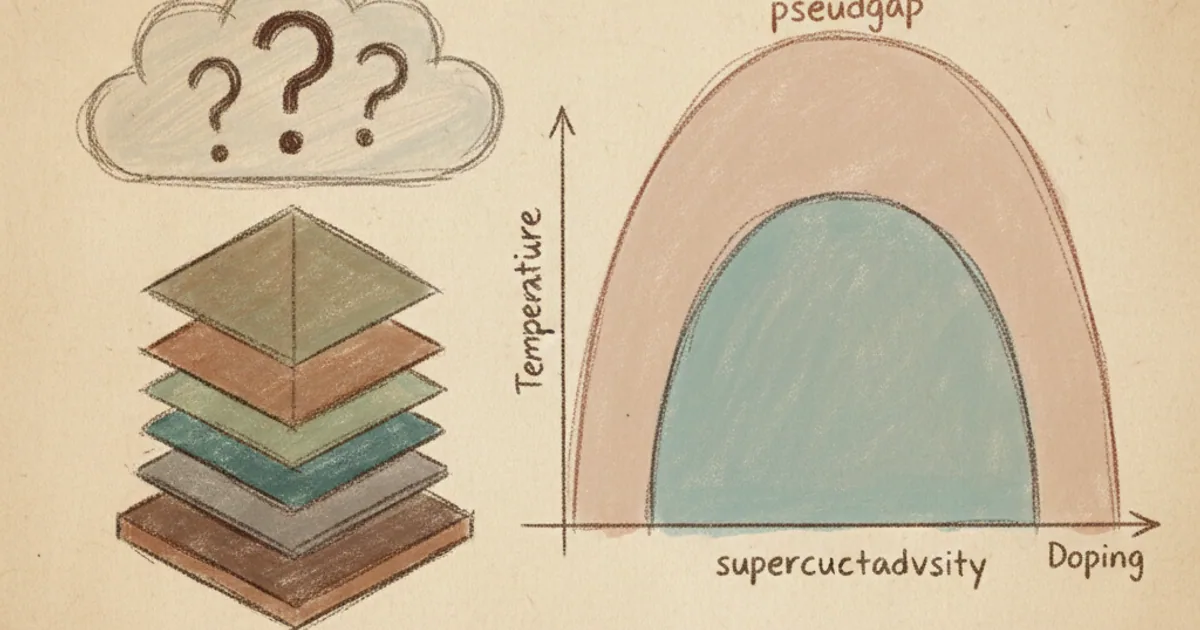
Cuprate superconductors share a common structural feature: layers of CuO₂ planes (copper oxide squares) separated by layers of other atoms ("charge reservoir layers"). The superconductivity happens primarily in these CuO₂ planes.
The parent compound — undoped cuprate — is a Mott insulator with antiferromagnetic order. Strongly correlated electrons sit on copper sites with one electron per site, repelling each other so strongly that they can't move (insulator), and aligning their spins antiparallel with neighbors (antiferromagnet).
Adding charge carriers (by doping with other atoms or by introducing oxygen vacancies) breaks the antiferromagnetic order and produces a sequence of unusual phases:
- Antiferromagnetic insulator: at zero doping.
- Pseudogap: at low doping, a strange state with a partial energy gap above Tc and complex order parameters that aren't fully understood.
- Superconductor: at moderate doping, with Tc forming a "dome" — rising from zero, peaking at optimal doping, falling back to zero at higher doping.
- Strange metal: at high temperature above the dome, with resistivity proportional to T rather than T² (unusual; standard Fermi liquid theory predicts T²).
- Normal Fermi liquid: at very high doping.
The phase diagram looks like nothing in conventional superconductors. Multiple competing electronic orders, strong correlations, and unusual transport properties all point to physics that BCS doesn't capture.
What's "wrong" with BCS for cuprates
Conventional BCS theory has well-established predictions for any phonon-mediated superconductor:
Tc scales with the phonon-cutoff frequency and the electron-phonon coupling strength, with a specific formula involving exponentials. For typical metals, this caps Tc at about 30 K (the classic "McMillan limit").
Pairing symmetry is s-wave: the Cooper pair has a uniform sign across the Fermi surface.
Isotope effect: Tc varies with the lattice atom mass M roughly as Tc ∝ M^(-0.5).
Energy gap ratio: 2Δ(0)/kTc ≈ 3.52 (universal for weak-coupling BCS).
Specific heat: characteristic exponential dependence at low temperature.
In cuprates, NONE of these standard predictions holds cleanly:
Tc up to 138 K (ambient pressure) exceeds any reasonable phonon-mediated limit by a factor of several. Some extended phonon theories try to push this up, but the structural and chemical features of cuprates don't support it.
Pairing is d-wave: the Cooper pair has nodes (zeros) where the gap changes sign. Confirmed by phase-sensitive experiments. d-wave pairing typically arises from non-phonon mediators (specifically antiferromagnetic spin fluctuations).
Isotope effect is anomalously small: α ≈ 0.05-0.1 instead of 0.5. This is very inconsistent with phonon-only mediation.
Energy gap ratio: 2Δ/kTc ≈ 4-8, far from BCS weak-coupling. Strong-coupling extensions help but don't fully fit.
Specific heat and transport: don't follow standard BCS predictions in detail. The strange-metal phase above Tc has resistivity ∝ T which itself is unexplained.
The combination strongly suggests cuprate pairing is NOT phonon-mediated, or at least not only phonon-mediated.
Leading theories
Several competing frameworks have been proposed for the cuprate mechanism:
Antiferromagnetic spin fluctuations
The most-cited candidate. Argument: the parent compound is antiferromagnetic; doping disrupts the long-range order but spin fluctuations remain. These fluctuations could mediate an attractive interaction between electrons, with d-wave symmetry naturally arising.
Many calculations have shown this is plausible. Quantitative agreement with all experimental details is still debated. But this is widely considered the leading candidate.
Resonating Valence Bond (RVB)
Proposed by Philip Anderson (Nobel laureate) immediately after the cuprate discovery. Argument: the doped Mott insulator has a "resonating valence bond" state where pairs of electrons form a fluctuating network of singlet bonds. Superconductivity emerges from this background.
RVB has been mathematically formalized in various ways. It captures some cuprate phenomenology but hasn't produced a universally accepted quantitative theory.
Stripes and electronic inhomogeneity
Cuprates show evidence of "stripe" phases: charge and spin alternations in real space at the nanoscale. Some theories propose superconductivity arises from coupling between these inhomogeneous patterns. Still being investigated.
Phonon-plus mechanisms
Some theories propose phonons play a role but are augmented by other interactions (electron-electron correlations, charge transfer). Hybrid mechanisms could reach the observed Tc but at the cost of more parameters and less universality.
Quantum criticality
Cuprates may be near a "quantum critical point" — a phase transition at zero temperature where fluctuations dominate. The strange-metal phase could be a quantum-critical state, and superconductivity could be enhanced by these fluctuations.
This framework has been pursued vigorously and produces some testable predictions, but no complete theory yet.
Iron-based superconductors
Discovered in 2008 (by Hideo Hosono's group at Tokyo Institute of Technology). A separate family of high-Tc materials based on layered iron-pnictide and iron-chalcogenide compounds. Tc up to ~55 K at ambient pressure, ~65 K in monolayer films.
The pairing in iron-based superconductors is also non-standard:
- Different gap structure ("s±" or extended s-wave) than cuprates' d-wave.
- Different parent compound: parent is antiferromagnetic metal, not insulator.
- Different sensitivities to doping and pressure.
Many physicists hoped iron-based superconductors would unlock cuprate mysteries by providing a second example to compare. Some progress but also new puzzles — the two families have important differences as well as similarities.
Hydride superconductors under extreme pressure
Starting in 2015, a different route to high Tc opened up: hydrogen-rich materials under extreme pressure.
The theoretical idea (Neil Ashcroft, 1968): hydrogen, being the lightest element, would have very high phonon frequencies (since phonon frequency ∝ 1/√M). High phonon frequencies in standard BCS allow high Tc — Ashcroft proposed metallic hydrogen could be a room-Tc superconductor. The catch: stable atomic metallic hydrogen requires extraordinarily high pressures (estimates around 350-500 GPa, depending on the specific phase). Hydrogen-rich compounds (hydrides) can reach the relevant regime at lower pressures (~100-200 GPa) — still extreme but achievable in diamond anvil cells.
The 2015 breakthrough: H₃S (hydrogen sulfide) at 155 GPa pressure shows Tc ≈ 203 K. Confirmed by multiple groups. Followed by LaH₁₀ (lanthanum hydride) at 170 GPa pressure showing Tc ≈ 250-260 K.
These hydride superconductors are believed to be CONVENTIONAL BCS — phonon-mediated, with the unusually high Tc coming from the high hydrogen phonon frequencies. The pressure compacts the structure, increases electron-phonon coupling, and pushes Tc into the room-temperature range.
But: 150-170 GPa is in the millions of atmospheres. Reaching such pressures requires diamond anvil cells (small samples, hard to study in detail). The hydrides aren't practical materials — they exist only inside diamond anvils. The achievement is scientific: it confirms that very high Tc is achievable via phonon mechanisms, IF you can get the right structure.
Translating this to room-Tc at ambient pressure is the holy grail. Several recent claimed discoveries have failed independent replication. The field continues actively.
The 2023 LK-99 saga
In July 2023, a Korean group (Sukbae Lee, Ji-Hoon Kim) claimed to have discovered ambient-pressure room-temperature superconductivity in LK-99 (a copper-doped lead apatite). Videos showing partial levitation of the material went viral. Replication attempts began worldwide within days.
Over the following weeks:
- Multiple independent groups synthesized samples following the published recipe.
- None observed convincing zero resistance.
- The "levitation" was attributed to diamagnetism (a normal property of many materials) combined with crystal anisotropy.
- The temperature anomaly in resistivity was attributed to a phase transition in copper sulfide impurities.
By late 2023, the consensus was that LK-99 was not a superconductor at room temperature, ambient pressure, or anywhere else relevant. The original claim was retracted in spirit (though formal retraction has been delayed).
The episode was instructive about the field: high-profile claims, rapid (open-data) verification efforts, eventual consensus through independent replication. The same pattern has repeated several times over the years with various claimed room-Tc materials.
Recent developments and the 151 K result
In 2026, the Texas Center for Superconductivity at the University of Houston reported a new result: a pressure-quench protocol applied to the Hg-cuprate produced ambient-pressure superconductivity at 151 K. This is now the highest confirmed ambient-pressure Tc.
The mechanism: applying high pressure during synthesis stabilizes a different oxygen configuration in the cuprate that has higher Tc. Releasing the pressure can preserve this metastable state, locking in the higher Tc at ambient conditions.
If this result replicates broadly, it provides another lever for pushing Tc higher — though 151 K is still far from room temperature, and the cooling cost difference between 138 K and 151 K is modest.
What would room-Tc actually change?
If ambient-pressure room-Tc superconductors existed and were practical to manufacture:
Energy transmission: lossless power lines could span continents, eliminating the ~5-7% of energy lost in transmission today. Long-distance HVDC could be replaced by even more efficient superconducting cables.
Energy storage: superconducting magnetic energy storage (SMES) at grid scale becomes feasible.
Magnetic levitation: maglev transport becomes much cheaper and more widespread.
Electronics: lower-power, faster digital systems possibly. Lossless inductors and resonators. Compact, powerful electromagnets for every application.
Medical imaging: MRI machines without the helium cooling system would be much cheaper, smaller, more widely deployable.
Quantum computing: many quantum architectures depend on superconducting circuits; room-Tc operation would dramatically simplify systems.
Fusion: tokamak magnets without cryogenics.
The economic impact would be enormous — comparable to the impact of semiconductors in the 20th century.
This is why despite many false starts, the search continues — backed by sustained funding and growing theoretical understanding.
The takeaway
In 1986, Bednorz and Müller discovered superconductivity in copper oxides at unexpectedly high temperatures, soon pushed above the liquid nitrogen boiling point (77 K) and eventually to 138 K at ambient pressure (and 151 K via the 2026 Houston pressure-quench protocol). The microscopic mechanism in these cuprates is still not fully understood after nearly 40 years. Conventional BCS phonon-mediated pairing can't produce these Tc values; antiferromagnetic spin fluctuations, RVB-style states, and quantum criticality are leading theoretical candidates, but no complete quantitative theory exists. Iron-based superconductors (2008) provide a second family with non-BCS pairing and similar mysteries. Hydride superconductors under extreme pressure (since 2015) reach 200-250 K but require millions of atmospheres of pressure — scientifically exciting but not yet practical. The search for ambient-pressure room-temperature superconductors continues; the practical impact if discovered would be transformative across energy, electronics, transport, and medical imaging.

Comments 0
No comments yet. Be the first to share your thoughts.