
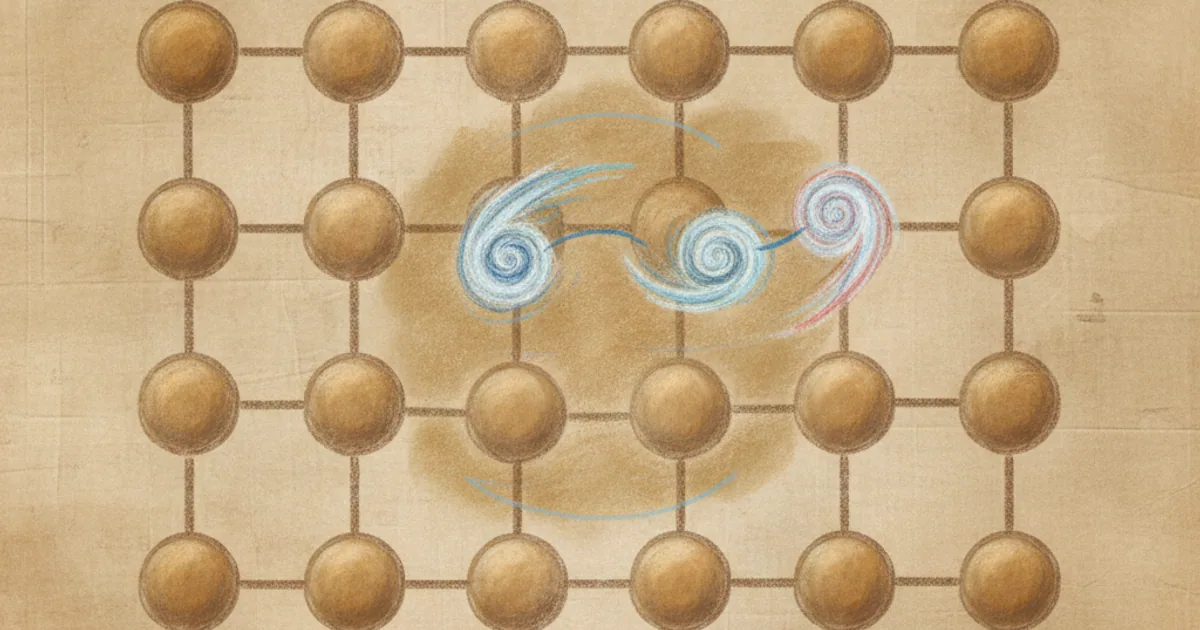
The seemingly impossible thing
Two electrons normally repel each other. Both are negatively charged; the Coulomb interaction pushes them apart with a force that scales as 1/r². Bringing them close together costs energy.
Yet in a superconductor, electrons pair up into stable bound pairs. They stay paired indefinitely (at low temperature), and the pair behaves as a single composite particle with different quantum properties than the individual electrons. The pair has zero net spin (the two electrons have opposite spins), zero net momentum (opposite momenta), and can occupy the same quantum state as many other Cooper pairs — which would be impossible for individual electrons (Pauli exclusion).
How can repelling particles pair up?
The answer is indirect attraction mediated by the lattice. The electron-electron interaction is repulsive directly, but the lattice can act as a "matchmaker" that mediates an effective attraction.
The mediator: the crystal lattice
In a metal, conducting electrons move through a periodic lattice of positively-charged ions. The ions aren't fixed — they vibrate around their equilibrium positions, with the vibration energy quantized as phonons.
Imagine a single electron passing through the lattice. Its negative charge briefly attracts nearby positive ions, pulling them slightly toward it. After the electron passes, the ions oscillate back toward their equilibrium positions — they overshoot slightly, then settle.
For a brief time after the electron has moved on, there's a region of slightly higher positive-ion density along its path. This region has an effective positive charge — and a second electron passing through it experiences attraction to that positive concentration.
So the lattice acts as a "memory" of the first electron's path, creating a region of attraction that a second electron can fall into. The two electrons effectively attract each other — through the lattice.
This is the mechanism BCS theory (Bardeen, Cooper, Schrieffer, 1957) put on rigorous footing.
The Cooper-pair geometry
In the standard BCS ground state of a conventional superconductor, the bound pair has specific properties:
Opposite momenta (in the equilibrium ground state): the pair is formed from time-reversed states |k,↑⟩ and |−k,↓⟩ — opposite momenta and opposite spins. The pair has zero net center-of-mass momentum. In a current-carrying superconductor or unconventional pairing states (FFLO, certain heavy-fermion systems), the pair can have nonzero center-of-mass momentum.
Opposite spins (in singlet pairing): the most common case. Pair total spin is zero, making the pair a composite boson with integer total spin. Spin-triplet superconductors also exist (superfluid ³He, candidates like Sr₂RuO₄) where the pair has total spin 1 — still a composite boson because integer total spin is what matters for bosonic statistics, not specifically spin zero.
Spatially extended: The two electrons aren't tightly bound like a chemical bond. They're correlated over a long distance — the coherence length ξ — which in conventional superconductors is typically 50-1000 nm. Within this distance, many other electrons are present; the pair correlation is statistical, not a tight orbit.
A useful mental image: don't picture two electrons holding hands. Picture two electrons separated by a "communication zone" of about 1000 atomic spacings, with the lattice mediating an attractive force between them. Within that zone, many other electrons are coming and going, also in their own pair correlations.
The energy gap
When pairs form, the system enters a lower-energy state than the normal metal. The pair's binding energy is small — much smaller than typical electron Fermi energies — but it produces a crucial feature: an energy gap Δ between the superconducting ground state and the lowest excitation.
To break a pair and excite a single electron, you need at least 2Δ of energy. At temperatures below Tc, thermal energy kT is much smaller than 2Δ, so pair-breaking is exponentially suppressed.
The gap is what produces zero resistance: an electron can't lose energy by scattering off a phonon or impurity because there are no available low-energy excitations to scatter into. The next available state is above the gap, requiring energy that's not available at low temperature.
Typical gap values:
- Aluminum: Δ ≈ 0.18 meV at Tc = 1.18 K. So 2Δ ≈ 0.36 meV.
- Niobium: Δ ≈ 1.55 meV at Tc = 9.26 K. So 2Δ ≈ 3.1 meV.
- Lead: Δ ≈ 1.4 meV at Tc = 7.2 K. So 2Δ ≈ 2.8 meV.
- YBa₂Cu₃O₇ (YBCO): Δ ≈ 20-30 meV at Tc ≈ 92 K. So 2Δ ≈ 40-60 meV.
BCS theory predicts a specific universal ratio for conventional superconductors:
2Δ(0) / kT_c ≈ 3.52
This holds well for most BCS superconductors. High-Tc cuprates significantly exceed this ratio (often 4-8), suggesting they're not standard BCS — see why high-temperature superconductors are mysterious.
The isotope effect: a smoking gun
If the pairing is mediated by lattice vibrations, then the lattice mass should matter. Heavier atoms vibrate at lower frequencies; lighter atoms at higher frequencies. The phonon spectrum determines the effective electron-electron attraction.
The isotope effect: replace the lattice atoms with different isotopes (same chemistry, different masses), and Tc shifts.
For conventional BCS superconductors, the prediction is:
Tc ∝ M^(-α) with α ≈ 0.5
Where M is the lattice isotope mass.
Experiments on mercury, lead, tin and similar elements confirm this with α typically near 0.5. This is the strongest experimental evidence that pairing IS phonon-mediated in conventional superconductors.
In high-Tc cuprates, the isotope effect is much weaker — α ≈ 0.05-0.1 — which is one of the puzzles. Whatever mediates the pairing in cuprates, it's not (only) phonons.
Why does pairing only happen at low temperature?
The effective electron-electron attraction is weak — much smaller than the direct Coulomb repulsion at short distances. It only matters at distances comparable to the lattice spacing or larger.
At room temperature, electrons in a metal have thermal energy kT ≈ 25 meV. Compare to typical gap values: Δ ≈ 1 meV for niobium. The thermal energy is 25 times the gap. Any pair that forms would immediately be broken by thermal fluctuations.
For pairs to persist, kT must be much less than 2Δ. This typically requires temperatures below ~10 K for conventional superconductors. Above Tc, thermal noise destroys the pairing.
This is also why most metals DON'T become superconducting at any temperature: their effective electron-phonon coupling is too weak, the resulting gap is too small, and the pairing temperature is so low that other physics (such as ferromagnetism, or the loss of mean free path) intervenes first. Some metals (copper, gold, silver) are predicted to be superconducting only at temperatures effectively zero — too cold to be relevant.
The condensate: many pairs in one state
Once you have a population of Cooper pairs, the second piece of magic kicks in: because pairs are bosons (composite particles with integer total spin), many pairs can occupy the same quantum state.
This is a Bose-Einstein-like condensate (with some technical distinctions because the pairs aren't truly bosonic in the Bose-Einstein sense — they're better described as a BCS condensate). Many trillions of pairs collectively occupy a single coherent quantum state described by one macroscopic wavefunction Ψ(r).
The condensate has:
- A definite phase φ(r) at each point.
- A pair density n_s(r) (typically uniform across a bulk superconductor).
- Coherence across macroscopic distances.
This is the "macroscopic quantum state" discussed in what is superconductivity, really. It's what produces all the unusual superconducting properties: persistent currents, Meissner effect, Josephson effect, flux quantization.
Limitations of BCS
BCS theory works extraordinarily well for conventional superconductors — predicting Tc, gap structure, isotope effects, thermal behavior, magnetic field response. It earned the 1972 Nobel Prize.
But BCS in its standard form doesn't fully explain:
High-temperature cuprates (since 1986): Tc up to ~134-138 K for optimally-doped HgBa₂Ca₂Cu₃O₈₊δ at ambient pressure, with Tc enhanced toward ~160 K under high pressure. The standard phonon-mediated mechanism can't produce Tc this high. The pairing in cuprates is widely believed to involve magnetic interactions (specifically antiferromagnetic spin fluctuations), but the exact mechanism is debated 40 years after discovery.
Hydride superconductors under pressure (since 2015): H₃S at 203 K (155 GPa); LaH₁₀ around 250 K (170 GPa). These ARE thought to be conventional BCS — phonon-mediated — but with very high phonon frequencies (because hydrogen is light), giving high Tc. The mechanism is in line with extended BCS theory, but the specific behavior pushes the limits.
Iron-based superconductors (since 2008): a separate family with Tc up to ~55 K. Pairing mechanism appears to involve magnetic interactions, distinct from cuprates.
Heavy-fermion superconductors: certain compounds where pairing involves f-electrons. Unusual pairing symmetries.
Topological superconductors: emerging field where pairing involves topological band structure. Connected to Majorana fermion proposals.
In all of these, the BCS conceptual framework (pairs of electrons, condensate, gap) still applies — but the mechanism creating the attractive interaction isn't the simple phonon-mediated one.
What Cooper pairs are NOT
A few common misconceptions:
Not electrons on top of each other: The pair is a long-range correlation, not a tight orbit. The two electrons are typically separated by hundreds of nanometers in conventional superconductors.
Not just two electrons of opposite spin: In a normal metal, you can find pairs of electrons with opposite spins everywhere. What's special about Cooper pairs is the COHERENT PHASE RELATIONSHIP between the pair members and across the whole condensate.
Not chemical bonds: Chemical bonds are localized electron pairs sharing two atomic orbitals, with binding energies of eVs. Cooper pairs are delocalized correlations across many atoms, with binding energies of meVs.
Not unique to superconductors: Similar pairing physics shows up in some other systems — paired neutrons in atomic nuclei, paired protons, even paired He-3 atoms in superfluid He-3. The mechanism is different in each case but the conceptual framework is similar.
The takeaway
Cooper pairs are bound pairs of electrons formed by an indirect attractive interaction mediated by the crystal lattice. One electron distorts the surrounding lattice; a second electron is attracted to the resulting positive-ion concentration. The pair has opposite momenta and spins, behaves as a composite boson, and can join many other Cooper pairs in a single macroscopic quantum state — the superconducting condensate. The bound state has an energy gap Δ that protects against scattering, producing zero resistance below Tc. BCS theory (1957, Nobel 1972) put all of this on rigorous mathematical footing. The isotope effect (Tc varying with lattice isotope mass) is the strongest experimental evidence for the phonon-mediated mechanism. Conventional superconductors are well-described by BCS; high-Tc cuprates and other exotic superconductors have pairing mechanisms still under investigation.

Comments 0
No comments yet. Be the first to share your thoughts.