
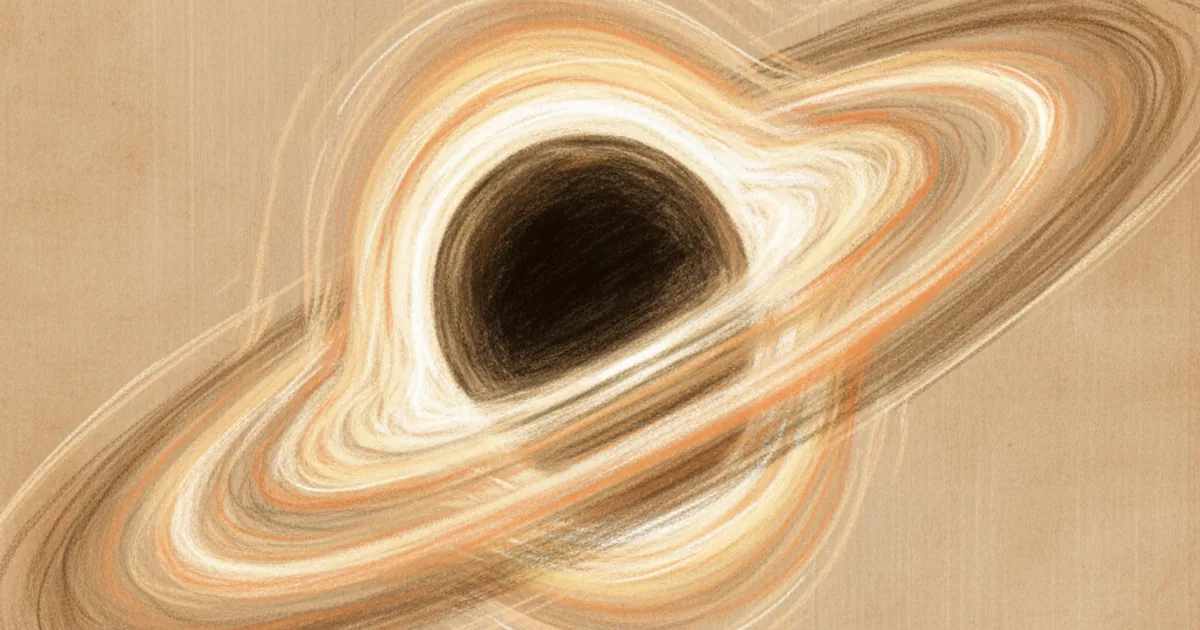
A simple definition
A black hole is a region of space where enough mass is packed into a small enough volume that the escape velocity exceeds the speed of light. Since nothing can travel faster than light (see the relativity articles), nothing inside this region can ever leave.
The boundary of this region — the surface where escape just barely becomes impossible — is called the event horizon. Inside, every direction points further in. The escape velocity isn't actually approaching the speed of light; it's exceeded it. Light itself can't get out.
This is a real, physical region of space, governed by general relativity. We've seen them, photographed two, watched stars orbit invisible ones, and detected the gravitational waves of their mergers. Black holes are not theoretical anymore.
How big the event horizon is
For a black hole of mass M, the event horizon radius (called the Schwarzschild radius) is:
r = 2GM / c²
For a Sun-mass black hole, that's about 3 km. For a 10-solar-mass black hole (typical stellar remnant), about 30 km. For Sagittarius A* at our galaxy's centre (4 million solar masses), about 12 million km — bigger than the Sun itself. For the largest supermassive black holes (tens of billions of solar masses), the event horizon is light-days across.
A black hole isn't necessarily small. It just has a lot of mass in a relatively small region.
How they form
Two main paths:
Stellar collapse. A star massive enough (over ~20 solar masses) burns through its nuclear fuel and undergoes core collapse. If the leftover core is more than about 3 solar masses, no known force can stop the collapse — even the pressure of neutron-degenerate matter (which holds up neutron stars) gives way. The core collapses to a point. The surrounding stuff falls in or gets blown away as a supernova. What's left is a stellar-mass black hole.
Supermassive black holes (galactic centres). Every large galaxy has a black hole at its centre, typically millions to billions of solar masses. How they got so big is an active question. They probably formed early, then grew by absorbing matter and merging with other black holes over billions of years.
Primordial black holes. A speculative third path: pockets of unusually dense matter in the very early universe might have collapsed directly. None have been confirmed.
What's actually inside
According to general relativity (which we have no reason to doubt at black-hole scales except in one specific way), inside the event horizon all timelike paths lead to a central point of zero size and infinite density — the singularity.
This is almost certainly a sign that general relativity is incomplete at very small scales. Real physics doesn't permit infinite densities; some quantum-gravity theory should replace the singularity with something finite. But we don't have a working theory of quantum gravity yet. The interior of a black hole is the most extreme regime where physics breaks.
We can't test the interior. Nothing crosses the event horizon and reports back. The singularity remains a placeholder for physics we haven't figured out.
How black holes interact with surroundings
A black hole is not a cosmic vacuum cleaner. Its gravitational effect at distance is the same as any other object of the same mass. If the Sun magically became a black hole tomorrow, Earth would not be sucked in — it would continue orbiting normally. (It would get very cold, but that's a different issue.)
Within an accretion disk — gas swirling close to the black hole — things heat up dramatically. Friction within the disk releases huge amounts of energy as the gas spirals inward. This is what makes black holes visible. The Event Horizon Telescope's photos show the accretion disk's emission with a dark shadow where the black hole sits.
Some black holes launch enormous jets of plasma perpendicular to their accretion disks. These jets can stretch millions of light-years from active galactic nuclei (galaxies with feeding supermassive black holes). The galaxy M87, whose central black hole was the first photographed, has a kiloparsec-scale jet visible in optical telescopes.
How we know they're real
Several independent lines of evidence:
Star orbits. Stars near the galactic centre orbit something extremely massive but invisible. The orbit of star S2 around Sagittarius A* has been tracked for decades; it requires a 4-million-solar-mass dark object at the focus. The Nobel Prize 2020 went to Genzel and Ghez for this work.
Gravitational waves. When two black holes merge, they emit gravitational waves (ripples in spacetime) detectable by LIGO and Virgo. The first detection in 2015 was a merger of two ~30-solar-mass black holes, 1.3 billion light-years away. Many more detections since. The waveforms match general-relativity predictions for black-hole mergers to high precision.
Direct images. The Event Horizon Telescope (an Earth-sized network of radio dishes) photographed M87*'s accretion disk in 2019 and Sagittarius A* in 2022. Both images show the predicted bright-ring-around-dark-shadow morphology with the right size scales.
X-ray binaries. Many "X-ray binary" systems have one normal star and one invisible compact companion that's too heavy to be a neutron star — meaning it's a black hole pulling matter off the companion and heating it to X-ray-emitting temperatures.
Each line of evidence independently requires the existence of objects with the properties of black holes. The combination is overwhelming.
Hawking radiation
In 1974, Stephen Hawking showed that black holes are not perfectly black. Quantum effects near the event horizon allow them to slowly radiate energy and lose mass over astronomical timescales.
The mechanism: quantum vacuum fluctuations near the horizon occasionally produce particle-antiparticle pairs where one falls in and one escapes. The escaping particles carry energy away. The black hole loses an equivalent amount of mass.
For stellar-mass black holes, Hawking radiation is absurdly slow — the temperature is nanokelvins, the lifetime is 10⁶⁷ years. For tiny primordial black holes, it could be significant.
Hawking radiation is one of the few quantum-gravity predictions we have. It has never been directly observed (the rates are too small), but the theoretical case is strong, and it informs our understanding of black-hole thermodynamics.
If you'd like a guided 5-minute personalized course on black holes — including the photo evidence and the math basics — NerdSip can generate one.
What's still open
Some big open questions about black holes:
- The information paradox. What happens to information that falls into a black hole? Hawking radiation appears to destroy it, but quantum mechanics says information must be preserved. This is one of the central problems in theoretical physics.
- What replaces the singularity. Some quantum-gravity theory presumably resolves the infinite density at the centre.
- The first black holes. When and how did the very first supermassive black holes form? JWST is finding surprisingly massive black holes already in place very early in the universe.
- Wormholes. General relativity allows for connecting black holes via "wormholes" — but they're either unstable or require exotic matter we have no evidence for. Probably not real, but mathematically possible.
The takeaway
A black hole is a region of space where gravity is strong enough that not even light can escape. They form from massive stellar collapse and from billion-year mergers in galactic centres. They're real, photographed, and produce gravitational waves we detect routinely. Their interiors mark a frontier of physics — likely where general relativity breaks down and quantum gravity takes over. They are, plainly, the most extreme places in the universe.

Comments 0
No comments yet. Be the first to share your thoughts.