Subject
Stars, black holes, the Big Bang, the seasons — the universe explained from intuition up, not equations down.
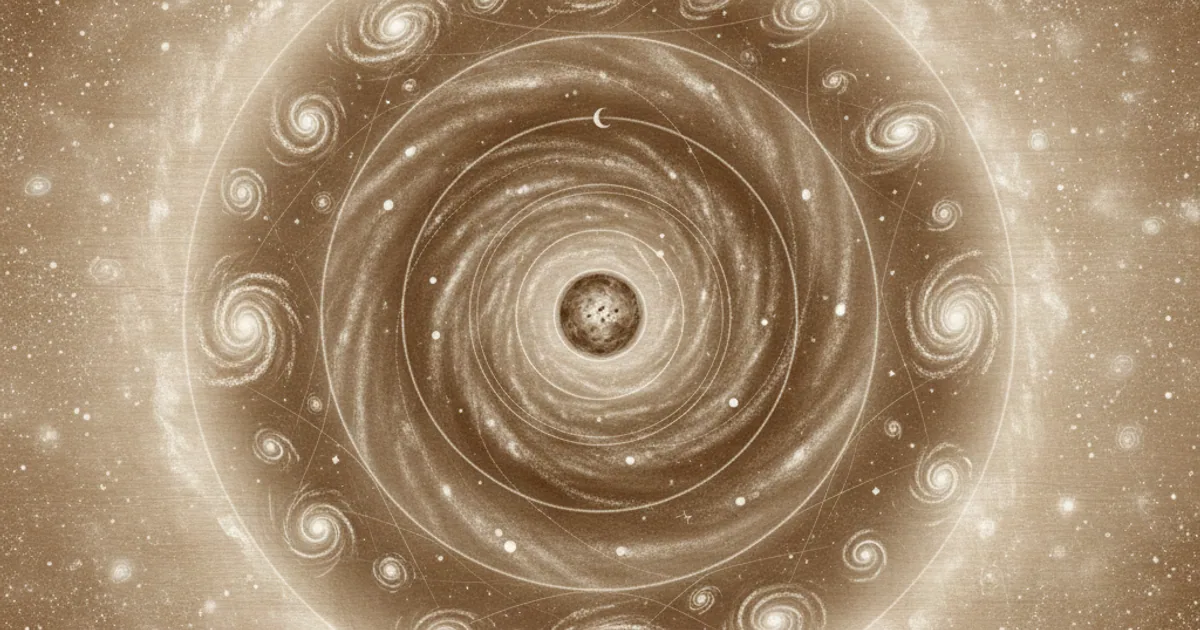
The cosmos is organised in nested scales, each one dwarfing the last. The mistake people make when picturing space is imagining everything at the same scale — as if planets, stars, and galaxies were comparable kinds of objects. They aren't, by many orders of magnitude.
To see the layout, walk up the ladder of scale. Each rung up is roughly 1,000× larger than the one below.
The Solar System is the world of light-seconds, light-minutes, and at its outermost edge, light-hours. We've sent spacecraft (Voyager 1 and 2) to its edge; the trip took 45+ years at over 60,000 km/h.
Distances inside our neighbourhood of stars are light-years. Even our nearest stellar neighbour is over 4 years away at light speed. The Apollo missions reached the Moon in 3 days; reaching Proxima at the same speed would take 134,000 years.
Our galaxy is a flat disc with spiral arms. The Sun sits about halfway out from the centre. We're moving around the galactic centre at about 220 km/s — so the Sun completes one orbit every ~225 million years (the dinosaurs we know of all lived during a single such galactic year).
Galaxies cluster gravitationally into groups; groups into superclusters; superclusters into vast filaments and walls separated by emptier voids — the so-called cosmic web.
Here's where intuition breaks. The observable universe is 93 billion light-years across, but the universe is only 13.8 billion years old. How? Because space itself has been expanding while light has been travelling. Light from distant objects left them when the universe was smaller; the universe has expanded since, stretching out the distances. The light is still arriving from points that are now much farther away.
The observable universe isn't all of the universe — it's just the part close enough that light from it has had time to reach us. The actual universe is larger, possibly infinite. We can't see beyond the observable boundary because the light from there hasn't reached us yet.
When you look at distant things, you're looking at the past. The Moon you see is the Moon as it was 1.3 seconds ago. The Sun you see is 8 minutes old. The closest stars are years to centuries old. The Milky Way's centre is 26,000 years old as you observe it. Andromeda is 2.5 million years old as it appears to you tonight.
The most distant galaxies the James Webb Space Telescope has photographed sent their light when the universe was 200-400 million years old, billions of years before Earth existed. We're literally watching the universe assemble itself in slow motion across all distances.
At distances of about 13.8 billion light-years, you reach a wall called the cosmic microwave background — light emitted when the universe was 380,000 years old and first became transparent. Before that moment, the universe was a hot opaque plasma; light couldn't travel through it. So we can't see anything older than the CMB by direct light.
Different signals can in principle probe even earlier moments. Gravitational waves and neutrinos passed through the early plasma freely. But we don't yet have detectors sensitive enough to see them from the very early universe.
To make all of this concrete:
You cannot visually picture the universe to scale. The mind is not built for it. The yardstick is light travel time, and at every step up the scale, it stretches by a factor of thousands.
If you'd like a guided 5-minute course on cosmic scales with quizzes, NerdSip can generate one on this topic.
The universe is nested: planets around stars (light-minutes), stars in galaxies (thousands of light-years), galaxies in groups and superclusters (millions of light-years), all inside an observable universe 93 billion light-years across. Light travel time is the unit, and every observation of something distant is also an observation of the past. We sit halfway out from the centre of one ordinary galaxy in one ordinary supercluster, watching the universe still unfolding in light that has been travelling for billions of years.
A short editorial reading list. Pick whichever fits how you like to learn.


Comments 0
No comments yet. Be the first to share your thoughts.