
A ball-of-gas fight
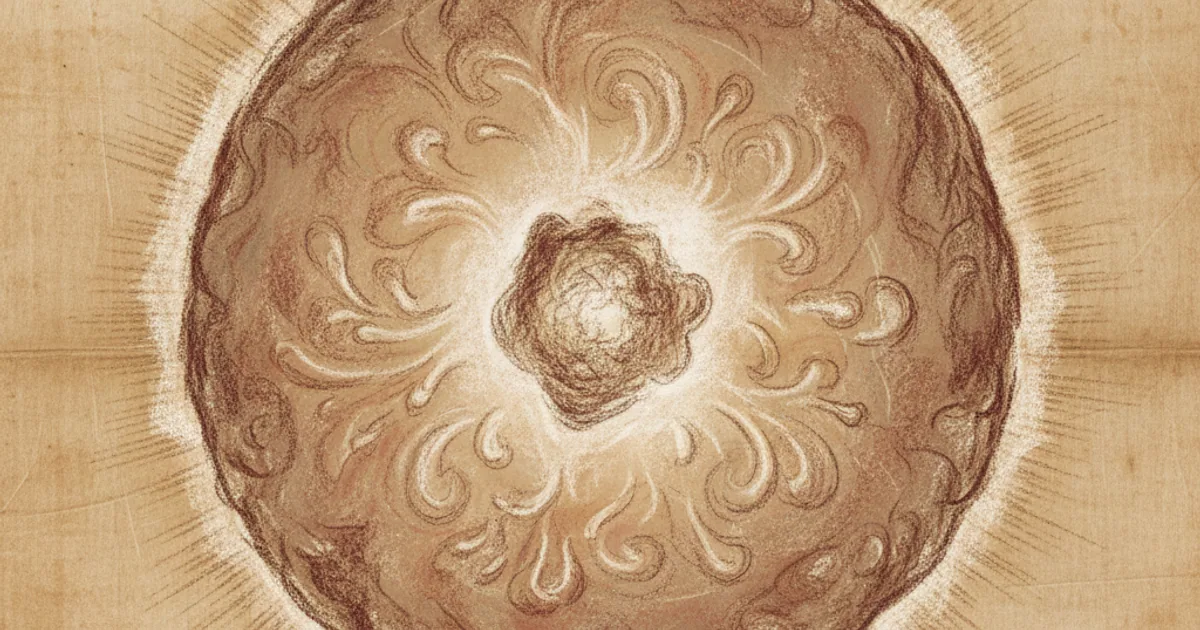
A star is a ball of hydrogen so big that gravity is trying to crush it, and the only thing stopping that crush is fusion in the core pushing outward. Stars exist in the balance between these two forces.
When gravity wins, the star collapses. When fusion wins, the star expands. The remarkable thing is how stable this fight is — stars like the Sun maintain the balance for 10 billion years, give or take.
How fusion gets started
A star starts as a cloud of hydrogen gas. Gravity pulls the cloud inward. As the cloud collapses, its centre heats up — compression always heats a gas.
If the cloud is massive enough (about 8% of the Sun's mass), the core temperature eventually reaches about 10 million °C. At that temperature, hydrogen nuclei are moving so fast that some of them collide with enough energy to fuse, despite their mutual repulsion (both have positive charge).
The fusion reaction merges four hydrogen nuclei into one helium nucleus. The helium nucleus weighs slightly less than four hydrogens — the missing mass is released as energy, by E=mc² (see the E=mc² article).
In the Sun's core, this happens about 10³⁸ times per second, releasing 380 billion billion megajoules per second. That's the energy that makes the Sun shine — and that pushes outward against gravity to keep the star inflated.
The Sun in numbers
Some specifics about our star:
- Mass: 333,000 Earth masses.
- Diameter: 1.4 million km (109 Earths across).
- Core temperature: ~15 million °C.
- Surface temperature: ~5,500 °C.
- Hydrogen burned per second: ~600 million tons.
- Mass converted to energy per second: ~4.3 million tons.
- Age: 4.6 billion years.
- Remaining hydrogen-burning lifetime: ~5 billion years.
The Sun has been doing this since before Earth formed and will keep doing it for roughly as long as Earth has existed so far. From a human timescale, stars are effectively eternal.
Why bigger stars die younger
Counterintuitively, more massive stars have shorter lives.
A star with 10 times the Sun's mass has more hydrogen to burn. But it also burns it much faster — the more massive star has stronger gravity, so its core is hotter and denser, so the fusion rate is enormously higher. The fusion rate grows faster than the fuel supply.
Net result:
- Stars 0.1× the Sun's mass: live 10 trillion years (longer than the universe has existed).
- Stars 1× the Sun's mass: 10 billion years.
- Stars 10× the Sun's mass: 30 million years.
- Stars 100× the Sun's mass: 2-3 million years.
The biggest stars in the universe live so briefly (by stellar standards) that you couldn't have seen them in the night sky a few million years ago — they didn't exist yet.
The end of hydrogen
Eventually a star runs out of hydrogen in its core. What happens next depends on its mass.
For a Sun-like star (under ~8 solar masses):
- Hydrogen runs out in the core. Fusion stops there. Gravity wins. The core contracts.
- The core gets denser and hotter from the contraction. Hydrogen in a shell around the core starts fusing instead.
- The outer layers swell up. The star becomes a red giant, hundreds of times its original size. The Sun, when this happens in 5 billion years, will engulf Mercury, Venus, and probably Earth.
- The core gets hot enough to fuse helium. This buys some more time, but only briefly compared to the hydrogen-burning phase.
- The outer layers drift away. What's left is a hot, dense core called a white dwarf — Earth-sized but with the mass of a star, slowly cooling for billions of years.
For massive stars (over ~8 solar masses), the sequence goes further:
- After helium, the core fuses heavier elements. Carbon, then oxygen, neon, silicon — each shorter than the last.
- Eventually the core reaches iron. Iron is the end of the line — fusing iron absorbs energy rather than releasing it. The core can't generate any more pressure.
- Gravity wins catastrophically. The core collapses in a fraction of a second, and the outer layers crash inward, rebound, and explode as a supernova.
- What's left depends on mass. Most of the mass blasts outward, seeding the galaxy with heavy elements. The leftover core becomes either a neutron star (a ball of pure neutrons, 20 km across with the mass of two Suns) or, for the most massive stars, a black hole (see the black hole article).
Where the heavy elements come from
Every chemical element heavier than iron in your body — gold in any jewelry you've ever worn, iodine in your thyroid, every atom that isn't hydrogen, helium, lithium — was forged in dying stars.
Specifically:
- Lighter elements up to iron: fused in stars' cores during their lives.
- Heavier elements (up to roughly bismuth): forged in supernova explosions.
- The heaviest elements (gold, platinum, uranium): formed in neutron-star mergers — collisions between dead stellar cores.
The carbon in your DNA, the calcium in your bones, the iron in your blood — all of it was nuclear-baked inside stars that exploded billions of years ago, then scattered into the gas clouds that eventually formed our Solar System. The famous Carl Sagan line — "we are star stuff" — is meant literally.
Why stars take 100,000 years to glow
A photon produced in the Sun's core doesn't fly straight out. The Sun is so dense that photons get absorbed and re-emitted billions of times on their way to the surface. The diffusion process takes roughly 100,000 years.
Once the photons reach the photosphere (the visible surface), they fly to Earth in 8 minutes. So when you see sunlight, you're seeing energy that left the Sun's core when humans were starting to migrate out of Africa.
If you'd like a 5-minute personalized course on stars, fusion, and the periodic table's origin, NerdSip can generate one for you.
What we still don't fully understand
Despite a century of stellar astrophysics, some things remain open:
- Massive star formation. Why and how stars above ~50 solar masses form is incompletely understood.
- Supernova mechanics. The exact way the core collapse drives the explosion is still being modelled.
- Neutron-star interiors. The matter at neutron-star densities is the densest stable form of matter, and its physics is the frontier of nuclear theory.
- The first stars. Stars that formed within the first few hundred million years after the Big Bang — Population III stars — have never been directly observed. Their properties are still partly inferred.
The James Webb Space Telescope is currently making the first direct observations relevant to several of these questions.
The takeaway
A star is a balance between gravity (trying to compress) and fusion (pushing back with energy from converting hydrogen to helium). The balance is stable for millions to trillions of years depending on mass. When fusion can no longer keep up, the star dies — either gently as a white dwarf or violently as a supernova — and seeds the universe with the heavy elements that everything from your bones to your phone's circuitry is made of. The night sky is a slow-motion factory for chemistry.

Comments 0
No comments yet. Be the first to share your thoughts.