
Two theories, one author
When people say "relativity," they usually mean one of two distinct theories, both due to Einstein:
- Special relativity (1905): how things move at constant velocity, when gravity isn't involved.
- General relativity (1915): how gravity actually works, treated as the geometry of spacetime.
The first is built on one strange-sounding postulate. The second extends it to include gravity, and produces some of the most counterintuitive predictions ever confirmed.
The other articles in this cluster cover why time slows down, E=mc² unpacked, why gravity isn't a force, and the twin paradox. This is the orientation.
Special relativity, in two postulates
Einstein 1905, summarised:
- The laws of physics are the same for every observer moving at constant velocity. No experiment you can do inside a sealed train car can tell you how fast the train is moving — only that it's not accelerating.
- The speed of light in vacuum is the same for every such observer. No matter how fast you're moving toward a flashlight, the light from it arrives at exactly the same speed (about 299,792,458 m/s) as if you were standing still.
Both postulates seem reasonable on their own. Combined, they force a complete rewrite of what space and time are.
Why? Because if light's speed is the same for everyone, and speed is distance over time, then either the distance or the time (or both) must be different for different observers. Einstein worked out what the consequences are.
The consequences
Time dilation. A clock moving past you ticks more slowly than a clock at rest beside you. Not as an illusion or a measurement artifact — the moving clock genuinely accumulates less elapsed time. The effect is tiny at everyday speeds (nanoseconds per day for a fast plane) but huge at near-light-speed.
Length contraction. Objects moving past you are shorter (along the direction of motion) than they are when at rest. Again, not an illusion — physically shorter, in your frame.
Relativity of simultaneity. Two events that look simultaneous to you may not look simultaneous to a moving observer. There's no universal "now" — only "now in this reference frame."
E = mc². Mass and energy are interconvertible. Mass is just very compact energy. (See E=mc² unpacked for what this actually means and what it doesn't.)
Speed limit. Nothing with mass can be accelerated to the speed of light — it would require infinite energy. Massless things (photons) travel at light speed always. The speed of light is the universal cap.
These were all derived in 1905. Every one has been experimentally verified to absurd precision.
General relativity, in one principle
The leap from special to general happened over the next decade. The trigger was a thought experiment Einstein called "the happiest thought of my life":
A person in free fall feels no gravity.
Inside an elevator falling freely toward Earth, you can't tell — by any local measurement — that you're falling. Things float. You float. The elevator interior is indistinguishable from a sealed box drifting in deep space.
Conversely, a person in a rocket accelerating in deep space feels weight pressing them to the floor. By any local measurement, they can't distinguish that pressing from the gravitational pull of Earth.
This is the equivalence principle: gravity and acceleration are locally indistinguishable.
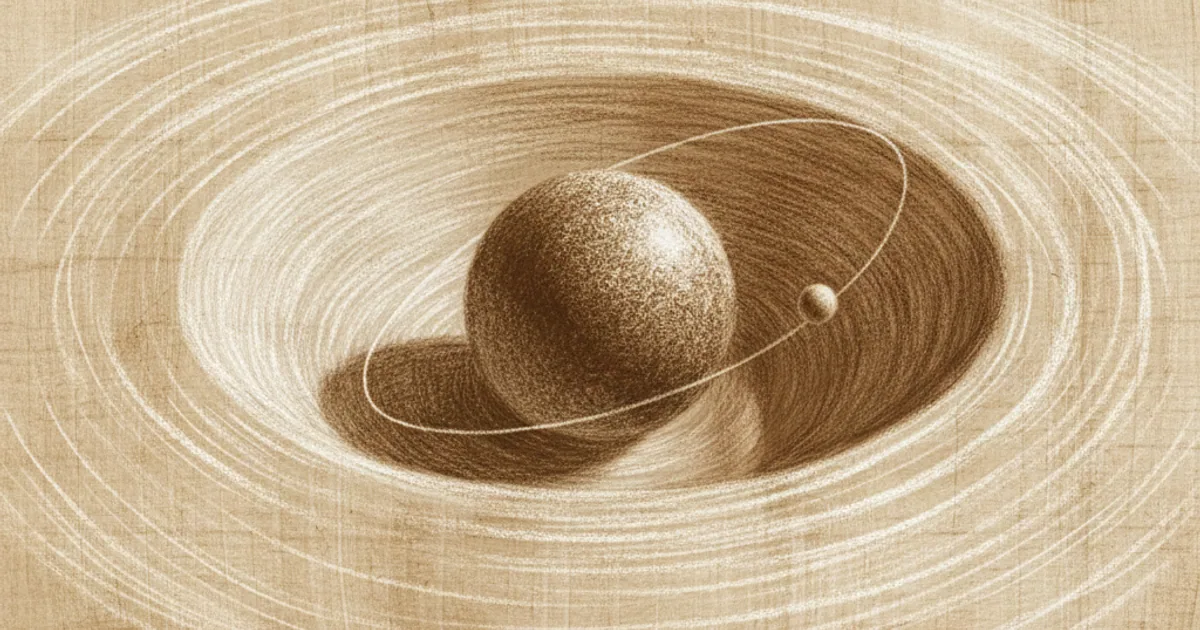
If that's the case, then gravity isn't really a force pulling on objects. It's the way the geometry of spacetime curves near mass — objects in free fall are simply following the straightest available paths through curved geometry.
The geometry payoff
Einstein spent eight years working out the mathematical machinery (Riemannian geometry, tensor calculus, with significant help from Marcel Grossmann and others). The final result, in 1915, was the Einstein field equations:
Gᵤᵥ = 8πG/c⁴ · Tᵤᵥ
This is one symbolic statement. Underneath, it's ten coupled nonlinear partial differential equations. In words: mass-energy curves spacetime; the resulting curvature is what we experience as gravity.
Newton's gravity, in this framework, is what you get when curvature is small and velocities are slow. It's not wrong — it's a low-energy approximation. General relativity is the more complete theory.
What general relativity predicted that Newton couldn't
- Bending of starlight by the sun. Confirmed during the 1919 solar eclipse by Eddington, making Einstein an overnight celebrity.
- Mercury's perihelion precession. Mercury's orbit precesses faster than Newtonian gravity predicts. General relativity gives the exact correction.
- Gravitational time dilation. Clocks tick slower in stronger gravity. GPS satellites, in weaker gravity than us, run faster — and the system corrects for this.
- Black holes. Sufficient mass curves spacetime so much that even light cannot escape. Predicted in 1916 (Schwarzschild), photographed in 2019 (Event Horizon Telescope).
- Gravitational waves. Ripples in spacetime from accelerating masses. Detected in 2015 (LIGO).
- Gravitational lensing. Galaxies bending the light from objects behind them, used routinely now to study distant galaxies.
- The expanding universe. The natural prediction of general relativity for a homogeneous universe — Einstein initially patched in a "cosmological constant" to avoid it, then called it his biggest blunder, then dark energy turned out to behave a lot like one.
What relativity is not
It's not "everything is relative." Some things are absolute: the speed of light, the spacetime interval between two events, the rest mass of a particle, causal structure. Relativity is named for what isn't invariant (simultaneity, lengths, durations), but the theory is mostly about what IS invariant.
It doesn't contradict Newton. Newton's laws emerge from relativity in the limit of low velocities and weak gravity. They're correct for almost every problem you'll ever encounter in daily life. Relativity adds corrections that matter at speeds close to c or in strong gravitational fields.
It doesn't allow faster-than-light travel. No information, signal, or matter can move faster than light. Wormholes and warp drives are speculative — they require exotic forms of matter we have no evidence for.
Where it shows up in daily life
- GPS: without relativistic corrections (both special and general), positions would drift by ~10 km per day.
- Gold's colour: the relativistic motion of inner electrons in heavy atoms shifts gold's electronic transitions enough to make it look yellow instead of silver.
- Mercury's slippery feel: same reason — relativistic effects on heavy-atom chemistry.
- Nuclear power and weapons: E=mc² accounts for the energy released when nuclei split or fuse.
- Old cathode-ray TVs: electrons in the tube moved fast enough to need relativistic correction in beam-deflection calculations.
The takeaway
Special relativity rewrote what space and time are by demanding light's speed be the same for everyone. General relativity rewrote what gravity is by treating it as spacetime curvature rather than a force. Both have stood for over a century. Their predictions show up in technology you use daily, and they're the foundation for everything from cosmology to particle physics. The deeper articles in this cluster zoom in on the specific consequences — and if you'd rather build this kind of understanding a little every single day, that's the most reliable way it sticks.

Comments 0
No comments yet. Be the first to share your thoughts.