
What Newton said
Newton's framing, from 1687: every mass attracts every other mass with a force proportional to the product of the two masses and inversely proportional to the square of the distance between them. F = GmM/r².
This works beautifully for designing bridges, launching satellites, predicting eclipses, and almost any practical problem you'll ever encounter. As a calculational tool, it's great.
But it doesn't say what gravity is. Newton himself acknowledged the gap. In a letter to a colleague in 1693, he wrote that the idea of forces acting at a distance through empty space was "so great an absurdity that I believe no man who has in philosophical matters a competent faculty of thinking can ever fall into it." He hoped someone would eventually explain the mechanism.
That someone arrived in 1915.
Einstein's reframe
The starting point is a thought experiment: imagine you're in a sealed elevator with no windows. Two scenarios:
- Scenario A: the elevator is stationary on Earth's surface. You feel your normal weight.
- Scenario B: the elevator is floating in deep space, far from any planet, and accelerating upward at 9.8 m/s². You feel the same weight pressing you to the floor.
By any local experiment you can do inside the elevator — dropping a ball, watching it bounce, weighing yourself — these two scenarios are indistinguishable.
This is the equivalence principle: gravity and acceleration are locally identical.
Einstein took this seriously. If gravity is locally the same as acceleration, then maybe gravity isn't a "force" at all. Maybe it's what happens when you don't move in the simplest possible way through a curved space.
What it actually is
In general relativity, the universe is a four-dimensional spacetime — three space dimensions plus one time dimension, woven together. Mass and energy curve this fabric. The curvature is real geometry.
An object in free fall — like an apple falling from a tree, or you in zero gravity in orbit, or a photon passing near the sun — is just following the straightest possible path through curved spacetime. These straightest paths are called geodesics.
On flat ground, a geodesic is a straight line. On a sphere (like Earth's surface), it's a great circle. In curved spacetime around a mass, geodesics are paths that to a local observer look "straight" but to a distant observer look curved.
The apple falling toward Earth isn't being pulled. It's just following its natural geodesic. What's strange is that you, standing on the ground, are not following yours — the Earth's surface is pushing up against you, deflecting you from the geodesic you'd otherwise be on (which would carry you toward the planet's center).
Why falling feels weightless
This is the test that flips your intuition:
- Standing on the ground: you feel weight.
- In free fall (jumping off a ledge, skydiving before deploying parachute, on the ISS): you feel weightless.
Newton's framing says gravity pulls on you constantly, so why don't you feel that pull when falling? Newton has to add: well, you also feel inertia, and the two cancel in free fall, leaving you weightless.
Einstein's framing says: when you're falling, no force is acting on you. You're just following your geodesic. There's nothing to feel. When you're standing on the ground, the ground is pushing up — that's a real contact force, and that's what you feel as weight.
The Einstein picture matches your experience better. You don't feel gravity when in free fall because there isn't any. You feel the surfaces that prevent you from falling.
The rubber sheet picture
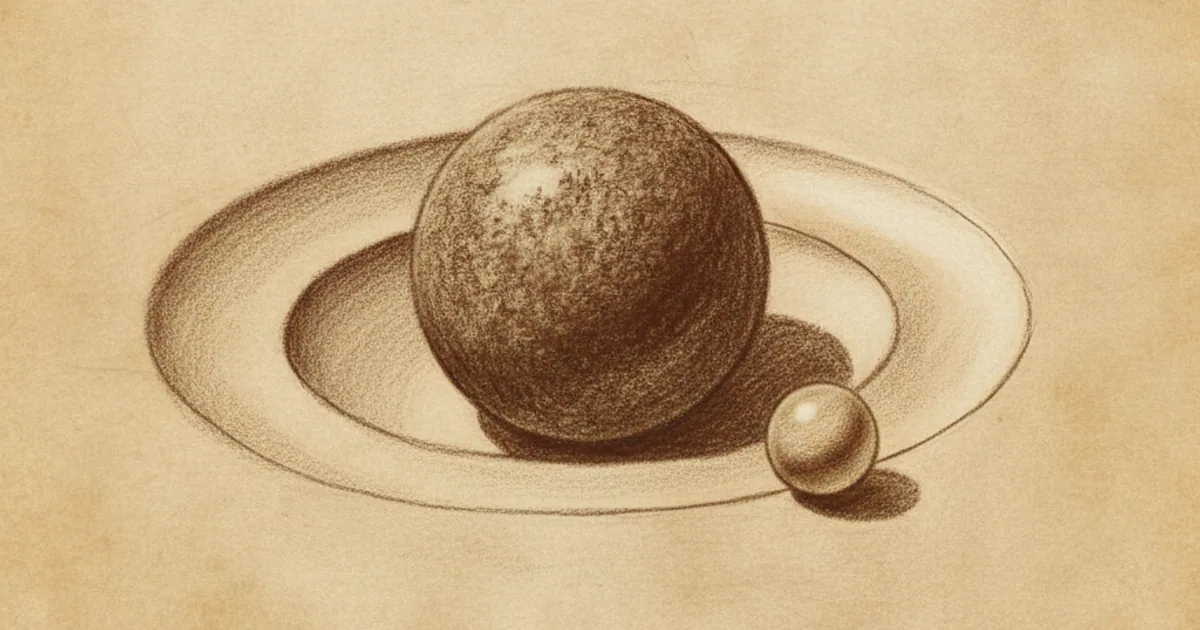
A common visualization: spacetime as a stretched rubber sheet, masses as bowling balls denting it, smaller objects rolling around the dents.
This is a useful first picture, but it's imperfect:
- It's only spatial curvature. Most of the gravitational effects we experience on Earth come from the temporal part of the curvature — time itself runs at different rates at different altitudes. The rubber-sheet picture leaves this out entirely.
- The sheet bends because of another gravity pulling the bowling ball down, which is circular reasoning.
- It's 2D; real spacetime is 4D.
Still, the rubber sheet captures the idea: mass curves geometry, smaller objects follow the resulting paths. Don't take it as a literal model.
What happens in the cleanest experiments
Several predictions of general relativity deviate from Newton's predictions, and the experiments come down on Einstein's side:
Mercury's perihelion shift. Mercury's orbit precesses (the orientation rotates slowly) by about 43 arcseconds per century more than Newton predicts. General relativity gives exactly the right number.
Bending of starlight by the sun. Light grazing the sun deflects by 1.75 arcseconds — twice what a naïve Newtonian "photons have mass" calculation gives. Confirmed in 1919, repeatedly since.
Gravitational time dilation. Clocks deeper in gravity run slower. GPS satellites need this correction or they'd drift 10 km/day. Newton's gravity has nothing to say about clock rates.
Gravitational waves. Spacetime ripples from accelerating masses. Predicted in 1916, detected by LIGO in 2015. Newton's framework can't even formulate them.
Black holes. Sufficient mass curves spacetime so dramatically that even light cannot escape. Predicted in 1916, photographed in 2019.
Newton would have to add ad hoc corrections to handle each of these. Einstein gets them all from one principle: gravity is geometry.
Does it matter for daily life?
Practically: no. F = GmM/r² gives the same numbers as general relativity to many decimal places for everything you'll ever calculate by hand. Engineers and astronomers use Newtonian gravity routinely; they only switch to relativity when the situation calls for it (strong gravity, fast motion, precision timing).
Conceptually: yes. The picture of "things pull on each other across empty space" gives way to "things move along the natural lines of a curved space." It changes what gravity is, even if the numbers come out almost identical.
The takeaway
Gravity isn't a force in the way electricity or friction are. It's the shape of spacetime, sculpted by mass and energy. Objects in free fall are following geodesics — the straightest paths the curved geometry allows. What we feel as "weight" is the contact force that keeps us from following those paths. Newton's framing is a calculationally useful approximation that's exactly right for almost every engineering purpose. Einstein's framing is what's actually happening underneath. Replacing a familiar idea with a deeper one is the best feeling in learning, and the kind you can chase a little every day.

Comments 0
No comments yet. Be the first to share your thoughts.