
The hidden quantum world
Most introductions to quantum mechanics make it sound like a theory of strange laboratory experiments — particles being in two places at once, cats neither alive nor dead, photons traveling through both slits. All true and important (see the quantum-easy cluster). But it can give the impression that quantum mechanics is exotic and irrelevant to daily life.
The opposite is true. You're surrounded by quantum mechanics constantly. Most of modern technology depends on it. Most of chemistry IS it. The colours you see, the rigidity of solid objects, the brightness of LEDs, the operation of every transistor in every computer — all of these are quantum effects in disguise.
This cluster takes the practical view. The quantum-easy cluster covers the conceptual foundations: superposition, entanglement, the double-slit experiment, uncertainty, Schrödinger's cat. This cluster covers what those concepts let us build.
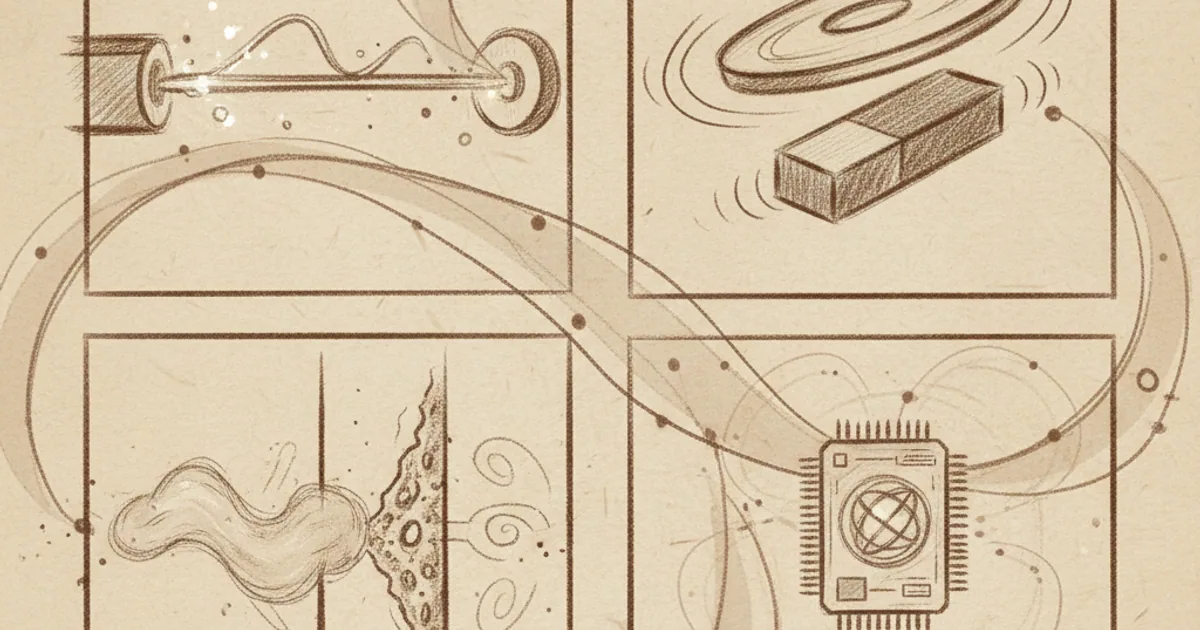
Four big real-world quantum phenomena
1. Quantum tunneling
Classically, a particle that doesn't have enough energy to climb over a barrier should bounce back. Quantum-mechanically, there's a small probability that the particle passes THROUGH the barrier without ever having "had enough energy" — a process called quantum tunneling.
Real-world consequences:
- Flash memory and SSDs: bits are stored by injecting electrons into a "floating gate" insulated from the rest of the circuit. The injection and removal both use quantum tunneling through a thin oxide barrier. Modern flash memory is engineered quantum tunneling at terabyte scale.
- Scanning Tunneling Microscope (STM): tunneling current between a sharp tip and a surface lets us image individual atoms. The current depends exponentially on distance, providing atomic-scale resolution.
- Nuclear fusion in the Sun: protons in the Sun's core don't classically have enough thermal energy to overcome their mutual electrical repulsion and fuse. They tunnel through the Coulomb barrier. Without quantum tunneling, the Sun wouldn't shine, and we wouldn't be here.
- Radioactive alpha decay: alpha particles tunnel out of unstable nuclei. The half-life depends exponentially on the tunneling probability — explaining why uranium-238 has a 4.5-billion-year half-life while polonium-212 has 0.3 microseconds.
- Tunnel diodes and Josephson junctions: semiconductor devices that exploit tunneling for high-frequency operation and quantum-precise voltage references.
Details in quantum tunneling explained.
2. Lasers
A laser exploits stimulated emission — a quantum-mechanical process where an excited atom, hit by a passing photon of the right energy, emits a second photon that's identical to the first (same frequency, same direction, same phase). Chain this up and you get many photons all marching in step: a laser beam.
Real-world consequences:
- Laser pointers, barcode scanners, laser printers: low-power solid-state diode lasers.
- Optical fibers carrying internet traffic: pulses of infrared laser light travel through glass fibers; the whole internet backbone is photons.
- CD/DVD/Blu-ray and fiber data: laser reading and writing of optical media.
- Industrial cutting and welding: high-power CO₂ and fiber lasers cutting metal precisely.
- Eye surgery: LASIK reshapes the cornea with precise ultraviolet laser pulses.
- LIGO: detected gravitational waves from merging black holes using interfering laser beams, sensitive to motions smaller than 1/10,000 the width of a proton.
- Atomic clocks: lasers cool atoms to nano-kelvin temperatures and probe their transitions; the most precise modern optical lattice and trapped-ion clocks reach fractional uncertainties around 10⁻¹⁸–10⁻¹⁹ — corresponding to roughly one second of drift in 30 to 300 billion years.
Details in how lasers actually work.
3. Superconductivity
Below a critical temperature, certain materials lose all electrical resistance and become superconductors. Currents flow indefinitely without losing energy. Magnetic fields are expelled. Quantum mechanics is responsible — electrons pair up (into "Cooper pairs") and behave collectively as a single quantum state.
Real-world consequences:
- MRI scanners: superconducting electromagnets, cooled by liquid helium, produce the 1.5-3 tesla fields used in medical imaging. Estimated 50,000-70,000 MRI machines are operating worldwide (numbers vary by source and grow yearly).
- Particle accelerators: the LHC at CERN uses superconducting magnets to steer protons. Without superconductors, accelerators at LHC scale wouldn't be practical.
- Maglev trains: superconducting levitation for very-high-speed rail. The Japanese Chuo Shinkansen uses superconducting magnets.
- Quantum computers: many quantum computing platforms use superconducting circuits. IBM's, Google's, and Rigetti's quantum processors are all superconducting.
- Power grid components: high-temperature superconducting cables in some demonstration projects; SMES (superconducting magnetic energy storage) for grid stabilization.
- SQUIDs (Superconducting Quantum Interference Devices): ultra-sensitive magnetic field sensors, used in MEG brain imaging, geological prospecting, and physics research.
Details in how superconductors work.
4. Quantum computing
Conventional computers use bits that are 0 or 1. Quantum computers use qubits that can be in superpositions of 0 and 1, and that can be entangled with each other. For certain problem classes, this enables exponentially faster computation.
Real-world consequences (as of mid-2026):
- Working quantum computers with hundreds to over a thousand physical qubits, operated by IBM, Google, Quantinuum, IonQ, Rigetti, and various academic groups.
- Demonstrations of "quantum advantage" for narrow benchmark problems (sampling, certain optimization tasks).
- Experimental applications in chemistry simulation (calculating molecular properties), optimization (scheduling, routing), and machine learning.
- Anticipated future applications: factoring large numbers (breaking current cryptography), simulating quantum systems for materials and drug design, certain optimization problems.
Practical large-scale quantum computers — millions of error-corrected logical qubits — are still 5-15 years away by most estimates. But the trajectory is real, and major nations are investing billions in development.
Details in what quantum computing actually is.
Less famous but everywhere: quantum effects you don't notice
Beyond the headline applications, quantum mechanics underpins much more:
The colour of everything. Atoms and molecules absorb specific wavelengths of light because electrons jump between specific quantized energy levels. Different substances have different energy-level patterns, so they absorb different wavelengths, so they look different colours. The redness of blood (hemoglobin's iron complex), the green of grass (chlorophyll), the blue of the sky (light scattering off molecules), the brilliance of gold (relativistic quantum effects on its electrons) — all quantum. See why things have colour and what makes gold yellow.
The rigidity of solids. Why can't your hand pass through a table? Pauli exclusion principle: no two electrons can occupy the same quantum state. The electrons in the table and your hand resist sharing space. This isn't "the electrons push each other with electrostatic force" — it's a fundamentally quantum effect that prevents matter from collapsing into itself.
The structure of atoms. Why don't electrons just fall into the nucleus? Quantum mechanics. Electrons occupy specific allowed orbits (quantized energy levels); they can't spiral in continuously because there are no allowed states with smaller and smaller energy. The smallest hydrogen orbit has a specific size (~53 pm, the Bohr radius), set by Planck's constant. Without this quantum stability, atoms couldn't exist.
The whole of chemistry. Chemical bonds, reaction rates, molecular shapes, acidity, hydrogen bonding, why water is weird — all quantum mechanics. The reason molecules have specific structures and not others, the reason some atoms bond and others don't, the reason reactions proceed at the rates they do — pure quantum mechanics, calculated from Schrödinger's equation.
Every transistor and LED. Semiconductor band structure is a quantum-mechanical concept. The bandgap that makes a material a conductor, insulator, or semiconductor is set by quantum mechanics. Every computer chip, every LED, every solar cell exploits this. Total transistors ever fabricated is now in the ~10²² range and growing, so the count of transistors operating worldwide is plausibly 10²²–10²³ — all functioning because quantum mechanics describes how electrons behave in periodic crystal lattices.
Black-body radiation and the colour of hot things. Hot iron glows red, hotter glows white. This is black-body radiation, the very problem that started quantum mechanics in 1900 when Max Planck introduced quantized energy to explain it. Every hot object's glow is engineered Planck distribution.
The photoelectric effect. Light kicks electrons out of metals. Einstein explained this in 1905 (Nobel Prize 1921) by proposing that light comes in discrete quanta — photons. This is the basis of photodetectors, solar cells, photomultipliers, and image sensors in every digital camera.
MRI and atomic clocks. Both use quantum-mechanical resonance — nuclei in a magnetic field absorb radio waves at specific frequencies (MRI), atoms transition between specific energy levels (clocks). These provide diagnostic medical imaging and the timekeeping that underlies GPS.
Magnetism. Magnetism is a quantum effect at the atomic scale. Permanent magnets work because electrons have spin (intrinsic quantum property) and because of quantum-mechanical exchange interactions between neighbors. See how magnets really work.
A note on classical vs quantum
A natural question: where's the line between "classical" and "quantum" physics?
Roughly: when an object's characteristic action (energy × time) is comparable to Planck's constant ℏ (~10⁻³⁴ J·s), quantum effects matter. When it's many orders of magnitude larger, classical physics is fine.
Atoms: characteristic action ~10⁻³⁴ to 10⁻³¹ J·s. Quantum. Molecules: similar. Quantum. Bacteria, DNA: characteristic action ~10⁻²⁵ J·s. Some quantum effects in chemistry; classical for bulk behavior. Cells, your fingertip: characteristic action ~10⁻²⁰ J·s and up. Classical. Cars, planes, planets: vastly larger. Pure classical.
But this isn't a hard cutoff. Carefully engineered systems can show quantum behavior at much larger scales — superconducting circuits with macroscopic numbers of electrons, Bose-Einstein condensates with millions of atoms, large molecules in double-slit experiments. Modern experimental physics keeps pushing the quantum scale upward.
For everyday objects in everyday conditions, classical mechanics is right. For the molecules and electrons making them up, quantum mechanics is the underlying truth.
Quantum technology: an emerging industry
The "second quantum revolution" is a phrase used to describe the deliberate engineering of quantum effects for new applications. The first revolution (transistors, lasers, MRI) used quantum mechanics in macroscopic averages. The second revolution uses quantum effects directly — single qubits, single photons, entanglement as a resource.
Major directions:
Quantum computing: superconducting qubits, trapped ions, neutral atoms, photonics, topological qubits. Several different platforms competing.
Quantum sensors: atomic clocks, NV-center magnetometers, atomic gravimeters, single-photon detectors. Often using quantum effects to exceed classical sensitivity limits.
Quantum communication: quantum key distribution (QKD) for secure communication. China launched a QKD satellite (Micius) in 2016 and demonstrated intercontinental QKD; some commercial QKD links are deployed.
Quantum simulation: using one quantum system to simulate another. Useful for chemistry, materials science, condensed matter physics.
Major investments: the US National Quantum Initiative, the EU Quantum Flagship, China's national quantum program, large national programs in the UK, Japan, Australia, Canada, India, and others. The industry is growing fast though still smaller than classical computing or biotechnology.
If you'd like a guided 5-minute course on quantum mechanics and its real-world applications, NerdSip can generate one.
The takeaway
Quantum mechanics isn't only a theory of strange microscopic experiments. It's the foundation of much of modern technology. Lasers, flash memory, MRI machines, atomic clocks, LEDs, transistors, solar cells, and quantum computers all exploit quantum effects directly. The colour of every coloured thing, the rigidity of every solid, the existence of every atom, the whole of chemistry — all quantum. This cluster covers four areas where quantum mechanics meets practical engineering: tunneling, lasers, superconductors, and quantum computing. Beyond these, quantum effects underlie almost everything you touch — you just don't usually need to call it that.

Comments 0
No comments yet. Be the first to share your thoughts.