
Where the magnetism comes from
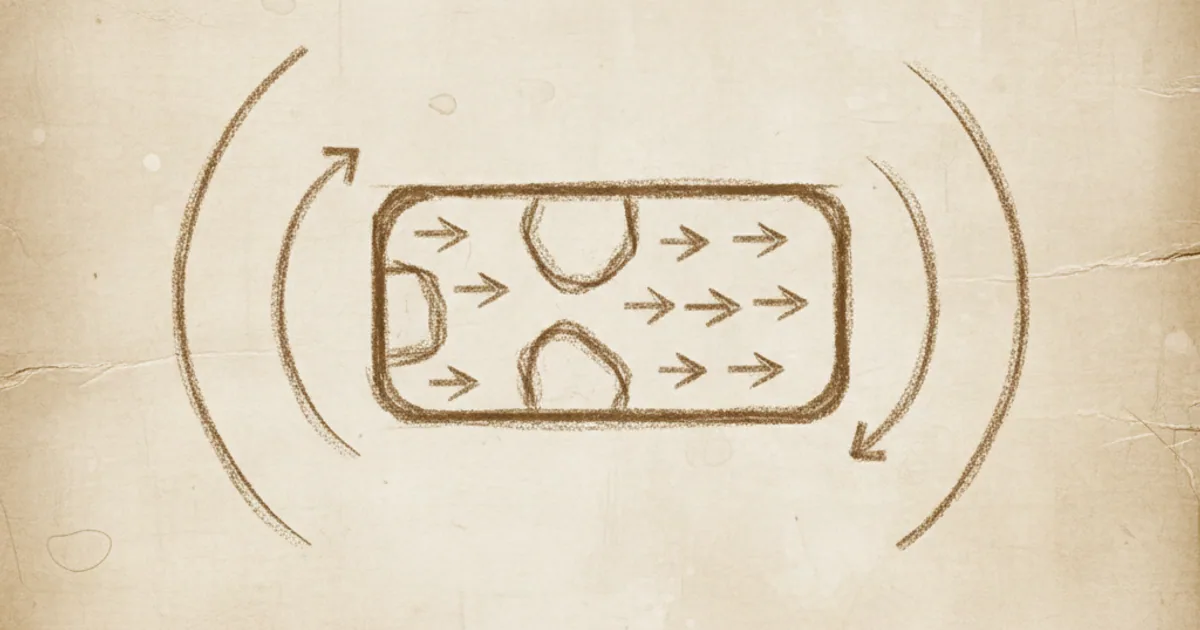
A bar magnet looks solid and inert, but at the atomic scale it's full of motion. Inside every atom, electrons move — both in orbit around the nucleus and through an intrinsic quantum property called spin. Each of these motions makes the electron behave like a tiny current loop, producing a tiny magnetic field.
In most materials, these atomic magnets point in random directions and cancel out. Bulk piece of copper, aluminum, plastic, glass: no net magnetism.
In ferromagnetic materials (iron, nickel, cobalt, and certain alloys), neighboring atoms' magnetic moments tend to align with each other. Aligned-moment regions are called magnetic domains. In a piece of unmagnetized iron, different domains point in different directions and partially cancel. In a magnetized iron — a magnet — most domains point the same way, producing a net macroscopic field.
That's the whole story, more or less. A magnet is a chunk of material whose electrons mostly point the same direction.
The two contributions to atomic magnetism
Each atomic magnetic moment has two sources:
1. Electron orbital motion. Electrons orbit nuclei (more precisely, occupy orbitals — quantum states with characteristic motion). Moving charges produce magnetic fields. This contributes some magnetic moment.
2. Electron spin. Each electron has an intrinsic magnetic moment from a quantum property called spin. "Spin" is a misleading name — it's not classical rotation in the way a planet spins on its axis, but a quantum number that gives electrons an intrinsic angular momentum AND an intrinsic magnetic moment, even when they're not moving in any classical sense.
In most materials, the spin contribution dominates over orbital. For ferromagnets specifically, the spin alignment is what drives the permanent magnetism.
Atomic nuclei also have tiny magnetic moments (from proton and neutron spins), but these are about 2,000 times smaller per particle than electron moments and contribute little to bulk magnetism — though they are detectable in MRI machines.
Why iron is magnetic and copper isn't
Both iron and copper have electrons with spin. The crucial difference is in how the electrons in neighboring atoms interact.
In ferromagnetic materials (iron, nickel, cobalt, gadolinium, and various alloys):
- Atoms have unpaired electrons in specific orbitals (3d in iron).
- A quantum mechanical effect called exchange interaction makes it energetically favorable for neighboring atoms' unpaired-electron spins to align in the same direction.
- This is a cooperative effect — each aligned pair makes nearby alignment easier — leading to large domains of aligned moments.
In most other elements (copper, gold, silver, aluminum):
- Either all electrons are paired with opposite spins (cancelling), or the exchange interaction is weak or anti-aligning.
- No spontaneous magnetic order.
There are subtler magnetic behaviors:
Paramagnetism: weak alignment with an external field, no spontaneous alignment without one. Aluminum, oxygen, sodium are paramagnetic.
Diamagnetism: weak repulsion from any magnetic field — present in essentially all materials but obvious only in those with no stronger magnetism. Water, copper, graphite, bismuth are notably diamagnetic. Strong enough fields can levitate diamagnetic objects (frogs have been levitated with very strong magnets).
Antiferromagnetism: neighboring moments alternate direction and cancel. Chromium, hematite (Fe₂O₃ at low temperatures) are antiferromagnetic.
Ferrimagnetism: neighboring moments alternate but with different magnitudes, leaving a net field. Magnetite (Fe₃O₄), the original "magnet" mineral known to antiquity, is ferrimagnetic.
For everyday magnets, ferromagnetism is the relevant one.
Domains: the microscopic puzzle pieces
A piece of unmagnetized iron isn't truly "non-magnetic." Internally, it has small regions (typically 1 μm to 1 mm across) where all the electron spins are already aligned. These are domains. They form spontaneously because alignment lowers energy.
The catch: different domains point in different directions, and the overall material has no net field.
Magnetizing the iron means rotating or growing the domains so most point the same direction. This happens when:
- The iron is exposed to a strong external magnetic field (the field forces alignment).
- The iron is cooled from above the Curie temperature in a magnetic field.
- Some domains expand at the expense of others through "domain wall motion."
Once magnetized, the domains tend to stay aligned because (a) they're at a lower-energy state than mixed orientations, and (b) the alignment is stable to small thermal fluctuations at room temperature.
Some materials are hard magnets: their domains resist re-randomization. Permanent magnets are made from these. Common materials: Alnico (aluminum-nickel-cobalt alloys), ferrites (iron oxides), and most modern strong magnets are rare-earth alloys (neodymium-iron-boron, samarium-cobalt).
Other materials are soft magnets: their domains realign easily with an applied field but don't hold the magnetization when the field is removed. Useful for transformer cores, electromagnet cores, motor cores. Common soft magnetic materials: silicon steel, mu-metal, ferrites.
The Curie temperature
Heat disrupts magnetic alignment. The temperature above which thermal motion overwhelms the exchange interaction and destroys ferromagnetic order is the Curie temperature.
Common Curie temperatures:
- Iron: 770 °C (1,043 K).
- Nickel: 358 °C (631 K).
- Cobalt: 1,121 °C (1,394 K) — the highest of common ferromagnets.
- Neodymium magnets (NdFeB): typically 310-400 °C, depending on grade.
- Gadolinium: 19 °C (just below room temperature) — gadolinium is ferromagnetic only when cold.
Below the Curie temperature, domains can form and alignment is stable. Above, thermal motion randomizes the spins and the material becomes only weakly paramagnetic.
This is why heating a magnet to red-hot temperature destroys its magnetization. Cooling it back down doesn't restore the original alignment (the domains re-form randomly), so you'd need to re-magnetize it in an external field.
The Curie temperature is also a way to "demagnetize" objects deliberately — heat past Curie, cool without an applied field, and the material is non-magnetic.
What a magnetic field actually does
A magnetic field exerts force on:
1. Moving charges. A charge q moving with velocity v in a magnetic field B experiences a force F = qv × B (the cross product means perpendicular to both v and B). This is the Lorentz force. It's what makes electric motors work (see how electric motors work) and what bends cosmic ray paths around planets.
2. Magnetic dipoles. Other magnets, current loops, and atomic magnetic moments experience torques and forces in non-uniform magnetic fields. This is why two magnets attract or repel each other.
3. Some materials in bulk. Ferromagnets are strongly attracted to magnetic field gradients; paramagnetic materials are weakly attracted; diamagnetic materials are weakly repelled.
A magnetic field does NOT directly do work on a charge (because the force is always perpendicular to velocity), but it can change the charge's direction. This subtlety matters in particle accelerators and motors.
Permanent magnet varieties
Different applications need different magnet properties:
Ferrite magnets: cheap, weak, common in refrigerator magnets, cheap motors, some loudspeakers. Iron oxide compounds.
Alnico magnets: aluminum-nickel-cobalt alloys. Strong at high temperatures, good for sensors. Older speakers and microphones.
Neodymium-iron-boron (NdFeB): extremely strong, the standard "rare earth magnet." Used in hard drives, wind turbines, electric motors, headphones, MRI machines. NdFeB magnets at room temperature can be hundreds of times stronger than ferrite magnets of the same size. Discovered in 1984; revolutionized small motors and high-density data storage.
Samarium-cobalt (SmCo): very strong, very high Curie temperature (better high-temperature performance than NdFeB), more expensive. Used in aerospace, military, and some industrial applications.
Flexible magnets: ferrite particles in plastic or rubber matrix. Refrigerator magnets, magnetic signs, magnetic strips.
A neodymium magnet the size of a small coin can lift several kilograms of iron. A large rare-earth magnet array can be dangerous — they can pinch fingers, attract other magnetic objects from across a room, and damage electronics. Safety practices around strong magnets are real.
Maglev, MRI, hard drives
A few real-world applications:
MRI scanners use superconducting electromagnets (cooled to ~4 K) to produce fields of 1.5 to 3 tesla — about 30,000 to 60,000 times Earth's magnetic field. These fields align hydrogen nuclei in the body, and the response gives detailed images of soft tissue. Specialized research scanners operate at 7 T and above.
Hard disk drives store data as magnetic domains on a spinning platter. Each domain represents a 0 or 1 by its magnetization direction. Read heads detect the magnetic field as the platter spins past. Modern HDDs pack data at very high domain density — terabytes of data stored as microscopic magnetic patterns.
Maglev trains use powerful magnets to levitate the train above the rails (eliminating wheel friction) and propel it forward. The Shanghai Maglev runs at up to 430 km/h commercially; the Japanese Chuo Shinkansen, still under construction, has tested at 603 km/h.
Electric motors use the Lorentz force on current-carrying wires in a magnetic field. Stationary magnets (or electromagnets) interact with current in moving coils, producing rotation. See how electric motors work for details.
Particle accelerators (LHC, etc.) use powerful electromagnets to steer charged particles around curved paths and to focus the beams.
Earth's magnetic field
Earth itself is a magnet. Its core contains molten iron and nickel; the convective motion of this conducting fluid, combined with Earth's rotation, generates a magnetic field through a process called the geodynamo.
Earth's field is about 25-65 microtesla at the surface (small compared to a refrigerator magnet up close, but it covers the whole planet). Key roles:
- Compass navigation: needles align with the field's horizontal component, pointing toward magnetic north.
- Solar wind protection: deflects most charged particles streaming from the Sun, protecting the atmosphere and life. Auroras (northern and southern lights) form where some charged particles funnel along field lines into the upper atmosphere.
- Magnetosphere: the region around Earth where its field dominates over the solar wind, extending ~10 Earth radii on the sunward side and millions of kilometers on the night side.
The magnetic poles are NOT at the geographic poles — they're offset by some degrees and slowly migrate. The north magnetic pole has been moving from Arctic Canada toward Siberia at increasing speed (~50 km/year in recent decades).
Earth's field also reverses polarity occasionally — north becoming south and vice versa. The last reversal was about 780,000 years ago. The geological record shows hundreds of past reversals at irregular intervals.
If you'd like a guided 5-minute course on magnetism, NerdSip can generate one.
The takeaway
A magnet is material whose electrons' intrinsic magnetic moments — mostly from quantum spin, plus some orbital motion — point predominantly in one direction. In most materials, atomic magnetic moments cancel out due to random orientation. In ferromagnets (iron, nickel, cobalt, and certain alloys), neighboring moments align cooperatively in microscopic domains; magnetization is the alignment of these domains. Above the Curie temperature (770 °C for iron), thermal motion disrupts the alignment and the material becomes only weakly paramagnetic. Modern permanent magnets — especially neodymium-iron-boron alloys — are dramatically stronger than older ferrites and have transformed many technologies (motors, hard drives, MRI). And Earth itself is a giant magnet, with its field generated by motion of molten iron in the core.

Comments 0
No comments yet. Be the first to share your thoughts.