
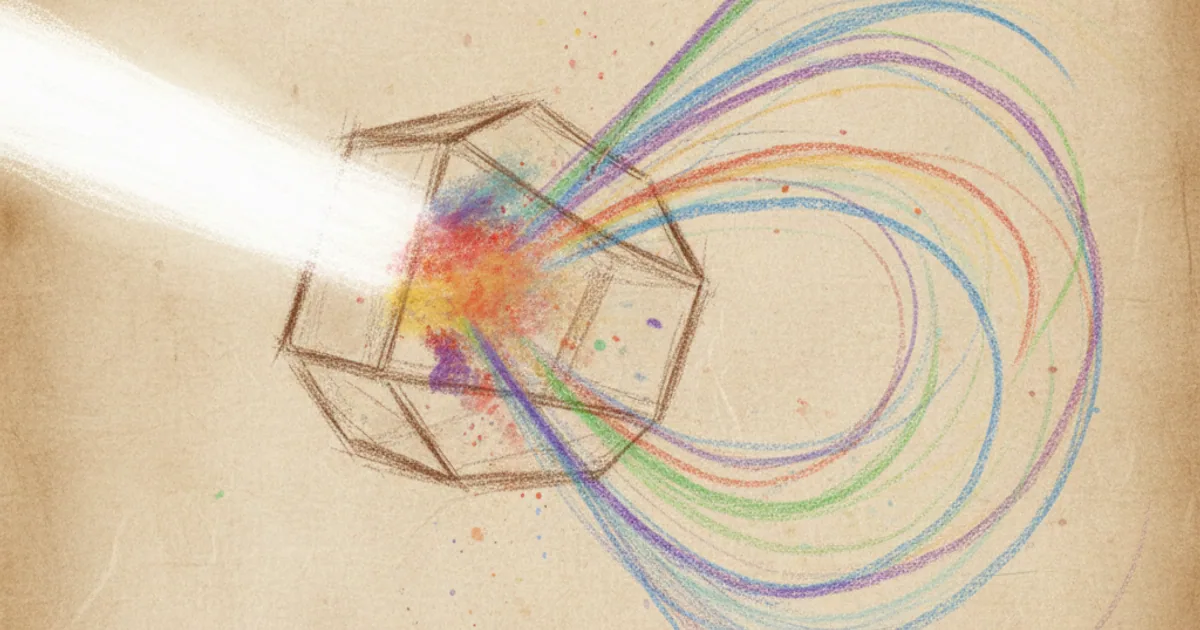
The basic mechanism
White light contains all visible wavelengths roughly equally — red (700 nm), orange, yellow, green, blue, violet (400 nm). When white light hits an object, three things can happen to each wavelength:
- Absorbed. The light's energy is taken in by the object (usually exciting an electron to a higher orbital).
- Reflected. The light bounces off the surface and continues in another direction.
- Transmitted. The light passes through (transparent or translucent objects).
For most opaque objects, light is either absorbed or reflected — and which wavelengths get absorbed determines the color you see.
A red apple looks red because its skin absorbs all wavelengths except red. The red light bounces back, reaches your eye, and you see red.
A blue car looks blue because its paint absorbs all wavelengths except blue.
A black surface absorbs everything — no light reaches your eye, so the surface looks black.
A white surface reflects everything — all wavelengths come back, mixing into white in your perception.
That's the headline. The interesting question is why specific molecules absorb specific wavelengths.
Why molecules absorb specific colors
Electrons in atoms and molecules can only occupy specific energy levels. When light hits a molecule, an electron can absorb a photon if and only if the photon's energy exactly matches the gap between the electron's current level and an empty higher level.
This means each molecule has a unique set of wavelengths it will absorb, determined by the energy gaps in its electronic structure. The gaps for most simple molecules are too large for visible light — they correspond to ultraviolet wavelengths. Such molecules don't absorb in the visible range; they look colorless or white.
To get visible color, you need a molecule with electronic transitions in the visible range (roughly 1.6 to 3.1 electron-volts). Common ways to engineer such transitions:
- Conjugated systems. Long chains of alternating single-double bonds (like in carrots' beta-carotene, or in chlorophyll). These spread electrons across many atoms, lowering the energy gaps into the visible range.
- Transition metals. Iron, copper, cobalt, etc. have partially-filled d-orbitals with transitions in the visible. This is why metal complexes are often colorful (and why blood is red — iron in hemoglobin).
- Charge-transfer transitions. Electrons jumping between different parts of a complex molecule, like in many dyes.
Pigments in plants and animals are usually conjugated-organic or metal-complex types.
The complement rule
The color you see is the complement of the color absorbed. This is because if an object absorbs blue light, the remaining wavelengths (red + green + yellow + orange) mix in your eye into the perceived color "yellow" — which is what's left when you remove blue from white light.
Some common complements:
| Absorbed | Perceived |
|---|---|
| Red | Cyan/green |
| Yellow | Blue/violet |
| Green | Magenta/red |
| Blue | Orange/yellow |
This is why chlorophyll, which absorbs red AND blue light (using both for photosynthesis), reflects green — the colors it doesn't absorb. From the plant's perspective, green is the wavelength it didn't want; from ours, it's the only color we can see in a leaf.
Structural color — the geometry trick
Some of the most vivid colors in nature don't come from pigments at all. They come from micro-scale geometry producing constructive and destructive interference of light.
A peacock's feather, a morpho butterfly's wing, the iridescent shell of a beetle — these contain tiny periodic structures (regular spacing of layers, ridges, or scales) whose dimensions are similar to the wavelength of light. Light hitting these structures reflects off multiple layers; depending on the spacing, certain wavelengths reinforce each other (constructive interference) while others cancel out (destructive). The result: a vivid color that doesn't fade because no pigment is being consumed.
Structural color often appears iridescent — shifting hue with viewing angle — because the wavelength satisfying constructive interference changes as you tilt the object.
Industrial examples: anti-counterfeit holograms on credit cards, "color-shifting" car paints, the films used to dichroic mirrors. Same physics.
Birds have a particular knack for structural color — many "blue" birds (bluejays, kingfishers) are actually structural blues, not pigment-based, because biological blue pigments are rare.
Emission color — when matter glows
The colors discussed above are all reflective: white light hits an object, and the object selectively reflects part of it.
Some sources produce color by emitting light. The mechanism is similar but in reverse: an electron drops from a higher orbital to a lower one, releasing the energy difference as a photon of specific wavelength.
- Fire. Hot soot particles glow (incandescence) with a wavelength distribution determined by their temperature. Yellower flames are hotter than redder ones.
- LEDs. Specific semiconductor compositions produce specific colors via electronic transitions.
- Fireworks. Different metal salts produce different colors when heated. Copper compounds give blue, strontium gives red, barium gives green, sodium gives yellow.
- Auroras. Energetic particles from the Sun excite atmospheric oxygen and nitrogen, which emit greens, reds, and pinks as they return to their ground states.
- Lasers. A single specific wavelength via stimulated emission.
The colors you see in the sky at sunset are reflective (Rayleigh scattering — see why sunsets are red). The colors in a flame or a star are emissive. Both follow the rules of electronic transitions in atoms and molecules.
Color perception is also a thing
The wavelength of light determines what color a physicist would call it. What color you SEE depends on your eye and brain.
Your retina has three types of cone cells, peaking in red, green, and blue regions of the spectrum. Your brain combines their relative signals to construct a perceived color. This is why "pink" exists as a color despite there being no specific pink wavelength — pink is a brain construct from particular mixes of red and blue cone activation.
Other species see different colors. Bees see ultraviolet; many flowers have UV patterns invisible to us but obvious to pollinators. Birds have four cone types (one for UV). Dogs have two. Color is partly physics and partly biology.
If you'd like a 5-minute personalized course on color physics, NerdSip can generate one with quizzes.
The takeaway
Things have color because their electrons absorb specific wavelengths and reflect the rest. The absorbed wavelengths are determined by the energy gaps between electron orbitals — for molecules to be colored in the visible range, they need transitions with the right energy. Pigments (selective absorbers), structural colors (interference geometry), and emissive sources (electronic relaxation) cover essentially all everyday colors. Once you see the single mechanism — light interacting with electrons — every color you see makes physical sense.

Comments 0
No comments yet. Be the first to share your thoughts.