
The simple definition
Momentum is mass times velocity.
In symbols: p = m·v.
That's it. A 1 kg object moving at 1 m/s has 1 kg·m/s of momentum. A 10 kg object moving at 1 m/s has 10. A 1 kg object moving at 10 m/s also has 10. Heavy and slow can have the same momentum as light and fast.
Momentum is a vector — it has direction. A ball moving north has momentum pointing north; a ball moving south has momentum pointing south. If they have the same mass and the same speed, their momenta are equal in magnitude but opposite in direction.
The intuitive translation: momentum is "how hard is it to stop this thing." A fast bullet and a slow truck can have similar momenta if the truck is much heavier than the bullet. Stopping either takes a comparable amount of force-times-time.
Why momentum matters: conservation
The single most important fact about momentum:
In a closed system (no external forces), the total momentum stays constant.
This is conservation of momentum — one of the deepest laws of physics. It holds in classical mechanics, in special relativity (with redefined momentum), and even in quantum mechanics (with the proper formalism). Nothing changes the total momentum of a closed system except external forces pushing on it.
If you add up all the momentum vectors of all the parts of an isolated system, that sum is the same before any interaction as after.
Some immediate consequences:
Two objects collide. Total momentum before = total momentum after. If they stick together, the combined object continues with a velocity such that the new mass × new velocity equals the old summed momentum. If they bounce off each other, the individual velocities change, but the total adds back to the original.
Recoil. A gun fires a bullet. Before: total momentum is zero (both at rest). After: the bullet has forward momentum; the gun has equal-magnitude backward momentum. Total is still zero. This is why guns kick back.
Rocket propulsion. A rocket throws mass (exhaust gases) out the back at high velocity. Total system momentum stays constant; since gases go one way, rocket goes the other. (See Newton's laws for the third-law treatment.)
Walking. Each step, you push backward on the ground. Earth (effectively infinite mass) absorbs that momentum without measurable acceleration. You absorb the equal forward push and move forward.
Why conservation holds
There are two ways to see why momentum is conserved.
1. From Newton's laws. If two objects A and B interact, A pushes B with force F. By Newton's third law, B pushes A with force -F. Over a time interval Δt, A's momentum changes by -F·Δt and B's by F·Δt. Total change: zero. The argument extends to any system of interacting objects.
2. From symmetry. A theorem from mathematician Emmy Noether (1918) says: every continuous symmetry of physics corresponds to a conservation law. The symmetry "physics works the same way regardless of WHERE you are" (translational symmetry of space) corresponds directly to conservation of momentum. If the laws of physics didn't change as you moved from one location to another, momentum would have to be conserved — and they don't, so it is.
This is one of the most beautiful results in physics. Conservation laws aren't accidents; they reflect deep symmetries of the universe.
Impulse: changing momentum
A force acting over time changes momentum:
Δp = F·Δt
This quantity (force × time) is called impulse. It equals the change in momentum.
This is more useful than it sounds. Several applications:
Airbags and crumple zones. A car crash brings a body from 50 km/h to 0 in a very short time. Newton's second law: F = m·a means huge force, because acceleration (going to zero very fast) is huge. Airbags extend the deceleration time from milliseconds to maybe 100 ms. Same total change in momentum, but spread over more time, so smaller peak force. Survivable instead of lethal.
Catching a baseball. Stiff hands: the ball stops in a tiny time, you feel a sharp impact. Hands moving backward as you catch: the deceleration takes longer, you feel less impact.
Jumping off a high object. Land stiff-legged: short impact time, large force on your body. Bend your knees: longer time, smaller force. Same final momentum (zero); very different peak force.
Punching. A fist with the same speed delivers the same momentum, but a longer follow-through (extending the contact time) reduces the peak force on YOUR knuckles too.
The general principle: spreading momentum change over more time reduces the peak force. This is the design principle behind safety equipment, packaging, vehicle structures, fall mats, sports protective gear.
Elastic vs inelastic collisions
In any collision, momentum is conserved. Energy is more complicated.
Elastic collision: kinetic energy is also conserved (or very nearly so). Both objects bounce off each other and the total kinetic energy after equals before. Examples: billiard balls (nearly elastic), atoms in a gas (very nearly elastic), some types of subatomic collisions.
Inelastic collision: some kinetic energy is converted to heat, sound, deformation, or other forms. The objects may stick together or just deform without bouncing as much. Examples: cars crashing (very inelastic), a ball of clay hitting the floor (perfectly inelastic — it stops), people running into each other.
Perfectly inelastic is the extreme: the objects stick together after the collision. You can solve for the joint velocity using just momentum conservation.
For a perfectly inelastic collision between an object of mass m₁ with velocity v₁ and a stationary object of mass m₂:
Before: total momentum = m₁·v₁ + 0 = m₁·v₁. After: combined mass = m₁ + m₂, velocity = v. Conservation: m₁·v₁ = (m₁ + m₂)·v. So: v = m₁·v₁ / (m₁ + m₂).
A 2000 kg car at 30 m/s hits a stationary 1000 kg car. Combined velocity: (2000 × 30) / 3000 = 20 m/s. The combined wreckage moves at 20 m/s.
This is a useful approximation for predicting the outcomes of car crashes (with refinements for actual deformation).
A worked example: billiard balls
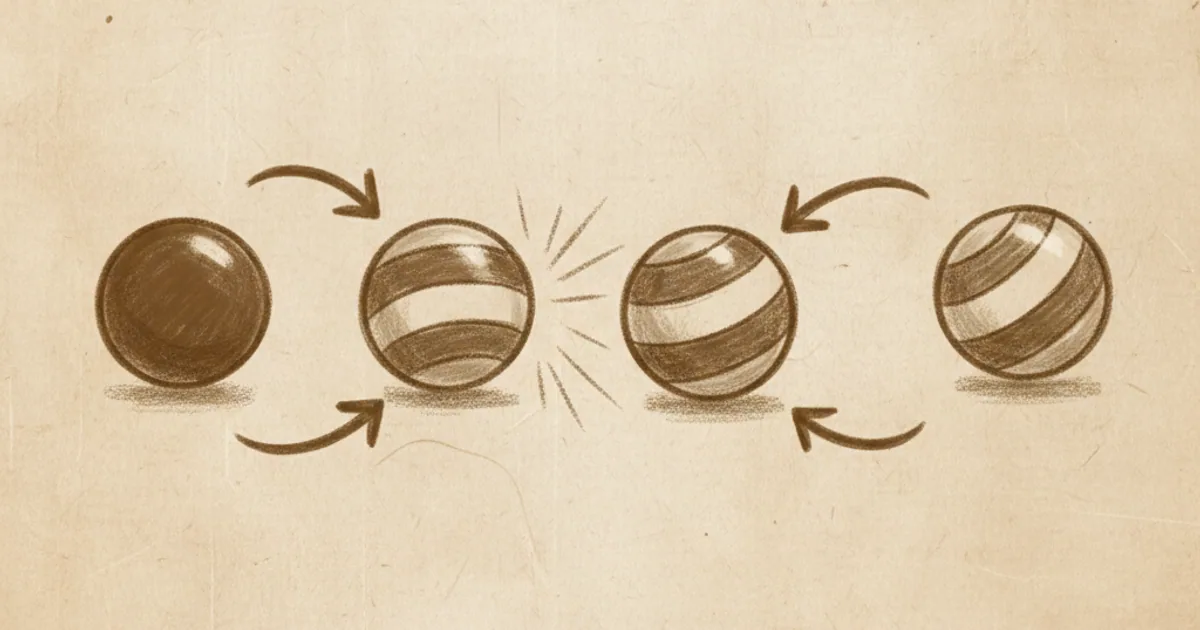
Two billiard balls. Ball 1 (mass m, velocity v) hits stationary ball 2 (mass m, velocity 0) head-on.
If the collision is perfectly elastic (typical for hard billiard balls hitting each other):
- Momentum conservation: m·v = m·v₁' + m·v₂'.
- Kinetic energy conservation: ½m·v² = ½m·v₁'² + ½m·v₂'².
Solving these two equations: v₁' = 0 (ball 1 stops) and v₂' = v (ball 2 takes off with ball 1's original velocity).
This is the classic "Newton's cradle" effect — the famous executive desk toy where a metal ball hits a row of stationary balls, transferring momentum and energy through them so only the last ball flies off. Each ball passes its momentum to the next; the last ball takes off; the rest stop.
For unequal masses, the math gets more interesting:
- Lighter ball hits heavier stationary ball: lighter ball bounces back; heavier ball moves slightly forward.
- Heavier ball hits lighter stationary ball: heavier ball continues forward (slowing slightly); lighter ball flies off faster than original.
For off-center hits (not head-on), the math involves momentum vectors in two dimensions. Billiards players develop intuitions for this through experience.
Angular momentum
Linear momentum has a rotational counterpart: angular momentum.
For a particle moving in a circle (or about a fixed axis), angular momentum is approximately mass × velocity × distance-from-axis.
For an extended rotating object, angular momentum is moment-of-inertia × angular-velocity. (Moment of inertia depends on how mass is distributed relative to the axis.)
Like linear momentum, angular momentum is conserved in closed systems. This produces some of the most counterintuitive behavior in physics:
The figure skater. Pulls in her arms while spinning. Her moment of inertia decreases (mass closer to axis). To conserve angular momentum, her angular velocity has to increase. She spins faster.
The collapsing star. A normal star slowly rotating collapses into a neutron star. Same angular momentum, but in a much smaller radius. The neutron star spins at hundreds of times per second.
Gyroscopes. A spinning gyroscope's angular momentum vector points along its axis. To change that direction requires a torque — and torque applied in one direction produces motion in a perpendicular direction (the famous "gyroscopic precession"). See how gyroscopes resist tipping.
Bicycles. Stable when moving partly because the wheels' angular momentum resists tipping. See why bicycles stay up.
Tornadoes and hurricanes. Form partly because Earth's rotation provides angular momentum. As air masses contract (over warm seas), they spin faster.
The conservation of angular momentum is as fundamental as conservation of linear momentum and follows from rotational symmetry of physics (Noether's theorem again — physics is the same regardless of how you're rotated, so angular momentum is conserved).
What momentum can't do alone
Momentum conservation is powerful but doesn't tell you everything:
Doesn't fix energy. Two billiard balls can have the same momentum after a collision in many ways depending on energy loss. You need energy considerations too.
Doesn't tell you trajectory shape. Conservation gives you the totals but not the specific path during the interaction.
Doesn't work alone for forces over time. You need Newton's laws to predict how things move under continuous forces. Momentum conservation gives you snapshots before and after.
In practice, momentum conservation is one tool among several. For full motion analysis, you combine it with Newton's laws, energy conservation, and sometimes angular momentum conservation.
If you'd like a guided 5-minute course on momentum and collisions, NerdSip can generate one.
The takeaway
Momentum is mass times velocity (p = m·v) — a vector quantity that captures how hard something is to stop. In any closed system, total momentum is conserved: the sum of momentum vectors before any interaction equals the sum after. This single law predicts collisions, recoil, rocket propulsion, and many other phenomena. Impulse (force × time) equals change in momentum — which is why spreading collisions over more time (airbags, crumple zones, catching with movement) reduces peak force. Angular momentum is the rotational counterpart, equally conserved, explaining everything from spinning figure skaters to gyroscopes to neutron stars. Together with Newton's laws and conservation of energy, momentum conservation describes most of mechanical motion in the universe.

Comments 0
No comments yet. Be the first to share your thoughts.