
Three sentences that run the world
In 1687, Isaac Newton published the Principia Mathematica, formalizing three statements about how forces and motion relate. Those three sentences — restated and refined over the centuries since — remain the most useful compression of mechanics into a few words. Almost any motion problem in the everyday world can be solved by careful application of them.
In modern wording:
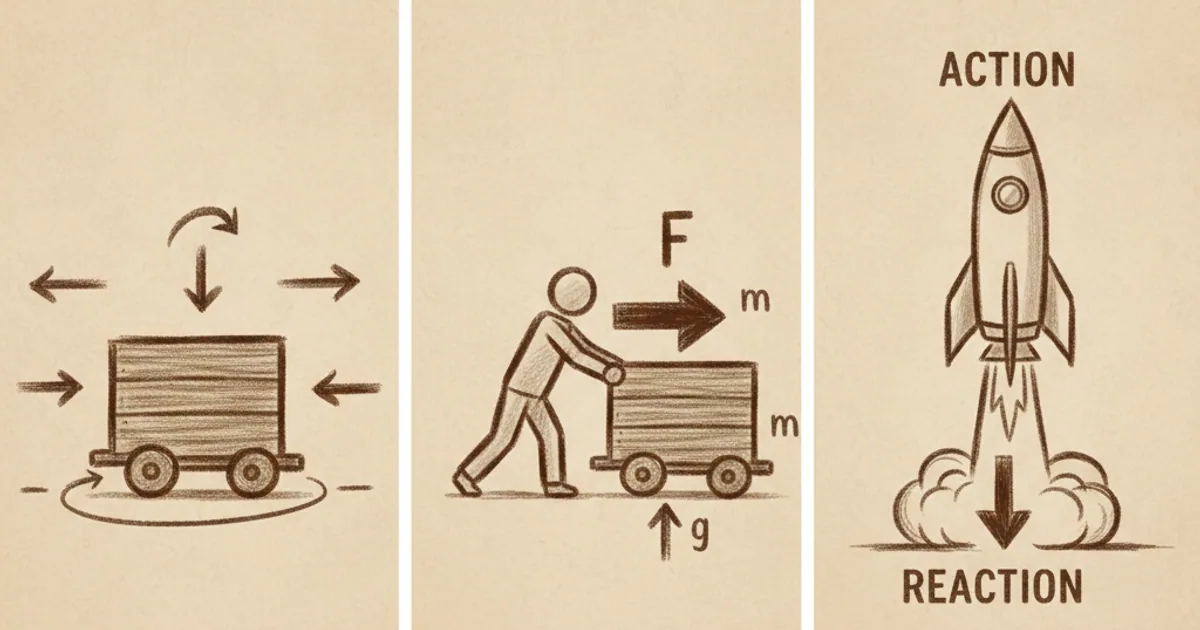
1. An object at rest stays at rest. An object in motion stays in motion at constant velocity. Unless a net external force acts on it.
2. The net force on an object equals its mass times its acceleration. Force and acceleration point in the same direction. In symbols: F = m·a.
3. For every action, there is an equal and opposite reaction. If A pushes B with some force, B pushes A back with the same force in the opposite direction.
That's all three. Each is worth unpacking.
First law: inertia
An object continues in its state of rest or uniform motion in a straight line unless acted upon by an external force.
This is the law of inertia. The key insight: motion doesn't naturally decay. Things keep doing what they're doing.
This was a radical departure from the prevailing Aristotelian view (which lasted ~2,000 years) that things naturally come to rest unless something keeps pushing them. Aristotle was wrong; Galileo and Newton replaced this with the right idea.
What's seductive about the wrong view: in everyday life, things DO seem to slow down on their own. Roll a ball — it stops. Stop pedaling a bike — you coast and gradually stop. Toss a baseball — it falls and rolls to a halt.
The reason these all stop is friction (and air resistance). Remove friction and the ball really does keep rolling forever. We've actually confirmed this — pucks slide on near-frictionless surfaces (ice, air-hockey tables) without slowing dramatically. The Voyager 1 spacecraft, in the near-vacuum of space, has been coasting for decades without slowing. Constant velocity isn't unstable; it's the default for any object not being pushed or pulled.
This law also says: you can't tell from inside a moving vehicle that you're moving, as long as the velocity is constant. No experiment performed entirely inside a windowless train traveling smoothly at 100 km/h can distinguish it from a stationary train. The physics is exactly the same.
This is the origin of Galilean relativity (and later, Einstein's special relativity): there's no special "rest" frame; physics is the same in any non-accelerating reference frame.
Second law: F = ma
The net force on an object equals its mass times its acceleration. The acceleration is in the same direction as the force.
In symbols: F = m·a.
Or rewritten: a = F / m. Given a force, the acceleration is the force divided by the mass.
This compact equation says four important things:
1. Forces cause accelerations, not motions. A force doesn't make something move at a specific speed; it makes something CHANGE its speed (or direction). To keep an object moving steadily, you only need a force if something is slowing it down (like friction).
2. The same force on a bigger mass produces less acceleration. A 1 N push on a 1 kg ball accelerates it at 1 m/s². The same 1 N push on a 10 kg ball accelerates it at 0.1 m/s². Mass is "resistance to acceleration."
3. Forces are vectors — they add up by direction. If gravity pulls a ball down with 10 N and a string pulls it up with 10 N, the net force is zero. The ball doesn't accelerate. If gravity pulls down with 10 N and someone pushes sideways with 5 N, the net force has components in both directions, and the acceleration is in the direction of the net force.
4. Units link the equation. 1 newton is defined as the force that accelerates 1 kg at 1 m/s². So 1 N = 1 kg·m/s². The SI system is built to make F = ma work in straightforward units.
For most "homework problems" in mechanics, the workflow is:
- List the forces acting on the object.
- Add them up as vectors to get the net force.
- Divide by mass to get the acceleration.
- Use the acceleration to predict the motion over time.
Engineers and scientists do this hundreds of times a day. It works.
A subtle but important point: momentum-based formulation
Newton actually originally wrote the second law in terms of momentum (mass times velocity), not directly in terms of acceleration. The modern equivalent:
F = dp/dt (force equals the rate of change of momentum).
For constant mass, this reduces to F = ma. But if mass is changing (e.g., a rocket burning fuel and losing mass as it accelerates), the momentum form is more accurate. This is why the momentum formulation is technically more general.
This subtlety is also where the connection to relativity lives. In special relativity, momentum isn't simply m·v; it's defined differently. F = dp/dt still holds, but p has a relativistic correction.
Third law: action-reaction pairs
For every action, there is an equal and opposite reaction.
In modern form: when object A exerts a force on object B, object B simultaneously exerts an equal and opposite force on A.
Examples:
- You push a wall with 100 N. The wall pushes back on your hand with 100 N. Your hand doesn't pass through the wall because the wall is rigid enough to exert that reaction force.
- You throw a heavy ball forward. The ball gets thrown forward; you get pushed slightly backward (by the same force, briefly).
- A rocket fires hot gases out the back. The gases get pushed backward at high speed; the rocket gets pushed forward.
- A swimmer pushes water backward with their hands. The water pushes the swimmer forward.
- Gravity from Earth pulls you down. You pull Earth up (with the same force, but Earth's mass is so large its acceleration is negligible).
The pairs are always on different objects. Both forces exist; they don't cancel each other (because they're not acting on the same thing).
The common misunderstanding
Many people, when they first learn the third law, ask: "If every action has an equal and opposite reaction, how does anything ever move?"
The answer: the pairs act on different objects. When you push a cart, you apply a force forward to the cart; the cart applies an equal force backward to YOU. The cart accelerates forward (because of the force on it). You don't accelerate backward as much because (a) you're typically more massive than the cart, and (b) friction with the ground holds you in place.
Each object responds only to the forces acting on IT, not to its pair force.
How rockets work
The third law is what makes rocket propulsion work. A rocket has no air or ground to push against — it's in space, surrounded by vacuum. How can it accelerate?
By throwing mass out the back. The rocket exerts a force on the exhaust gases, pushing them backward. The exhaust gases exert an equal and opposite force on the rocket, pushing it forward. Newton's third law in action.
This is also why rockets need huge amounts of fuel. To go fast, they need to throw a lot of mass out the back at high speed (since thrust = mass flow rate × exhaust velocity). Most of a launch rocket's weight at takeoff is propellant.
What about Newton's laws of gravity?
Newton also formulated the law of universal gravitation: every two objects with mass attract each other with a force proportional to the product of their masses divided by the square of the distance between them.
F = G·m₁·m₂/r²
Where G is the gravitational constant — the current CODATA recommended value is 6.674 × 10⁻¹¹ N·m²/kg².
This is separate from the three laws of motion, but Newton derived it in the same Principia. It explains:
- Why things fall toward Earth (Earth's mass attracts them).
- Why the Moon orbits Earth (Earth's gravity provides the centripetal force).
- Why planets orbit the Sun (Sun's gravity).
- Tides (Moon's gravity is uneven across Earth).
- Star motions within galaxies (approximately — though observed galactic rotation curves cannot be fully explained by visible matter alone, requiring dark matter or modified-gravity theories).
Newton's gravity is still extraordinarily accurate. General relativity (Einstein, 1915) refines it for extreme cases (strong fields, very high precision orbits, GPS satellites, light bending near the Sun) but Newton's law is what you use for designing spacecraft, predicting eclipses, calculating projectile motion, and most other practical purposes.
A worked example
A 1 kg ball is dropped from a 10 m height. How long until it hits the ground? With what velocity?
Forces on the ball: only gravity (we'll ignore air resistance). Force = mass × gravitational acceleration = 1 × 9.8 = 9.8 N downward.
Newton's second law: acceleration = force / mass = 9.8 / 1 = 9.8 m/s² downward.
Kinematics (basic motion equations):
- Position: y(t) = 10 - ½·9.8·t² (with y = 10 m at t = 0, and y measured upward).
- Velocity: v(t) = -9.8·t (negative because moving downward).
- Time to hit ground (y = 0): 10 = ½·9.8·t², so t² = 20/9.8 ≈ 2.04 s², so t ≈ 1.43 s.
- Velocity at impact: v ≈ -9.8 × 1.43 ≈ -14 m/s.
That's about 50 km/h — fast enough to break things if the ball is hard.
Notice: this problem was solved with just Newton's second law plus basic kinematic equations. The same approach scales to all sorts of motion problems.
The remarkable accuracy
It's worth pausing to appreciate how successful Newton's laws are.
The orbital mechanics of every artificial satellite, the trajectories of every spacecraft to the planets, the calculations behind every bridge and skyscraper, the dynamics of every car engine, the path of every missile and rocket, the swing of every pendulum, the timing of every clock with mechanical movement — all done with Newton's laws plus gravity.
The Curiosity rover's landing on Mars in 2012 involved precise calculations of Mars's orbital position, Curiosity's trajectory through space, atmospheric entry dynamics, parachute deployment, the sky-crane maneuver, and final touchdown velocity. All of it was Newtonian mechanics. The math is centuries old; the engineering is modern.
It's also worth noting that we KNOW Newton's laws aren't quite right at extreme scales. Relativity and quantum mechanics are more fundamental. But for the world of everyday objects moving at everyday speeds — the world Newton was modeling — they're accurate to many decimal places. They will keep working for designing things at human scales essentially forever.
If you'd like a guided 5-minute course on Newton's laws and how to use them, NerdSip can generate one.
The takeaway
Newton's three laws compress most of classical mechanics into three sentences. First: things keep doing what they're doing unless a net force acts (inertia). Second: net force equals mass times acceleration (F = m·a) — forces cause accelerations, with bigger masses requiring more force for the same acceleration. Third: every force is one half of a pair acting on two different objects (action-reaction). Plus Newton's law of universal gravitation (force between any two masses ∝ m₁m₂/r²). Together, these describe and predict almost every motion you encounter in daily life with remarkable accuracy. The framework is 350+ years old and still does the heavy lifting for almost all engineering and physics outside of relativistic and quantum scales.

Comments 0
No comments yet. Be the first to share your thoughts.