
The trick
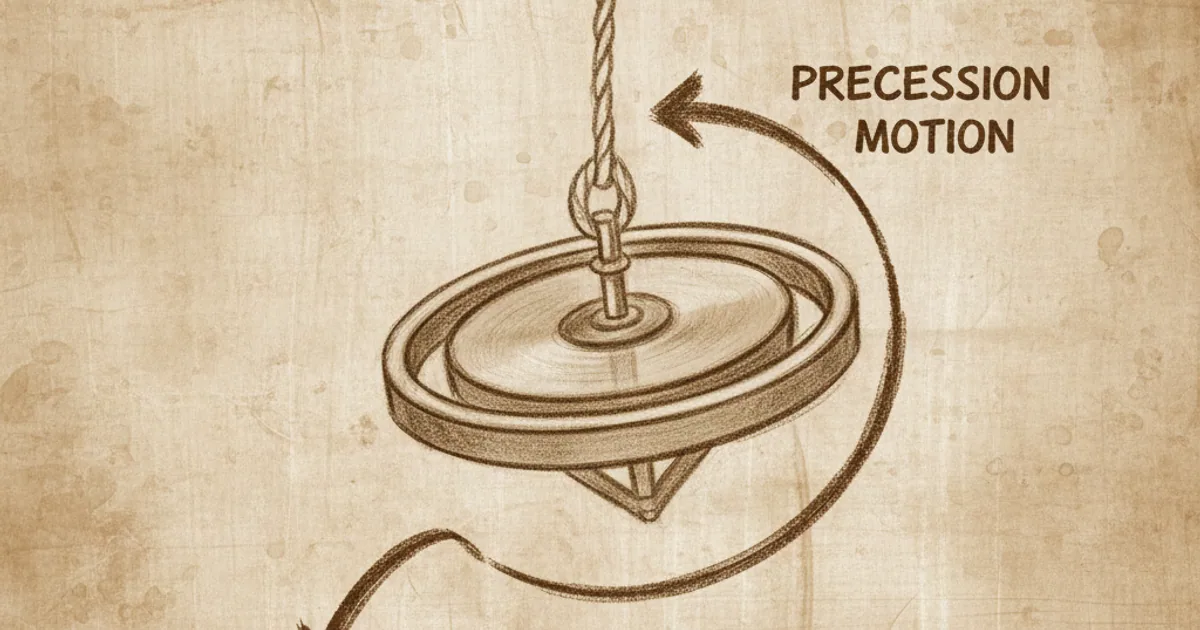
Spin up a heavy wheel on an axle. Try to tip the axis sideways. The wheel doesn't tip — instead, the axis moves in a surprising direction, perpendicular to your push.
This is gyroscopic precession. It's one of the most counterintuitive phenomena in classical mechanics, but once you see what's going on with angular momentum, it makes sense.
The same physics underlies gyrocompasses, spacecraft attitude control, the stability of moving bicycles, the wobble of a spinning top, and even Earth's slow ~26,000-year wobble that gradually changes which star is closest to "north."
What angular momentum is
To explain gyroscopes, we need angular momentum — the rotational version of momentum.
For a spinning object, angular momentum is roughly moment of inertia × angular velocity, where:
- Angular velocity (ω) is how fast it's spinning (radians per second, or revolutions per minute).
- Moment of inertia (I) describes how the mass is distributed relative to the spin axis. A wheel with mass concentrated at the rim has a larger moment of inertia than the same mass concentrated near the center.
Angular momentum L = I × ω, and crucially, it's a vector. The vector points along the spin axis, with direction set by the right-hand rule: curl your right-hand fingers in the direction of spin; your thumb points along L.
Like linear momentum, angular momentum is conserved in any closed system (no external torques). And like linear momentum, changing it requires a force-equivalent — in this case, a torque.
The relationship: τ = dL/dt (torque equals the rate of change of angular momentum). If you apply a torque, you change the angular momentum vector. Crucially, you change it in the DIRECTION of the torque.
The counterintuitive part
Here's the seeming paradox.
Imagine a gyroscope spinning fast. Its angular momentum vector L points along its rotation axis — let's say horizontally, to the right.
You apply a torque trying to tip it forward (so you'd expect the axis to rotate forward — angular momentum to start pointing down). The torque is directed forward.
But torque doesn't tip the gyroscope forward. Instead, the angular momentum vector swings sideways — the axis rotates perpendicular to where you'd expect.
Why? Because dL/dt equals the torque. The CHANGE in L is in the direction of the torque, which is forward. The initial L is large in one direction (sideways). Adding a small forward component to a large sideways vector doesn't tip the vector; it rotates it slightly into a new horizontal direction.
In other words: the torque doesn't tip the angular momentum vector — it ROTATES it. The gyroscope's axis swings horizontally rather than tipping vertically.
A worked picture
Think of pushing on a moving thing. If the thing is at rest, pushing it in direction X makes it move in direction X. If the thing is already moving fast in direction Y, pushing it in direction X doesn't make it move in direction X — it makes it move slightly in a NEW direction that's mostly Y with a bit of X added. The fast motion in Y is more important than the brief push in X.
Same with angular momentum. The fast spin gives a huge L vector in one direction. A torque tries to add to L in a different direction. The result is L pointing slightly differently — which means the spin AXIS has rotated slightly. The spinning object's axis swings (precesses) rather than tipping over.
The slower the spin, the smaller L is, the more responsive the gyroscope is to torque (closer to "ordinary" behavior). The faster the spin, the more dramatically the gyroscope precesses instead of tipping.
A spinning top: the classic case
Picture a spinning top. The axis is initially vertical (or nearly so). Gravity pulls the top's center of mass down, creating a torque that would tip the top over if it weren't spinning.
But the top IS spinning. The angular momentum L is large, pointing up along the axis. Gravity's torque is sideways (perpendicular to L). The result: L precesses around — the spin axis traces out a cone.
This is the wobble you see in a spinning top. As long as the top is spinning fast, it precesses rather than falling. As friction slows the top, the precession gets faster and wider, until eventually the top topples.
The rate of precession depends on:
- The torque (gravity × distance from pivot to center of mass).
- The angular momentum (mass × moment of inertia × spin rate).
Faster spin → slower precession (because L is larger and the torque has less effect). Slower spin → faster precession. As any toy spinning top slows down, its precession noticeably speeds up just before it falls.
Why bicycles benefit
A bicycle has two spinning wheels with angular momentum pointing horizontally (let's say to the rider's left, by the right-hand rule, when both wheels spin forward).
When the bike leans (say to the right), gravity provides a torque around the contact line of the tires. This torque is in a direction such that, applied to the angular momentum of the wheels, it precesses them — making the wheels steer slightly into the lean (to the right).
When the wheel steers right, the bike's path curves right. The contact points move right, ending up back under the bike's tilted center of mass. The bike rights itself.
This is one of several stabilizing mechanisms in a moving bicycle (see why bicycles stay up for the full picture). The gyroscopic effect contributes but is not the whole story; modern research has shown bicycles can be made stable through several different combinations of effects.
Spacecraft attitude control
Spacecraft can't use rocket thrust for every small attitude adjustment — they'd run out of fuel quickly. Instead, many spacecraft use reaction wheels or momentum wheels — heavy spinning disks inside the spacecraft.
If you spin up a reaction wheel inside the spacecraft, the spacecraft body has to spin in the opposite direction to conserve total angular momentum (since the spacecraft started with zero angular momentum). By controlling the wheel's spin rate, you can rotate the spacecraft precisely.
Hubble Space Telescope, the James Webb Space Telescope, the International Space Station, and many other spacecraft use this approach. It's silent, propellant-free, and allows micro-arcsecond pointing precision — much more precise than thruster-based control.
When reaction wheels eventually max out their spin (they can't spin faster than design limits), the spacecraft uses occasional thruster firings to "desaturate" them — let them slow down while applying compensating torque externally.
Gyroscopes also provide navigation reference — a fast-spinning gyro keeps a constant orientation relative to inertial space, even if its mount rotates. This is the basis of inertial navigation systems used in submarines (which can't use GPS underwater) and missiles.
Mechanical gyroscopes vs MEMS
The classical mechanical gyroscope is a spinning disk on a gimbal — visible as a heavy spinning wheel that holds its orientation.
Modern smartphones don't have mechanical gyroscopes (they'd be too big and fragile). Instead, they use MEMS gyroscopes — Micro-Electro-Mechanical Systems devices that detect rotation through tiny vibrating structures on a silicon chip. When the chip rotates, the vibrating structures experience subtle forces (Coriolis-style) that the chip's electronics detect and convert to a rotation signal.
MEMS gyroscopes are in:
- Most modern smartphones (screen orientation, gaming, photo stabilization — though some budget devices omit them).
- Camera image stabilization.
- Drones (for stable flight and attitude control).
- Cars (for skid detection and stability control systems).
- VR headsets (head tracking).
- Wearable fitness devices (motion tracking).
The physics is fundamentally the same — detecting rotation via angular momentum effects — but the implementation is dramatically different in scale and mechanism.
Earth as a gyroscope
Earth rotates about its axis once per day, giving it angular momentum pointing along that axis (approximately toward Polaris in the current era).
The Sun and the Moon both exert gravitational forces on Earth. Because Earth is slightly oblate (bulges at the equator), these forces produce a small torque trying to align Earth's equatorial plane with the orbital plane.
This torque doesn't tip Earth over. Instead, Earth precesses — its rotation axis traces out a large circle relative to the distant stars, completing one full cycle every roughly 26,000 years.
The Greek astronomer Hipparchus noticed this precession around 130 BCE by comparing star positions to records from centuries earlier. It's called the precession of the equinoxes.
A consequence: the "pole star" changes over time. Polaris is currently very near Earth's rotation axis, but won't always be. Vega will be the bright pole star around 14,000 CE. Thuban (in Draco) was the pole star around 3,000 BCE — used by ancient Egyptians.
Earth also has a smaller "nutation" — a wobble superimposed on the slow precession, with periods of about 18.6 years — caused mostly by variations in the Moon's gravitational pull.
Things that look gyroscopic but aren't quite
Some phenomena get mistakenly attributed to gyroscopic effects:
A spinning coin's stability: not really gyroscopic — it's more about the coin's geometry and where its center of mass is. A coin spinning on edge resembles gyroscopic motion but the dominant physics is different.
Helicopter stability: not primarily gyroscopic. Helicopters are stabilized mostly by aerodynamic forces from rotor disc tilt, not by the rotor's angular momentum.
Throwing a Frisbee or football: the spin DOES stabilize the flight, but the dominant effect is aerodynamic — the spin keeps the object's orientation fixed while air pressure does its work. Gyroscopic effects play a role but it's not the primary stabilizer.
Astronaut spin in microgravity: an astronaut who spins up a wheel in their hands will rotate in the opposite direction (conservation of angular momentum) — this is the same physics as spacecraft reaction wheels, not really "gyroscopic" in the precession sense.
The distinction can be subtle. Gyroscopic precession specifically refers to a fast-spinning object's axis swinging in response to a torque, distinct from other angular momentum effects.
If you'd like a guided 5-minute course on rotational physics and gyroscopes, NerdSip can generate one.
The takeaway
A gyroscope is a spinning object whose angular momentum vector points along its axis. Apply a torque, and instead of the axis tipping (as you'd expect for a non-spinning object), the angular momentum vector swings sideways — the gyroscope precesses. This follows from torque equaling the rate of change of angular momentum (τ = dL/dt). For a rapidly-spinning symmetric gyroscope with a torque perpendicular to its spin axis, the change in L is approximately perpendicular to L itself, producing steady precession — the canonical idealization that captures the essential behavior. The same physics keeps spinning tops upright, contributes to bicycle stability, lets spacecraft point precisely, drives the smartphone's screen orientation, and causes Earth's axis to slowly trace a ~26,000-year circle in the sky. Counterintuitive at first sight; conceptually simple once angular momentum is taken seriously as a vector.

Comments 0
No comments yet. Be the first to share your thoughts.