
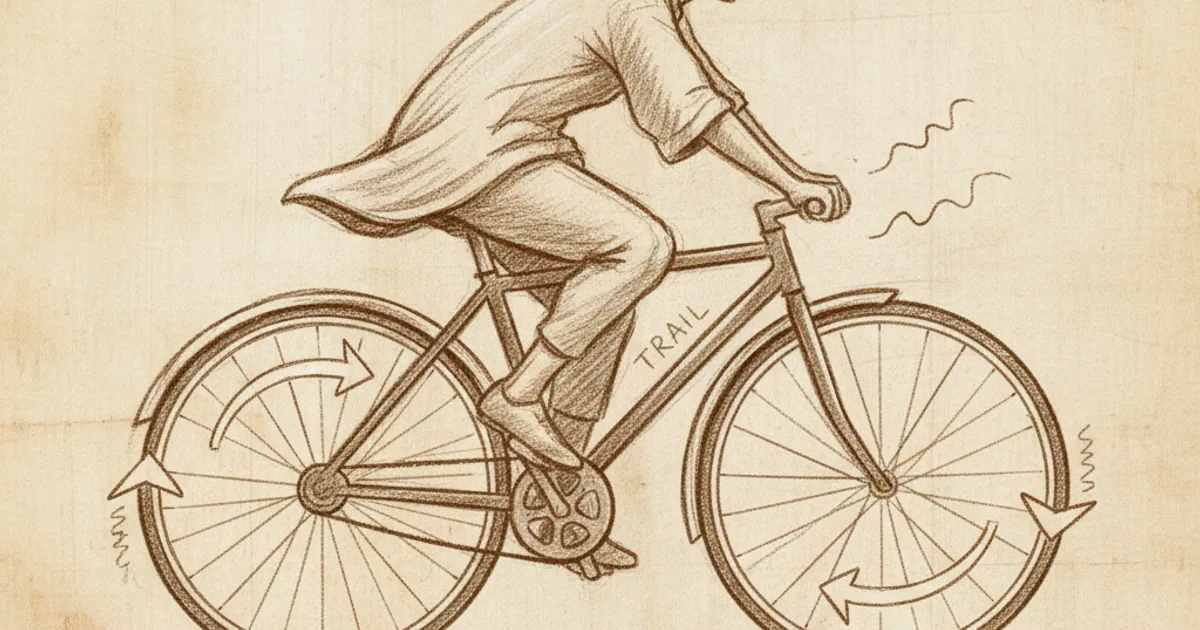
The everyday mystery
Stand a stationary bicycle on its wheels and let go. It falls over.
Now ride that same bicycle forward, even a slow walking pace, and it's stable. You can let go of the handlebars and it'll keep going straight for a while before any wobble develops. At certain speed ranges, bicycles are notably self-stable — many bikes will track straight by themselves for considerable distances on a smooth flat surface with no rider, though imperfections and perturbations eventually cause them to veer or fall. Self-stability holds over a finite speed window, not all speeds.
For a long time, the everyday explanation was "the gyroscope effect" — the spinning wheels' angular momentum keeps them upright. But it's more interesting and more subtle than that. Modern research has shown that no single effect is necessary for bicycle stability. Several effects interact, and you can build bicycles that work even if you cancel out any one of them.
A complete, modern, experimentally validated mathematical model — clarifying which combinations of design parameters produce stability — was published in 2007 by a Cornell-Delft research team. Earlier bicycle dynamics models existed (going back to Whipple in 1899), but the 2007 paper is the canonical modern formulation.
What might be happening
Three mechanisms get most of the credit for bicycle stability:
1. Gyroscopic precession of the wheels
A spinning wheel has angular momentum pointing along its axis (perpendicular to the wheel). To change this direction requires a torque.
When a bicycle starts to lean to one side, gravity provides a torque that would, on a stationary bike, simply tip it over. On a moving bike, this torque acts on a wheel that's already rotating. The result is gyroscopic precession — the wheel responds by steering INTO the lean rather than just falling over.
When the wheel steers into the lean, the bike turns slightly in the direction it was leaning. This curves the path of the wheels back under the bike's center of mass, righting the bike.
The gyroscopic effect contributes to stability and clearly exists. But experiments (including a bike with counter-rotating wheels canceling the gyroscopic angular momentum) show it's not the whole story.
2. Trail in the steering geometry
Look at a bicycle from the side. The front wheel doesn't just spin straight under the head tube — the steering axis (the line going through the head tube extended down to the ground) is angled forward, and the front wheel contact point with the ground is BEHIND where the steering axis hits the ground.
The distance between these two points is called trail (or "caster"). Typical bicycle trail is 5-10 cm.
The effect: when the bike leans, the trail makes the front wheel naturally steer into the lean (like a shopping cart caster aligns with motion). This is a purely geometric effect; it would still work even with no gyroscopes, no rider input.
Bikes with positive trail tend to be self-stable. Bikes with zero or negative trail (some experimental designs) are much harder to ride hands-free.
3. Rider steering corrections
Riders make small steering adjustments continuously, mostly unconsciously. When you feel the bike start to lean, you instinctively steer in the direction of the lean — which curves the bike's path under itself and rights the bike.
This is so automatic that experienced riders don't notice they're doing it. But it's essential. A novice rider trying to balance with a death grip on the handlebars without making corrections will fall. The fluid micro-adjustments of an experienced cyclist are doing real stabilizing work.
The same principle applies in many balancing tasks. Balancing a broom on your hand: you steer your hand under the broom whenever it starts to tip. Bicycles work similarly — you steer the bike under itself.
The 2007 paper that changed the picture
For decades, the conventional wisdom in physics teaching was that bicycle stability was "mostly the gyroscopic effect plus a bit of caster." Engineers and physicists each had pieces of the explanation, but a complete mathematical model that predicted which design parameters mattered didn't exist.
In 2007, Jaap Meijaard (Twente), Jim Papadopoulos (Northeastern), Andy Ruina (Cornell), and Arend Schwab (Delft) published a comprehensive bicycle dynamics paper in the Proceedings of the Royal Society A. They:
- Derived the full equations of motion for an idealized bicycle from first principles.
- Validated their equations against experiments.
- Showed that bicycle stability emerges from the interaction of multiple effects.
- Built an experimental bicycle ("the two-mass-skate bike") with no gyroscopic effect and no positive trail — that was still self-stable.
The two-mass-skate bike disproved the idea that any single effect is necessary. Instead, stability is a property of the overall dynamical system. By adjusting mass distribution, steering geometry, wheel spin, and other variables, you can get to a stable configuration through different combinations.
This was a major rethinking of bicycle physics. Decades of intuitive explanations turned out to be incomplete. The math behind a child's bicycle is surprisingly deep.
What makes a stable bicycle
Practical bicycle stability depends on a combination of factors:
Geometry:
- Steering head angle (angle of the head tube from vertical): typically 65-75°. Steeper angles (closer to vertical) are more responsive; shallower angles are more stable.
- Fork offset: how much the fork curves forward of the steering axis. Affects trail.
- Trail: as described above. Bicycles typically have ~5-10 cm of trail for stability.
- Wheelbase (distance between wheels): longer wheelbase is more stable, less maneuverable.
- Mass distribution: where the rider's weight is positioned, how much mass is in the wheels vs the frame.
Wheel size: larger wheels have more angular momentum at a given speed, contributing more gyroscopic stability.
Speed: most stabilizing effects scale with speed. Bicycles are unstable below a critical speed (typically 5-15 km/h, depending on the bike). Above that speed, they're stable.
A well-designed bicycle is stable across a wide speed range and feels responsive without being twitchy. Touring bicycles tend to be longer, slacker, and more stable; racing bicycles tend to be steeper-angled and more responsive at the cost of stability.
What about no-hands riding?
You can ride a normal bicycle no-hands. How?
Without your hands on the handlebars, the steering is essentially free. The bicycle uses its trail geometry to self-steer when it leans. Your body weight shifts can apply small torques to the frame, which lean the bike slightly, which the steering responds to. You're still controlling direction by shifting weight — but you're not actively steering the bars.
Children's bicycles are designed (often intuitively) to make this kind of feedback work. The geometry self-corrects enough that small body shifts are enough to control direction once you've learned the feel.
What you CAN'T usually do hands-free: turn sharply. You can adjust your direction gradually but you can't make a quick turn without the bars.
Why a stationary bike falls over
The opposite question: why CAN'T you balance a stationary bike?
Because none of the stabilizing effects work:
- No gyroscopic effect: the wheels aren't spinning, so they have no angular momentum to precess.
- Trail doesn't help: there's no forward motion for the trail to steer relative to.
- Steering corrections don't work: even if you steer the wheel, you can't curve the bike's path under it because the bike isn't moving forward.
All you have left is active balance — like balancing a pencil on its point. Possible briefly with hard concentration; not sustainable.
This is why beginners practice balancing by coasting on a bike with no pedaling (sometimes with pedals removed). The forward motion enables the self-stabilizing effects to do most of the work; the rider just has to learn to allow them.
Unicycles, motorcycles, and other variants
Unicycles have no front wheel, no trail, and no gyroscopic stability from a second wheel. All balance is provided by the rider's active steering of the single wheel and forward/backward weight shifting. Unicycling is fundamentally harder to learn than cycling because none of the passive stabilizing mechanisms exist.
Tandem bicycles (two riders) are stable as expected but require coordination between riders.
Tricycles are statically stable (three-wheel base of support) and don't need motion-based stabilization. Trikes feel completely different from bikes and have different cornering behavior.
Motorcycles use the same physics as bicycles but at higher speeds and with more wheel mass. The gyroscopic and trail effects are amplified. Counter-steering (briefly steering the wrong way to initiate a lean) is a real technique at high speeds because the dynamics are dominated by these effects.
Folding and unusual bikes: small-wheel bikes (Brompton, Birdy) are less self-stable than standard road bikes because the wheels have less angular momentum. They require more rider attention.
Penny-farthings (the historic huge-front-wheel, tiny-back-wheel design) had immense gyroscopic stability from the giant front wheel but were terrifying to ride because the center of mass was extremely high.
Try this
A few things you can do to test bicycle physics:
Coast a bike without pedaling, let go of the handlebars, and watch the bike track straight at moderate speed (do this on grass or sand to be safe).
Look at the front fork of any bike. Notice how it curves forward — that's what creates the trail.
Try to balance a stationary bike with both feet off the ground. Notice how much harder it is than balancing a moving one.
Watch a bike rider lean into a turn. Notice how the bike's lean angle matches the turn radius and speed — the rider is staying balanced against the centripetal acceleration.
If you'd like a guided 5-minute course on bicycle physics, NerdSip can generate one.
The takeaway
Bicycles stay upright through the interaction of several effects rather than one dominant cause. Gyroscopic precession of the spinning wheels resists tipping. The trail geometry of the front fork makes the bike self-steer into a lean, curving its path back under the center of mass. And the rider continuously makes small steering corrections, often unconsciously. The 2007 Meijaard-Papadopoulos-Ruina-Schwab analysis showed that no single effect is necessary — bicycles can be designed for stability through different combinations of these mechanisms. The full mathematical theory is recent and surprisingly intricate; everyday cycling intuition usually works without anyone needing to understand it.

Comments 0
No comments yet. Be the first to share your thoughts.