
The remarkable thing about everyday motion
Almost everything you see moving — a thrown ball, a rolling car, a person walking, a spinning wheel, a falling raindrop, a swinging pendulum, a planet around the Sun — obeys the same handful of rules. Those rules were largely worked out by Isaac Newton in the late 1600s, refined over the following centuries, and remain extraordinarily accurate for predicting how things move.
This is classical mechanics. It's the physics of "ordinary stuff": objects much larger than atoms, moving much slower than light. Despite being mostly a 17th-19th-century framework, it's still how engineers design cars, bridges, airplanes, satellites, factories, and almost everything else. It's not the most modern physics, but it's the most useful for the world humans actually live in.
The three pillars
Classical mechanics rests on three big interlocking ideas:
1. Newton's laws. Three statements about how forces relate to motion. The most concise way to predict what something will do next. See what Newton's laws actually say.
2. Conservation of momentum. Things resist changes to their motion. In any interaction (collision, push, explosion), the total momentum before equals the total momentum after, as long as no external forces act on the system. See what momentum really is.
3. Conservation of energy. The total energy of a closed system stays constant — energy can change form (kinetic ↔ potential ↔ thermal ↔ chemical) but never disappears. (Covered in what is energy in the energy cluster.)
These three are interlinked but each captures something distinct. Forces explain why things accelerate; momentum explains how interactions distribute motion; energy explains why some processes can happen and others can't.
What "force" actually means
A force is a push or a pull on an object. It has both magnitude (how strong) and direction (which way), making it a vector quantity. Measured in newtons (1 N is roughly the weight of a small apple — about 100 g — on Earth).
A few examples to anchor intuition:
- Gravity pulls everything toward the center of Earth with about 9.8 m/s² acceleration. Your weight in newtons is your mass in kg × 9.8.
- Friction opposes motion between surfaces. Static friction prevents things from starting to move; kinetic friction opposes motion that's already happening.
- Normal force is what a surface pushes back with when something rests on it — the force from a table holding up a book is the normal force.
- Tension is the pull in a stretched rope, cable, or spring.
- Compression is the push in a column, spring, or beam.
- Air resistance is friction with air molecules during motion.
- Magnetic and electric forces act on charged objects and currents (electromagnetism, but they show up in mechanics through their effects on motion).
Forces don't act on things directly making them move. They cause acceleration — changes in velocity. If forces balance (sum to zero), velocity stays constant (could be zero, could be a steady cruise). If they don't balance, velocity changes.
This is why a car at constant cruising speed isn't experiencing a net force despite the engine putting out lots of force: engine push forward = air resistance + rolling friction = no net force = constant velocity. The forces are large but balanced.
Acceleration: the actually surprising concept
For most people, the surprising part of classical mechanics is that a constant velocity requires no net force. You'd expect "stuff moving" to need ongoing push, like rolling a ball over a carpet. You're right that THERE we need a push — but only because friction is constantly trying to slow it down. The push and friction balance, net force is zero, constant velocity.
In space, with no friction, you could give an object a single push and it would move forever at the velocity you gave it. The Voyager 1 spacecraft is essentially doing this — its main engines stopped firing for cruise decades ago, and it continues to coast outward through interstellar space, using only small thrusters for occasional attitude corrections.
Once you internalize "constant velocity needs no force, only acceleration needs force," many things make more sense:
- Why a car accelerator hurts the gas mileage: accelerating from a stop is when you need most force, which means most fuel. Steady cruising is when the engine is just balancing friction — much more efficient.
- Why being in a car at high speed feels normal: there's no net force on you. You can't feel constant velocity; you can only feel acceleration.
- Why turning is the part of driving that's interesting: turning IS acceleration, even at constant speed (because direction is changing). The seat pushes you sideways to make you accelerate around the curve. You feel that.
Friction: the unsung force
Most of classical mechanics treats friction lightly, but in everyday life, friction usually matters more than gravity does.
Friction is what:
- Lets you walk (the floor pushes back).
- Lets cars accelerate, brake, and turn (tires grip the road).
- Stops a thrown ball from going on forever.
- Wears out brake pads and tires.
- Generates heat from rubbing (and ultimately from anything that loses kinetic energy to it).
Without friction:
- Walking would be impossible (no traction).
- Driving would be impossible (no acceleration or braking).
- Buildings would be hard to construct (no static friction holding things together).
- Knots wouldn't hold.
- Nuts wouldn't stay on bolts.
There are two main types of friction relevant to motion:
Static friction: prevents stationary surfaces from sliding past each other. Has to be overcome to start motion. Generally larger than kinetic friction.
Kinetic friction: acts on already-sliding surfaces, opposing the motion. Generally less than static friction. (This is why pushing something heavy starts hard, then becomes easier.)
For wheels: rolling friction is much smaller than sliding friction, which is why wheels transformed transportation. A rolling wheel doesn't slide against the ground at the contact point.
The strength of friction depends on the materials and the normal force (how hard the surfaces press together). It does NOT depend much on the contact area for most everyday cases — a counterintuitive result that's true for typical surfaces but breaks down for very soft or very smooth materials.
A worked example: throwing a ball
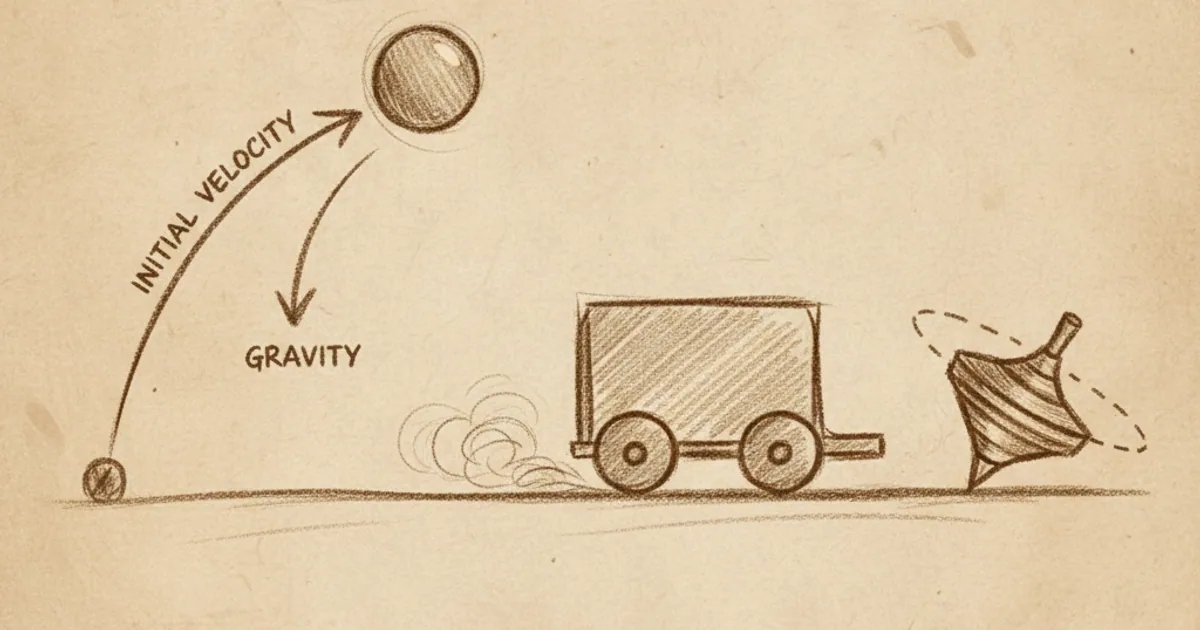
Throw a ball forward at 10 m/s on Earth (no air resistance for simplicity).
The ball's motion is governed by:
1. Initial velocity: 10 m/s forward (horizontal) and 0 m/s vertical at the moment of release.
2. Force: gravity pulls down with acceleration 9.8 m/s². No other forces (idealized).
3. Newton's second law: acceleration = force / mass. The ball accelerates 9.8 m/s² downward.
4. Predictions (assuming you released at chest height, ~1.5 m):
- After 1 second: the ball has moved 10 m forward and fallen 4.9 m. (It's now well below the ground if not caught.)
- The horizontal velocity stays 10 m/s (no horizontal force).
- The vertical velocity increases at 9.8 m/s² (gravity continually accelerating down).
5. Trajectory: a parabola. Maximum range (45° throw, ignoring air) = v²/g, so for 10 m/s, about 10 meters horizontally.
This kind of analysis — break motion into components, apply Newton's laws, solve for what you want to know — is the everyday workhorse of physics and engineering. With air resistance and spin added, the prediction gets more complex but the framework stays the same.
Spinning things: the angular world
Linear motion (moving from A to B) has a parallel set of rules for rotational motion (spinning around an axis).
- Linear velocity has angular counterpart angular velocity (how fast something rotates).
- Linear momentum has angular momentum (resistance to changes in rotation).
- Force has torque (rotational equivalent — push at a distance from the axis).
- Mass has moment of inertia (distribution of mass affects rotational behavior).
- Energy has both kinetic and rotational kinetic forms.
The conservation of angular momentum produces some of the most counterintuitive behavior in classical mechanics. A figure skater pulls her arms in and spins faster. A bicycle stays upright while moving. A gyroscope resists tipping. All of these are angular-momentum effects covered in detail in why bicycles stay up and how gyroscopes resist tipping.
What classical mechanics isn't good at
Classical mechanics is extraordinarily accurate, but it has limits:
At speeds approaching the speed of light — special relativity takes over. Classical predictions become wrong. Time dilates, lengths contract, mass and energy interconvert.
In strong gravitational fields — general relativity takes over. The orbit of Mercury, GPS satellites, and the precession of starlight near the Sun all need GR.
At atomic scales and below — quantum mechanics takes over. Particles don't have definite positions and momenta simultaneously; uncertainty principles kick in.
With many-body chaotic systems — classical mechanics still applies in principle, but the equations become impossibly complex. Weather, three-body gravitational problems, turbulence. We need statistical mechanics, computational methods, or numerical simulation.
Everywhere else — your daily life, every machine you'll ever use, the orbits of most spacecraft, the design of every building, vehicle, and tool — classical mechanics is right.
What you can do with it
Practical things classical mechanics lets you predict:
- The trajectory of any thrown, kicked, or launched object.
- The motion of cars, bikes, vehicles in general.
- The stresses on a bridge, building, or machine part.
- The path of a satellite or planet (to high precision for most cases).
- The behavior of springs, pendulums, oscillating systems.
- The forces in pulleys, levers, gears, and other simple machines.
- The dynamics of fluids (to a useful approximation).
It's the working physics of civilization. Worth understanding, even if it's not the latest physics — it's the physics that actually makes the modern world go.
If you'd like a guided 5-minute course on classical mechanics, NerdSip can generate one.
The takeaway
Classical mechanics is the physics of everyday motion. Three big pillars: Newton's laws (forces cause accelerations, equal and opposite reactions), conservation of momentum (things resist changes in motion), and conservation of energy (total energy stays constant across interactions). Friction usually matters more in daily life than gravity does. Rotational motion has its own counterintuitive rules but follows the same general framework. The theory was largely worked out by Newton in the 1680s and remains accurate enough that engineers and scientists use it for almost everything in the human-scale world.

Comments 0
No comments yet. Be the first to share your thoughts.