Subject
How life on Earth has changed over billions of years — and how we know. Natural selection, fossils, and the weird limbs we inherited.
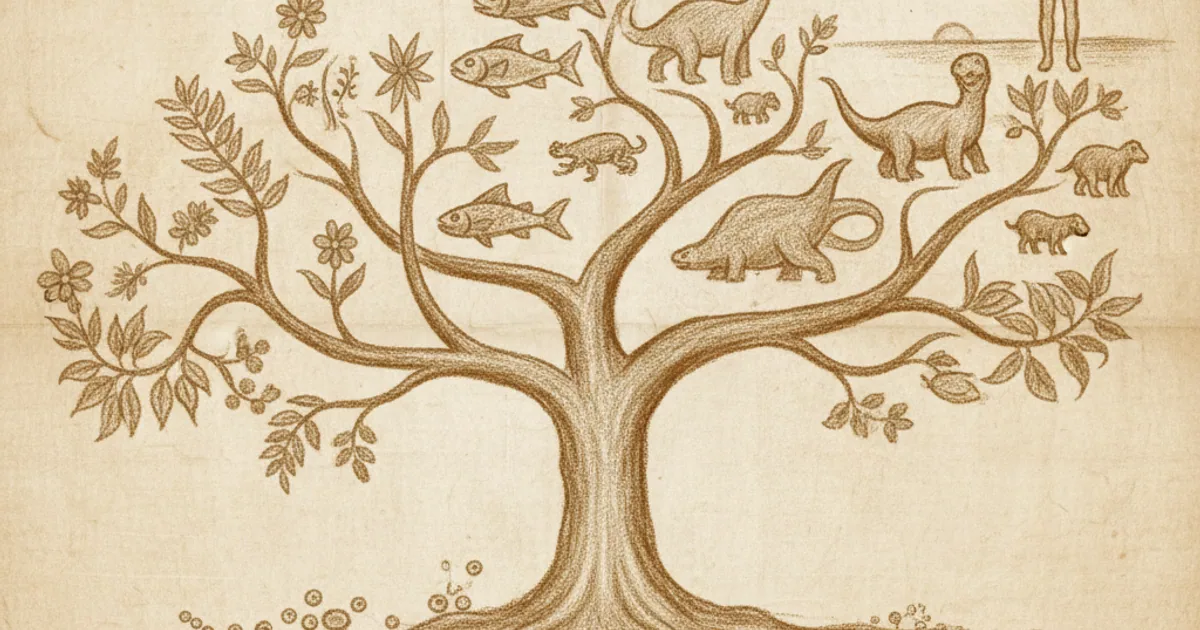
Evolution is change in the heritable traits of a population over generations.
That's it. The definition is simple, and the implications are everything we are.
Note what's NOT in the definition:
The dominant mechanism is natural selection (covered in detail in how natural selection works). The short version:
Result: the population gradually shifts. After enough generations, it can look very different from where it started.
Natural selection isn't the only mechanism. There's also:
Most observed evolutionary change involves several of these acting together.
Three ingredients are sufficient:
Variation — individuals differ. Heredity — offspring resemble parents more than random. Differential reproduction — some variants leave more descendants.
If you have all three, you get evolution. The remarkable thing is that's all you need. No designer, no plan, no goal. Just the math of differential reproduction working on heritable variation.
This is one of those ideas that seems obvious once you see it, and yet took until 1859 (Darwin's On the Origin of Species) to be fully articulated. Variations on the idea had been around longer, but Darwin and Wallace independently nailed the mechanism.
Evolution operates on scales that are hard for human brains to grasp.
If Earth's history were a 24-hour clock starting at midnight:
This deep-time perspective is what makes evolution work. With enough generations, tiny changes accumulate into vast differences.
Why are biologists so confident?
Fossils. The fossil record shows a clear sequence: simple cellular life first, then more complex multicellular life, then increasingly diverse animals, then specific lineages branching. We have fossils of intermediate forms — fish with leg-like fins, dinosaurs with feathers, ape-humans with mixed traits. The sequence matches the timeline predicted by evolution. (See what fossils tell us.)
DNA comparisons. Species with more recent common ancestors have more similar DNA. Humans share ~98.5% of DNA with chimpanzees, ~85% with mice, ~60% with bananas, ~50% with fruit flies. The pattern of similarities forms a tree that closely matches the tree built from fossils and anatomy. Three independent lines of evidence converging on the same family tree.
Direct observation. Evolution has been observed in real time:
Vestigial structures. Bodies carry leftovers from evolutionary history. Whales have tiny hip bones from their land-mammal ancestors. Humans have a vestigial tail bone (coccyx) and the muscles to wiggle ears we no longer prick up. (More in why we have five fingers.)
Biogeography. Species are distributed in ways that match their evolutionary history. Marsupials are concentrated in Australia (separated from other landmasses ~50 million years ago, before placental mammals dominated elsewhere). Pacific islands have unique species that evolved from a few colonizers. The pattern makes sense if species evolved in place from common ancestors; it makes no sense if they were independently created.
Developmental biology. Embryos of related species often start similar and diverge later. Human embryos have gill arches early in development — leftovers from fish ancestors. Snake embryos have leg buds that don't develop. These are signatures of shared ancestry.
Each line of evidence would be suggestive. Together they're overwhelming. The theory of evolution is supported by more independent lines of evidence than almost any other idea in science.
Some common misreadings worth correcting:
"Survival of the fittest" — but what's 'fit'? Not the strongest or most aggressive. Fitness in evolutionary terms means reproductive success — leaving more viable offspring. The fittest organism is the one whose genes propagate most. In some environments that's the strongest; in others it's the most cooperative, the most colorful, the smartest at finding mates. Different environments produce different "fittest" types.
"Evolution is random." Mutation is random. Natural selection is the OPPOSITE of random — it's the systematic preservation of variants that work. Saying evolution is random is like saying writing a novel is random because typos happen. The selection process produces order from random raw material.
"Higher" and "lower" organisms. No species is higher or lower in evolutionary terms. Bacteria are just as evolved as humans — they've been adapting for as long. Different doesn't mean better. Humans aren't the goal; we're a recent twig on an enormous bush.
"Evolution can't explain X (the eye, the bacterial flagellum, etc.)." Each specific case raised has been worked out in detail. Eyes have evolved independently at least 40 times in different lineages, with intermediate forms still existing in living species (light-sensitive patches, cup eyes, simple lenses, compound eyes, complex camera eyes). The "irreducible complexity" argument is a moving goalpost.
"It's only a theory." In scientific usage, theory means an explanatory framework backed by extensive evidence. Theories don't "graduate" into facts. The theory of evolution is at the same scientific status as the theory of gravity, the germ theory of disease, the atomic theory.
Beyond biology, evolution is the foundation of:
You can't understand modern biology without it. Theodosius Dobzhansky's famous line is widely quoted: "Nothing in biology makes sense except in the light of evolution."
If you'd like a guided 5-minute course on evolution and where humans fit, NerdSip can generate one.
Evolution is the change in heritable traits of populations over generations, driven mostly by natural selection acting on random variation. The timescale is billions of years; the evidence comes from fossils, DNA, direct observation, vestigial structures, biogeography, and developmental biology, all converging on the same family tree. It isn't about progress, doesn't say how life began, and isn't a simple ranking with humans at the top. It's the slow accumulation of countless small adjustments — and it has produced every living thing, including the one reading this sentence.
A short editorial reading list. Pick whichever fits how you like to learn.


Comments 0
No comments yet. Be the first to share your thoughts.