
The mechanism
Natural selection is the simplest important idea in biology. Three ingredients, one consequence.
Ingredient 1: Variation. Individuals in a population are not identical. Some are taller, some shorter; some have darker fur, some lighter; some have stronger immune systems, some weaker. Variation comes from random mutations, genetic recombination during sexual reproduction, and random chance during development.
Ingredient 2: Heredity. Traits pass from parents to offspring with high reliability. A tall parent tends to have taller-than-average offspring. The mechanism — DNA being copied and combined — wasn't known to Darwin but doesn't change the logic. Like begets like, with some noise.
Ingredient 3: Differential reproduction. Some variants leave more offspring than others. This can be because they survive longer, reproduce more efficiently, attract more mates, produce more viable young, or any combination.
Consequence. Variants that reproduce more become more common in the next generation. Over many generations, the population shifts. After enough generations, it can be unrecognizably different.
That's it. There's no fourth step. The whole mechanism is "if some variants leave more descendants than others, the population shifts toward those variants over time."
Why it's automatic
Note what natural selection does NOT require:
- A designer. Selection doesn't decide what traits to keep; it's a side effect of differential reproduction.
- An intention. Organisms don't try to evolve. They just live and reproduce.
- Foresight. Selection responds only to current conditions. It can't anticipate.
- Progress. The result isn't "better" in any absolute sense — only better-adapted to current conditions.
- A goal. Populations don't aim anywhere. They just track local environmental pressures.
The process is bookkeeping. Trait X helps reproduce → trait X gets more common. Trait Y hurts reproduction → trait Y gets rarer. Across millions of generations, this bookkeeping reshapes living things into the complex forms we see.
"Fittest" — what it actually means
The phrase "survival of the fittest" causes more confusion than insight. Two common misunderstandings:
Misunderstanding 1: "Fittest" means strongest. In evolutionary terms, fitness means reproductive success, not physical strength. A weak organism that has 10 surviving offspring is fitter than a strong organism with 1.
Misunderstanding 2: "Survival" is the key. Survival matters only insofar as it affects reproduction. An organism that survives long but doesn't reproduce contributes nothing to the next generation. Selection cares about descendants.
What "fit" actually depends on:
- Survival to reproductive age.
- Ability to attract mates (if sexually reproducing).
- Number of offspring produced.
- Survival of offspring to reproductive age (parental care matters).
- Sometimes: survival of close relatives (kin selection).
A trait is "fit" if it increases this composite measure in a particular environment. The same trait can be fit in one environment and unfit in another.
Examples in real time
Natural selection has been observed in measurable detail:
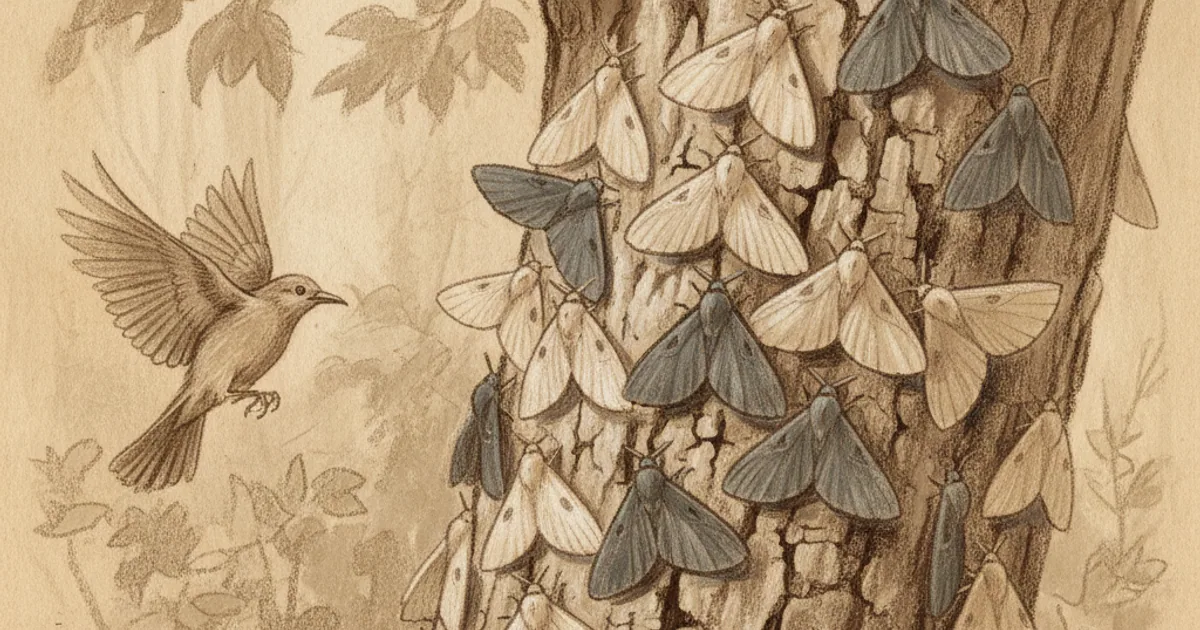
The peppered moth. In England before the industrial revolution, peppered moths (Biston betularia) had light bodies that camouflaged them on lichen-covered trees. After coal-smoke pollution killed lichen and darkened tree bark, dark-bodied moths became dramatically more common — they were now better camouflaged. After pollution was reduced, the light form returned. The change happened over decades and was followed in detail.
Galápagos finch beaks. Peter and Rosemary Grant spent 40 years measuring beak sizes of finches on Daphne Major. During droughts, when only large hard seeds remained, finches with bigger beaks survived better — measurably so. The next generation's beaks were larger. After wet years with abundant small soft seeds, beaks shifted back smaller. Selection was visible from year to year.
Antibiotic resistance. When we use antibiotics, we kill susceptible bacteria but spare resistant ones. Resistant bacteria reproduce and dominate the population. This is selection — fast and brutal because bacteria reproduce in minutes. Hospitals around the world manage this every day.
Pesticide resistance. Same logic with insects. Mosquitoes evolved DDT resistance within years of widespread use. Today's agricultural pests routinely evolve resistance to new pesticides within a decade.
Lenski's E. coli experiment. Richard Lenski has been growing 12 lines of E. coli in his lab since 1988 — now 75,000+ generations. He's watched fitness increase, mutations accumulate, and at one point a line evolved the ability to use citrate (an ability the original strain didn't have). Selection observed continuously for over 30 years.
Lactase persistence in humans. Most adult mammals lose the ability to digest milk. In some human populations — those with long histories of dairying — adults retain the enzyme. The genetic mutation for adult lactose tolerance has spread to ~35% of humans over the last 7,500 years. Selection in our own species, recent enough that you can date it from the genome.
Different types of selection
Natural selection isn't a single thing. It comes in flavors:
Directional selection. Pushes the average trait one direction — towards larger beaks, darker fur, faster running. The classic case.
Stabilizing selection. Favors the average against extremes. Human birth weight is stabilized — both very small and very large babies have lower survival.
Disruptive selection. Favors both extremes against the middle. Can split a population into two distinct forms, eventually two species. Some African crater lakes have fish species that arose this way.
Sexual selection. Mate choice drives trait evolution, sometimes against survival. The peacock's tail is a sexual-selection signature — it's costly and obvious to predators, but females prefer males with bigger tails, so the trait spreads anyway.
Kin selection. Behaviors that help close relatives survive can spread even if they're costly to the individual, because relatives share genes. This is why bees sacrifice themselves to defend the hive — their sisters carry the same genes.
These are different shapes the same basic mechanism takes when applied to different selection pressures.
What selection CAN'T do
Selection has real limits:
No foresight. Selection responds to current conditions. It can't prepare for future ones. If an environment changes faster than populations can adapt, species go extinct. This is happening now with climate change, habitat loss, and ocean acidification.
No backward thinking. Selection can't "redo" features. Vertebrate eyes have the retina mounted backward (with photoreceptors facing away from the light, wired through the front). It's suboptimal. Selection can't redesign; it can only modify what's there.
Only on heritable traits. Skills you learned, accidents you survived, food you ate — these don't pass to offspring (with some epigenetic exceptions). Selection only acts on genetic variation.
Not on what's good for the species. Selection acts on individual reproductive success. Sometimes what's good for individuals harms the species long-term (overpopulation, resource depletion). Selection doesn't care.
Slowly, mostly. Most selection is incremental. Dramatic changes require many generations or rare cataclysms. Don't expect dragons.
Selection isn't random
A common pseudo-objection: "Evolution is random; complex things can't arise from randomness."
Mutation IS random. New variations appear without direction.
Selection is NOT random. It's the systematic preservation of variants that work. It's the opposite of randomness.
Think of it like editing: random typing produces nonsense, but random typing + intelligent editing (keep what looks good, discard what doesn't) eventually produces ordered text. Selection is the editing step. Random mutation provides material; selection imposes order.
The eye, the immune system, the human brain — all are products of millions of generations of this random-mutation + non-random-selection process. The end result looks designed because selection is good at making things look designed. But there's no designer; there's just consistent differences in reproductive success.
If you'd like a guided 5-minute course on how selection actually operates, NerdSip can generate one.
The takeaway
Natural selection works because individuals vary, that variation is partly heritable, and some variants reproduce more than others. Over many generations, the population shifts toward better-reproducing variants. "Fittest" means "reproduces most" — not strongest. The process is automatic, requires no designer, and has been observed in real time across many species. Mutation is random; selection is decidedly not. The order that emerges is the accumulated record of which variants kept making more of themselves.

Comments 0
No comments yet. Be the first to share your thoughts.