
The event
About 540 million years ago, the fossil record changes dramatically. Before that point: simple multicellular life, mostly soft-bodied, mostly featureless. After that point: a sudden burst of complex animals with shells, jointed legs, eyes, jaws, segmented bodies, and the basic body plans we still see today.
In a window of roughly 20-25 million years, most major animal phyla — the deep taxonomic groups like arthropods, molluscs, echinoderms, chordates (our group) — appear in the fossil record. Many show up looking already diverse and specialized, with no obvious simpler ancestors in the immediate prior record.
This is the Cambrian explosion — named after the Cambrian period (538-485 million years ago) where it occurred.
Why "explosion" is a bit misleading
By geological standards, 20-25 million years is fast. By human standards, it's an unfathomably long time.
Compare:
- The Cambrian explosion: ~20-25 million years.
- All of dinosaur dominance: ~175 million years.
- Time since the dinosaur extinction: 66 million years.
- Time since humans split from chimps: ~7 million years.
- All of recorded human history: ~5,000 years.
A 20-million-year window has room for hundreds of major evolutionary changes. The "explosion" is fast relative to the 3 billion years of single-cell life that preceded it, not fast in absolute terms.
It also wasn't a single event. The "explosion" is shorthand for an extended period of rapid diversification, with different groups appearing over the window. Some animal groups (cnidarians like jellyfish, simple sponges) predate it by hundreds of millions of years. Others appear well into the Cambrian.
Still, something genuinely unusual happened. The fossil record before the Cambrian shows mostly microbial mats and soft-bodied Ediacaran fauna. The fossil record after shows recognizable ancestors of crabs, snails, starfish, and fish. The transition isn't smooth.
What might have caused it
There's no single explanation. Most modern accounts include several interacting factors:
Rising ocean oxygen. Before the Cambrian, ocean oxygen was lower. Higher oxygen enables larger, more active bodies (oxidative metabolism powers muscles and large nervous systems). Multiple measurements suggest oxygen levels rose to near-modern values around the time of the explosion. More oxygen = more complex animals possible.
The evolution of vision. Andrew Parker proposed the "light switch hypothesis": early Cambrian saw the evolution of complex eyes, which enabled active predation and visual escape. Predator-prey arms races could rapidly drive evolution of armor (shells, exoskeletons), better movement, better senses. Many Cambrian animals have eyes; Pre-Cambrian organisms generally don't.
Hox genes and developmental toolkits. The genetic infrastructure for building complex segmented bodies — hox genes, which lay out body plans during embryonic development — may have evolved in the Pre-Cambrian and become flexible enough to enable rapid body-plan innovation. Once you have the tools to build different body plans, evolution can experiment quickly.
Ecological opportunity. The mass extinction at the end of the Ediacaran (~540 million years ago) may have cleared out earlier life, leaving ecological niches empty. Empty niches drive rapid adaptive radiation as new species fill them. This pattern repeats throughout Earth's history (e.g., mammals after dinosaurs).
Hard parts evolved. Many Pre-Cambrian organisms had only soft bodies and rarely fossilized. The Cambrian saw the widespread evolution of shells, exoskeletons, and other mineralized parts, partly because of changing seawater chemistry. Hard parts not only allowed armor and structure but also fossilize much better — so part of the "explosion" is an artifact of better preservation, not just rapid evolution.
Climate stabilization. Earth went through severe "Snowball Earth" glaciations in the late Pre-Cambrian. After they ended, climate stabilized. Stable climates allow longer-lived ecosystems and more sustained evolutionary change.
Most scientists now think it's a combination: rising oxygen made complex bodies possible, hox-gene toolkits made body-plan innovation possible, vision and predation drove arms-race evolution, ecological opening from extinctions cleared space, and hard parts emerged and fossilized.
The fossils
Our knowledge of Cambrian life comes mostly from a few extraordinary fossil sites that preserved soft-bodied organisms — "Lagerstätten" (sites of exceptional preservation):
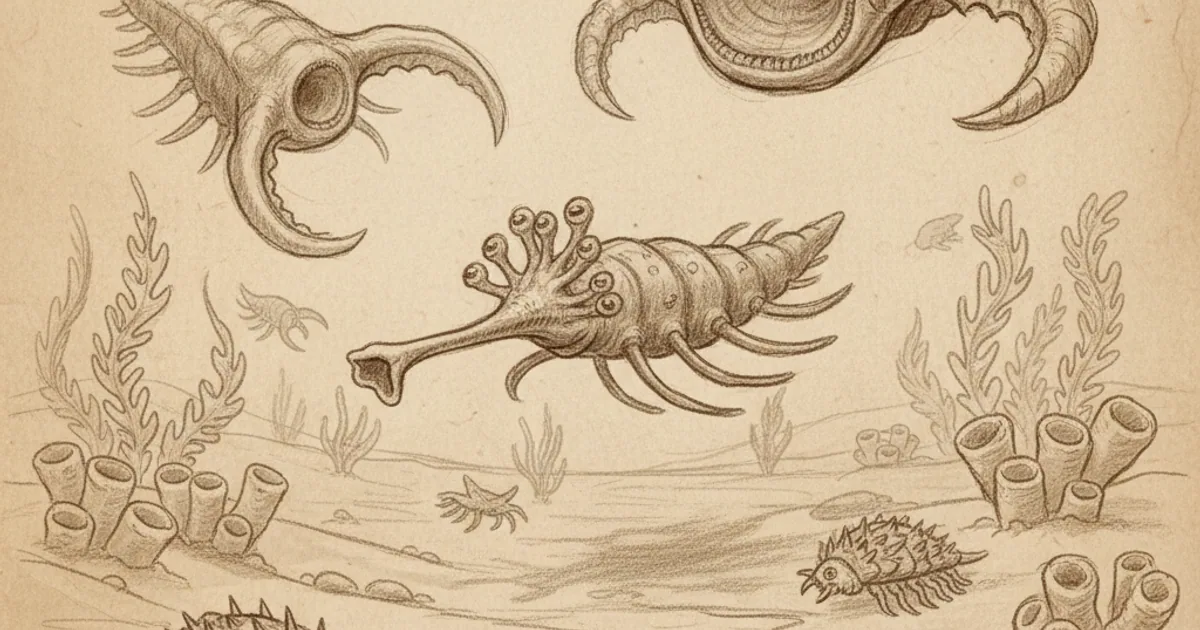
Burgess Shale (British Columbia, Canada). Discovered in 1909 by Charles Walcott. Preserved Cambrian creatures in extraordinary detail, including soft tissues. The site is famous for bizarre animals that don't fit any modern group — Opabinia (five eyes, long grasping nozzle), Hallucigenia (spike-backed worm; for decades scientists couldn't tell which side was up), Anomalocaris (meter-long predator), and many others.
Chengjiang fauna (Yunnan, China). Discovered in 1984. Slightly older than Burgess Shale, preserving similar exceptional detail. The chordate Myllokunmingia found here is one of the oldest known vertebrate ancestors — meaning the ancestor of all fish, amphibians, reptiles, birds, and mammals (including us) was already swimming in Cambrian seas.
Sirius Passet (Greenland) and Emu Bay Shale (Australia) are other major Cambrian Lagerstätten.
These sites suggest the Cambrian seas were filled with vastly more diversity than typical fossil records show — many soft-bodied organisms left no trace elsewhere. Without these preservation windows, we'd know much less.
Failed experiments
Not every Cambrian body plan survived. Many forms went extinct without descendants. Stephen Jay Gould's 1989 book Wonderful Life argued that Cambrian biology had MORE major body plans than modern biology — that there used to be more "phyla" and most went extinct, leaving us with the survivors.
Later analysis revised this somewhat: many of the "alien" Cambrian forms turn out to fit (loosely) into modern phyla as early or unusual members. But still, plenty of Cambrian organisms have no clear modern descendants.
The unsurvivors:
- Opabinia: five-eyed predator with a long flexible proboscis ending in a grasping claw. Looked like a sci-fi creature. No close modern relatives.
- Anomalocaris: top Cambrian predator, up to a meter long, with paired feeding appendages and a circular mouth lined with teeth. The largest known Cambrian animal. Its modern relatives are arthropods generally but no direct lineage survives.
- Hallucigenia: about 3 cm long, spines, multiple pairs of legs. Took decades to figure out it was a precursor to modern velvet worms (Onychophora).
- Wiwaxia: scale-armored slug-like creature. Mollusc-related, but unique.
The pattern is consistent with evolution: a burst of experimentation, most lineages going extinct, a few surviving and diversifying into modern groups.
What it doesn't mean
The Cambrian explosion is sometimes invoked in arguments against evolution: "How could so many body plans evolve so fast?" Several points:
It wasn't that fast. 20-25 million years is plenty of evolutionary time.
Animals didn't suddenly appear from nothing. Pre-Cambrian life included Ediacaran organisms, sponges, cnidarians, and almost certainly simple worms — soft-bodied ancestors that rarely fossilized. Molecular clock estimates suggest animal groups diverged before the Cambrian; they just didn't fossilize well until they evolved hard parts.
Many transitional fossils exist. Even within the Cambrian itself, there are sequences of increasingly complex forms.
Multiple causes are well-documented. Rising oxygen, hox-gene innovations, ecological opportunity, and predator-prey arms races are all evidenced by independent measurements.
The Cambrian explosion is unusual but not magical. It's an extended period of rapid evolutionary diversification driven by interacting factors — exactly the kind of event evolutionary theory predicts when conditions favor it.
If you'd like a guided 5-minute course on the Cambrian explosion and what we know about it, NerdSip can generate one.
The takeaway
The Cambrian explosion was an evolutionary diversification, beginning about 540 million years ago, in which most major animal body plans appear in the fossil record over roughly 20-25 million years. Causes likely include rising ocean oxygen, the evolution of vision and predation arms races, the development of genetic toolkits for building complex bodies, ecological opportunities after earlier extinctions, and the spread of mineralized hard parts that also fossilize better. It was fast by geological standards but not magically fast — and it produced both the ancestors of modern animals and many strange experimental forms that didn't survive. The Burgess Shale, Chengjiang, and similar fossil sites preserve a window into one of life's most creative periods.

Comments 0
No comments yet. Be the first to share your thoughts.