
The pattern
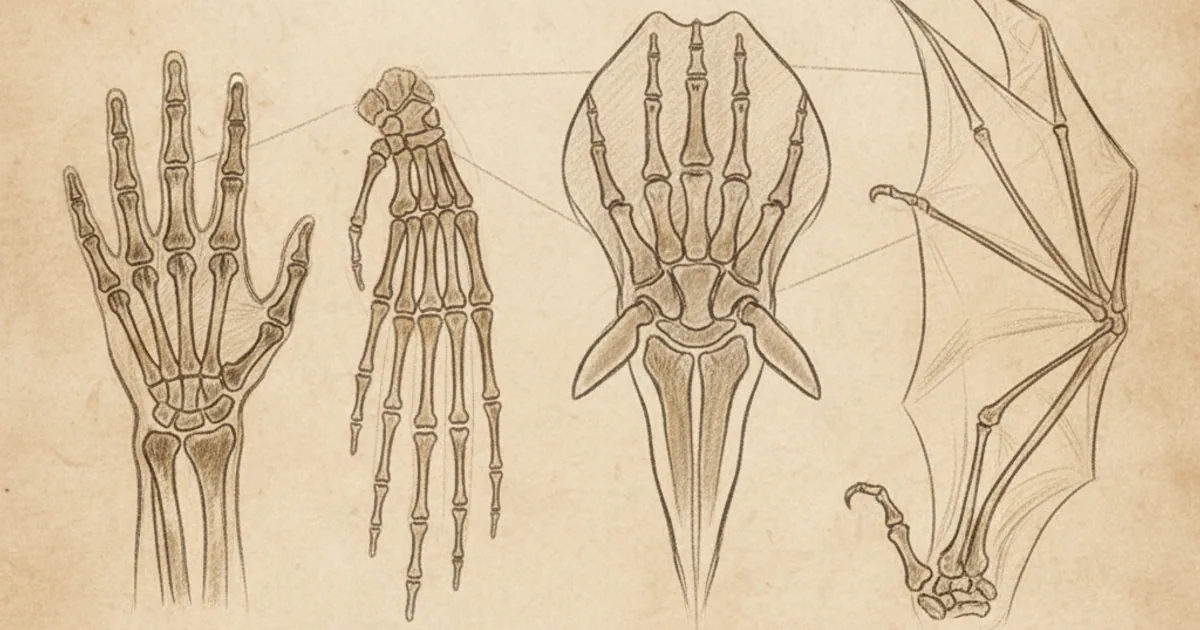
Look at your hand. Five fingers. Now look at the wing of a bat. Five fingers. The flipper of a dolphin. Five fingers (in the bone structure). The wing of a bird. Three visible — but five in the developmental program, with two fused or reduced.
This same pattern repeats across nearly every land-living vertebrate. It's called the pentadactyl limb: one bone, then two bones, then a wrist of small bones, then five digits. Humerus → radius and ulna → carpals → five fingers.
Why?
The short answer
Because we all inherited it from the same ancestor.
About 370 million years ago, an early tetrapod (four-legged vertebrate) crawled from water onto land. Its descendants — eventually including amphibians, reptiles, birds, and mammals — all kept the same basic limb structure. Different lineages modified it for their needs:
- Horses lost most fingers; they walk on a single digit per foot, the rest reduced to vestigial bones.
- Bats elongated four fingers into wing supports, with a free thumb.
- Whales fused everything into a flat flipper; the five-bone pattern is visible only in their skeleton.
- Birds fused several digits into a wing tip.
- Snakes lost limbs entirely, but their genome still carries the pentadactyl developmental program; many snakes have tiny vestigial pelvic bones.
- Humans kept all five flexible.
These look very different on the outside. But X-ray any of them and the same five-bone underlying pattern is visible. Different modifications of the same inherited blueprint.
Why this isn't optimal design
If a designer were starting fresh, would they pick five fingers? Probably not — the number is arbitrary. The reason we all have five is history, not function.
A startling fact: the earliest tetrapods, the ones that first crawled onto land, had MORE than five digits. Acanthostega (~365 million years ago) had eight digits per limb. Ichthyostega had seven. Tulerpeton had six.
Five was the pattern that became fixed in the common ancestor of all modern tetrapods, possibly because of developmental constraints — the genetic toolkit for forming digits stabilized around five. Once that pattern was locked in, evolution worked with what was there.
This is sometimes called a frozen accident — a feature that's arbitrary in itself but maintained because changing it would be too disruptive to development. Five digits became the basis for all subsequent vertebrate limb evolution. Lineages could reduce them (horses, cows), fuse them (birds), or modify them (bat wings), but starting over with seven was no longer an option.
Homology — the signature of common ancestry
The technical term for "same structure, inherited from a common ancestor" is homology.
Pentadactyl limbs are textbook homology. The bones of your hand, a chimp's hand, a bat's wing, a whale's flipper, and a frog's foot are homologous — they're modified versions of the same ancestor's limb.
Crucially, homology is different from analogy. Bird wings and insect wings both fly, but they're built on entirely different structures — birds use modified front limbs (still pentadactyl underneath), insects use exoskeleton outgrowths. Those are analogous (same function, different structure). Bird wings and bat wings are homologous (same structure, different function in some cases).
Homologous structures are one of the strongest pieces of evidence for evolution. If species had been independently designed, there'd be no reason to share underlying anatomy. If they evolved from common ancestors, you'd expect to see the same patterns modified for different uses — which is exactly what we see.
Other homologies in vertebrates:
- Same skull bones (modified)
- Same backbone structure
- Same major arteries and nerves
- Same hox genes laying out body segments
The whole vertebrate body is built from inherited pieces, modified differently in each lineage.
How development locks in five
Why is five so stable across so many millions of years? The answer involves hox genes and limb development.
When a vertebrate embryo grows a limb, signaling molecules (sonic hedgehog, fgf8, others) flow through the developing limb bud, telling cells where they are and what to become. The system has multiple feedback loops and overlapping signals. Once five digits became the default, the developmental machinery became deeply intertwined with that number. Adding or removing digits requires disrupting many connected signaling networks at once.
This makes evolution conservative for digit number. Reducing digits is somewhat easier — you just turn off late-stage growth (which is what horses, cows, and ostriches do). Adding a sixth full digit is harder because there's no slot in the existing developmental program for it.
Polydactyly (extra fingers) does occur in humans — about 1 in 1000 live births. It's usually a developmental hiccup, often hereditary. But extra fingers don't tend to be functional in the same way, and they're typically removed surgically. Evolution hasn't found a strong reason to standardize on six.
Modifications across the vertebrate tree
The same pentadactyl pattern shows up everywhere, modified:
Horse leg: only digit 3 (middle finger) is the load-bearing toe. Digits 2 and 4 are reduced to splint bones inside the leg. Digits 1 and 5 are gone or vestigial. Result: a single hoof, but developmentally still based on the five-digit plan.
Cow leg: digits 3 and 4 are the load-bearing pair (cloven hoof). Digits 2 and 5 are reduced. Digit 1 is gone.
Bird wing: digits 1, 2, and 3 (or 2, 3, 4 — there's a long debate) are fused into the wing tip. Some are reduced or absent.
Bat wing: thumb is free and small; digits 2-5 are dramatically elongated and connected by skin membranes.
Whale flipper: all five digits present in the skeleton, encased in a streamlined fleshy paddle. The internal structure looks remarkably like a human hand under X-ray.
Snake: typically no limbs at all, but pythons and boas retain vestigial pelvic bones — evolutionary leftovers from when their ancestors had hind legs.
Frog: four functional digits on the forelimbs, five on the hind. The forelimb fifth digit is reduced or absent.
Each modification fits the lineage's lifestyle. None starts from scratch. All build on the inherited five-digit framework.
Vestigial structures more generally
The pentadactyl limb is part of a broader pattern: bodies carry leftovers from evolutionary history that no longer have a function or have reduced function.
Other examples:
- Human appendix: a small pouch off the large intestine; functional in herbivorous ancestors for digesting plant material.
- Coccyx (tailbone): remnants of a tail in our ancestors.
- Goosebumps: muscles trying to raise hair that's no longer there for insulation or defensive display.
- Wisdom teeth: third molars that often don't fit in modern smaller jaws.
- Whale pelvis: small floating bones from their land-mammal ancestors.
- Cave fish eyes: blind cave fish often have eye structures that develop and then degenerate, useless in dark water.
Vestigial doesn't mean useless — some structures with reduced function still do something. But the structure is there because of inheritance, not because evolution designed it for current purpose.
If you'd like a guided 5-minute course on evolutionary inheritance in your own body, NerdSip can generate one.
The takeaway
We have five fingers because a tetrapod ancestor 370 million years ago happened to standardize on five digits, and all its descendants — humans, bats, whales, horses, birds — inherited and modified that pattern. Five isn't optimal; it's historical. The shared pentadactyl skeleton across very different-looking animals is one of the clearest pieces of evidence for common descent: same underlying structure, different functions, all explainable as modifications of one ancestor's body plan. Look at your hand and you're looking at a 370-million-year inheritance.

Comments 0
No comments yet. Be the first to share your thoughts.