
What a fossil actually is
A fossil is the preserved remains or trace of an organism that lived in the past.
Two main kinds:
Body fossils. Actual remains of the organism. Usually hard parts — bones, teeth, shells, woody plant tissue. Sometimes minerals replaced the original material molecule by molecule (petrified wood, mineralized bones). Rarely, fast burial in volcanic ash, amber, ice, or tar preserves soft tissue.
Trace fossils. Records of behavior — footprints, burrows, dung (coprolites), nests, tool marks. Trace fossils tell us about how organisms moved and lived, not just their anatomy.
Both types form rarely. Most organisms die and decompose entirely. Soft-bodied creatures almost never fossilize except in extraordinary circumstances. The fossil record is biased toward hard-shelled marine organisms in fine sediment — they're over-represented compared to forest-dwellers, soft-bodied animals, and microbes.
How fossilization works
For a fossil to form, several things must go right:
Quick burial. Before scavengers and decay finish the body. This usually means dying in or near sediment — riverbeds, lake bottoms, ocean floors, occasionally tar pits or volcanic ash deposits.
Suitable sediment. Fine particles (mud, silt) preserve detail; coarse sand doesn't. Anoxic conditions (no oxygen) slow decay.
Mineralization. Over thousands to millions of years, groundwater carrying dissolved minerals seeps through the buried remains. Minerals fill spaces, sometimes replacing original material atom by atom (permineralization, replacement).
Geological survival. The fossil-bearing rock must survive without being melted, metamorphosed, dissolved, or eroded entirely. Then eventually, it must reach near the surface for us to find it.
Someone finding it. Most fossils are still in the ground. Discovered fossils are a tiny fraction.
The whole sequence is unlikely. The fossil record we have represents perhaps a thousandth of a percent of past species. Every fossil is something of a miracle.
How fossils are dated
Two big approaches:
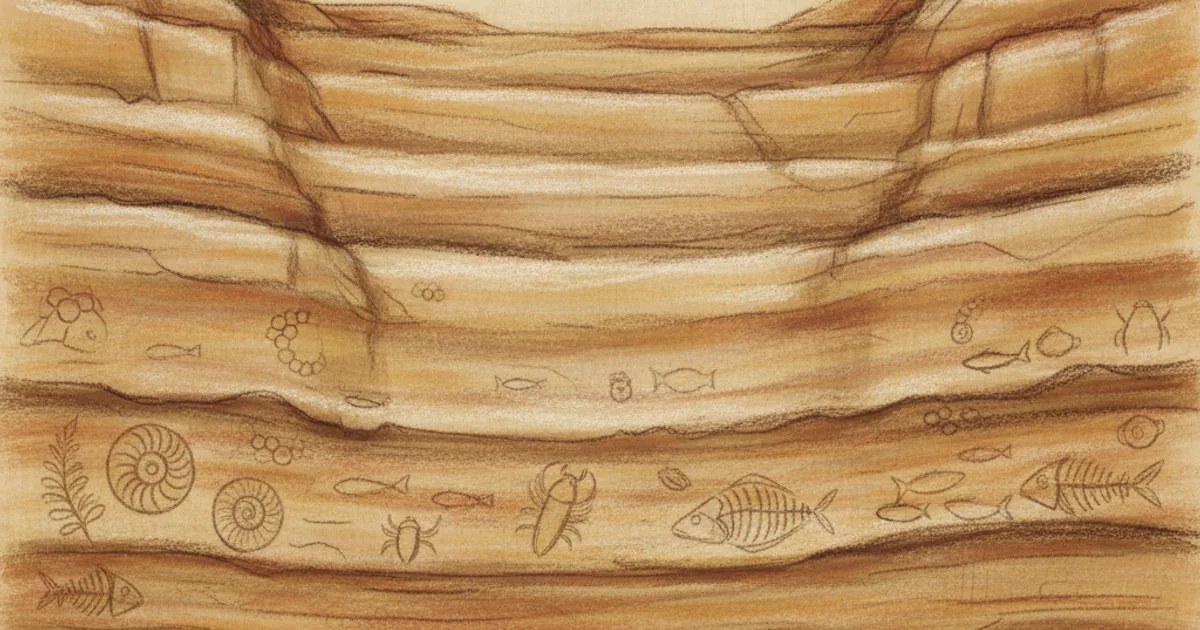
Relative dating — stratigraphy. In undisturbed sedimentary rock, deeper layers are older. A fossil found in a deeper layer is older than one found in a shallower layer in the same column. This was the original method, used by William Smith in early-1800s England to map rock strata. It gives order but not absolute ages.
Absolute dating — radiometric methods. Certain radioactive isotopes decay at known, constant rates. By measuring the ratio of original isotope to decay product, you can calculate how long ago the rock formed.
Different isotopes work over different time ranges:
- Carbon-14: half-life ~5,700 years. Good for organic material up to ~50,000 years.
- Potassium-40 → Argon-40: half-life 1.25 billion years. Good for volcanic rocks from 100,000 to billions of years.
- Uranium-238 → Lead-206: half-life 4.47 billion years. Good for the oldest rocks, including dating Earth itself.
- Uranium-235 → Lead-207, Rubidium-87 → Strontium-87, and others fill other ranges.
Most fossils can't be dated directly. Sedimentary rock (where fossils form) doesn't usually contain datable minerals. So palaeontologists date the volcanic ash layers above and below fossil-bearing strata, bracketing the fossil's age. With enough overlapping bracket measurements across many sites, the timeline becomes very precise.
Cross-checking. When multiple methods, applied to the same rock, give the same age, confidence is high. This consistency across independent dating techniques is part of why scientists trust the geological timescale.
What the record shows
After two centuries of paleontology, the picture is reasonably clear:
Earliest evidence of life: chemical signatures and microbial fossils ~3.5-3.8 billion years ago. Just single cells.
Multicellular organisms: ~1.5 billion years ago.
Complex multicellular animals: ~600 million years ago — the Ediacaran biota, soft-bodied alien-looking organisms.
Cambrian explosion (~540 million years ago): most major animal body plans appear in the fossil record within a relatively short period. See the Cambrian explosion explained.
Vertebrates: fish ~520 million years ago; amphibians ~370 million; reptiles ~320 million; mammals ~225 million; birds ~150 million.
Dinosaurs: dominant land animals from ~240 to 66 million years ago. Their extinction (probably triggered by an asteroid impact at the Cretaceous-Paleogene boundary) opened ecological space for mammals.
Modern mammal groups: diversified rapidly after 66 million years ago.
Hominins: branched from chimp lineage ~6-7 million years ago. Various species (australopithecines, Homo erectus, Neanderthals) preceded Homo sapiens.
Homo sapiens: ~300,000 years ago. Agricultural civilizations: ~12,000 years.
Each transition predicted by evolution can be found in the record at the right time. The order is consistent: simple → complex, fewer → more diverse, no overlap of major groups before they could have evolved.
Transitional fossils
A major prediction of evolution: there should be fossils with mixed features bridging major groups. We have many:
Tiktaalik (375 million years ago). A "fishapod" with fish gills and scales but also lobed fins capable of supporting weight and a flat amphibian-like head. Found in Arctic Canada in 2004 after Neil Shubin's team predicted where in time and which rocks to look in — and got it.
Archaeopteryx (~150 million years ago). A small theropod dinosaur with feathers, teeth, and a long bony tail. Mosaic of reptilian and avian features.
Ambulocetus ("walking whale", ~50 million years ago). An early whale ancestor with legs, capable of walking on land, hunting in water. Part of a well-fossilized sequence from land-dwelling artiodactyls to fully aquatic whales.
Australopithecus (~3-4 million years ago). Upright walking, but with smaller brains and ape-like jaws. The famous "Lucy" skeleton.
Pakicetus, Rodhocetus, Basilosaurus: a step-by-step whale-evolution sequence over ~10 million years.
Therapsids: mammal-like reptiles bridging reptile and mammal anatomy.
Pikaia, Haikouichthys: early chordate and proto-vertebrate fossils from the Cambrian.
When Darwin wrote in 1859, transitional fossils were sparse. The phrase "missing link" came from that gap. In the 165 years since, paleontologists have found thousands of transitional forms. The phrase has lost most of its sting.
What fossils can't tell us
Real limits:
Soft tissue. Most soft tissues don't fossilize. We rarely have skin, muscles, brain. We get clues from impressions, occasional exceptional preservation, and inference from related living species — but most of the body is gone.
Behavior. Some behavior can be inferred (footprints, predator-prey traces, nest sites), but most behavior is invisible. Did Tyrannosaurus roar like in movies? Probably not — soft tissue evidence and bird-relative comparison suggests low rumbling sounds. But we can't be sure.
Color. Sometimes preserved in feathers and shells via melanin granules. Often not. Most dinosaur color reconstructions are educated guesses.
Genetics. DNA degrades. Ancient DNA can sometimes be recovered from very recent fossils (mammoths, Neanderthals, ~100,000-year ranges in cold preservation). Older DNA is essentially impossible — too degraded.
Species boundaries. Different fossils that look slightly different might be different species, different sexes, juveniles vs adults, or normal variation. Telling these apart is hard without living examples to compare.
Most species. The fossil record probably samples less than 1% of species that have lived. There are entire groups of organisms we may never find.
What the record DOES tell us, very reliably
Despite limits:
Sequence. The order of appearance of major groups is highly consistent and matches what evolution predicts. Nothing modern appears before its evolutionary precursors.
Diversification patterns. Mass extinctions and recovery, adaptive radiations after empty ecological space, gradual change interrupted by punctuated rapid changes.
Geography. Distribution of fossils tells us about ancient continents (Pangaea, plate movements), ancient climates, ancient ecosystems.
Anatomy. Fossils reveal anatomical transitions in detail — the gradual change from leg-finned fish to true legs in amphibians, the steps from theropod dinosaurs to birds.
Timing. Major events have absolute dates. The dinosaur extinction is 66.0 million years ago, give or take ~10,000 years.
It's a fragmentary record. But the pieces that survived tell a coherent story.
If you'd like a guided 5-minute course on the fossil record and how we read it, NerdSip can generate one.
The takeaway
Fossils form when organisms are buried quickly in suitable sediment and survive geological upheaval for millions of years. They're dated by radiometric decay of minerals in nearby rocks, by stratigraphic position, and by cross-correlation across sites. The record we have, though incomplete, shows a clear and consistent sequence: simple life first, then complex, then diversifying into modern groups. Transitional fossils between major groups exist for fish-to-amphibian, dinosaur-to-bird, ape-to-human, and many others. The fossil record is the deepest direct evidence we have for the history of life on Earth.

Comments 0
No comments yet. Be the first to share your thoughts.