
The headline
Light comes in from the Sun. It hits a piece of silicon. Electrons in the silicon get knocked loose by the light. The way the silicon is built, those freed electrons all flow in the same direction — out of the panel, through a wire to whatever you've plugged in, and back into the panel on the other side.
That flow of electrons is electric current. That's a solar panel.
The physics is the photoelectric effect — the phenomenon Einstein won his 1921 Nobel Prize for explaining. Light delivers energy in discrete packets (photons), and if a photon has enough energy, it can free an electron from an atom. Different materials require different photon energies, but the principle is universal.
What silicon is doing
Pure silicon by itself wouldn't make a good solar panel — freed electrons would just rattle around and re-attach. The trick is to dope silicon with traces of other elements to create a built-in electric field.
N-type silicon is doped with phosphorus, which has one more outer electron than silicon. The extras float around as "free" electrons, ready to flow.
P-type silicon is doped with boron, which has one fewer outer electron. This creates "holes" — missing electrons that behave like positive charges (because surrounding electrons can shift into the hole, leaving a new hole next to them).
When you put an N-type and P-type layer in contact, free electrons near the boundary drift from N to P, and holes drift from P to N. After a tiny migration, a permanent electric field is set up across the boundary (called the p-n junction) that prevents further drift. The N side ends up slightly negative, the P side slightly positive.
This built-in field is the engine of the solar cell. When a photon comes in and knocks an electron loose somewhere in the silicon, the field sweeps the electron one way and the hole the other. They can't recombine because they've been physically separated. Connect a wire between the two sides and the electrons flow through the wire as current.
What a photon needs
Not every photon can free an electron. The photon needs at least enough energy to break the silicon bond and lift the electron into the "conduction band" where it can move freely. For silicon this minimum energy (the band gap) is about 1.1 electron-volts, corresponding to a wavelength of about 1100 nm — the near-infrared boundary.
- Photons of visible light (380-700 nm) have more than enough energy. Each one freed electron, with the extra energy becoming heat.
- Photons of infrared light (700-1100 nm) have just enough.
- Photons of longer infrared (>1100 nm) don't have enough — they pass through silicon without effect.
- Photons of ultraviolet (<380 nm) have lots of energy, but most of the extra above 1.1 eV becomes heat, not extra current.
This is why silicon panels max out around 33% efficiency (Shockley-Queisser limit). Long-wavelength photons miss entirely; short-wavelength photons deliver excess energy that becomes waste heat. Only a band in the middle is well-matched to the silicon band gap.
To get past this limit, you can stack cells with different band gaps — "tandem" or "multi-junction" cells. The top cell catches high-energy photons; the next catches medium; the bottom catches low. Each one is matched to its share of the spectrum. Lab records using this technique exceed 47%. It's expensive, though, which is why most commercial panels are still single-junction silicon.
The full picture of a solar panel
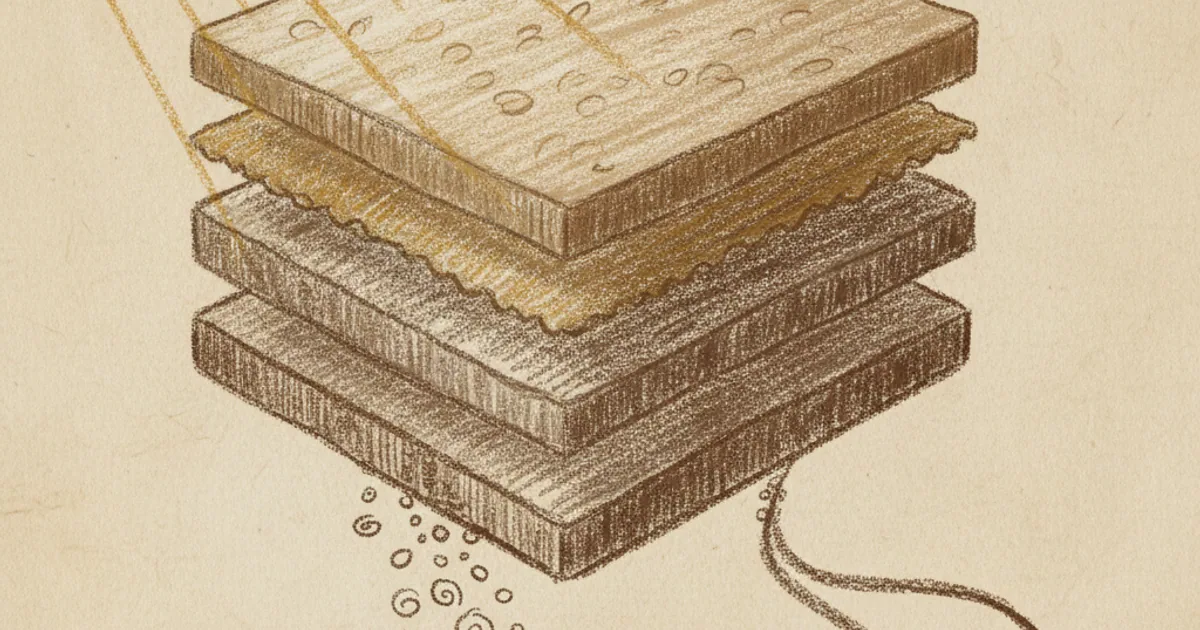
A modern panel is a sandwich:
Top layer: anti-reflective coating (a thin film tuned to reduce light bouncing off rather than entering).
Glass cover: protects the silicon from weather and physical damage.
Front electrical contact: a grid of thin metal "fingers" that collects electrons without blocking too much light. Designers want the contacts to be both highly conductive and minimally shadowing — a real engineering trade-off.
N-type silicon layer: thin, top side.
P-type silicon layer: thicker, bottom side.
Back electrical contact: usually a full metal sheet under the silicon.
Encapsulation and backing: weather-resistant polymer to seal everything.
Panels are made of many individual cells (typically about 15 cm square) wired in series and parallel to get a useful voltage and current. A standard residential panel might have 60-72 cells producing about 30-40 volts at peak.
Multiple panels wire into an inverter that converts the DC from the panels into AC for the grid or your home appliances.
How efficient are they?
Commercial silicon panels typically achieve 18-23% efficiency — meaning 18-23% of the energy in incoming sunlight becomes usable electricity. The rest is:
- Reflected (~5-10%, reduced by anti-reflective coatings).
- Transmitted through without effect (~10-15%, the long-wavelength miss).
- Lost as heat in the silicon (~30-40%, the photon excess-energy loss).
- Lost in resistive heating of contacts and wires (a few %).
- Lost to recombination (electrons re-attaching before reaching the contacts; minimized by careful materials engineering).
For comparison, photosynthesis converts ~3-6% of sunlight to plant chemical energy. Industrial solar panels are roughly 5x more efficient than the best plants.
Lab records keep climbing. The current single-junction silicon record is ~26%. Multi-junction lab cells exceed 47%. Each fraction-of-a-percent improvement in commercial efficiency translates to billions of dollars in industry revenue, so there's intense effort to push the numbers up.
The cost story
Solar panel costs have dropped about 99% since 1980. This is one of the most consistent technology cost curves ever measured.
Roughly:
- 1976: ~$80 per watt (in 2020 dollars).
- 2000: ~$5 per watt.
- 2020: ~$0.30 per watt.
- 2025: ~$0.15 per watt for panels alone.
The cost decline follows Wright's Law (also called the experience curve): cost drops by a roughly constant percentage each time cumulative production doubles. For solar, every doubling cuts costs by about 20%. Manufacturing scale, process improvements, and competitive markets have driven this consistently for decades.
The result: utility-scale solar electricity is now cheaper than electricity from new fossil fuel plants in most of the world. Combined with cheap battery storage (also dropping fast), solar is reshaping global electricity systems. As of the mid-2020s, solar is the fastest-growing electricity source globally.
What solar panels can't (easily) do
Solar isn't a silver bullet:
They produce when the sun shines. Output drops 80%+ on overcast days. Goes to zero at night. Storage (batteries, pumped hydro, hydrogen) or transmission from sunnier regions is needed to fill the gaps.
They're spread out. Solar energy is dilute. Even in sunny climates, 1 kW of average solar power needs about 5 square metres of panel. Replacing a 1 GW fossil plant with solar requires square kilometres.
They take up land. Rooftop solar is great but doesn't scale to civilization-level needs. Utility-scale solar farms need land, which sometimes competes with agriculture or natural habitat.
They degrade slowly. Modern panels lose about 0.5% efficiency per year. After 25 years they're at ~88% of original output. Not "forever" but a long, useful life.
Their environmental cost isn't zero. Manufacturing silicon panels uses energy (mostly recovered in 1-2 years of operation), some hazardous chemicals, and minerals like silver. The footprint per unit energy is far lower than fossil fuels but not zero.
Recycling is immature. Old panels are often landfilled. The industry is working on recycling but isn't there yet.
These are real limits, but they don't prevent solar from being a major energy source. They just mean solar fits into a system alongside storage, transmission, and other clean sources.
A quick history
- 1839: Edmund Becquerel discovers the photovoltaic effect in liquid electrolytes.
- 1883: Charles Fritts builds the first solid solar cell using selenium, ~1% efficient.
- 1905: Einstein explains the photoelectric effect with quantized light.
- 1954: Bell Labs creates the first practical silicon solar cell, ~6% efficient.
- 1958: Vanguard 1 satellite launched with solar panels — beginning of solar power in space.
- 1970s: Oil crisis drives research interest; costs still very high.
- 1980s-90s: Niche use; cost slowly declining.
- 2000s: German feed-in tariffs catalyse mass production; costs drop fast.
- 2010s: China dominates manufacturing; costs crash; solar becomes competitive with fossil fuels in sunny regions.
- 2020s: Solar is the cheapest new electricity source in most of the world; deployment accelerating.
The technology took ~150 years from first observation to mass deployment. The acceleration of the last 20 years is one of the fastest energy transitions in history.
If you'd like a guided 5-minute course on solar physics and how panels are made, NerdSip can generate one.
The takeaway
A solar panel is silicon doped with traces of other elements to create a permanent electric field. Photons knock electrons loose; the field sweeps them out as current. Modern panels convert ~20% of incoming sunlight to electricity, dropping in cost about 99% since 1980. They're now the cheapest new electricity source in most of the world, though they need storage or transmission to handle the day-night and cloud-cover variation. The underlying physics — the photoelectric effect — is what won Einstein the Nobel Prize. A century later, it powers an industry.

Comments 0
No comments yet. Be the first to share your thoughts.