
The core trick
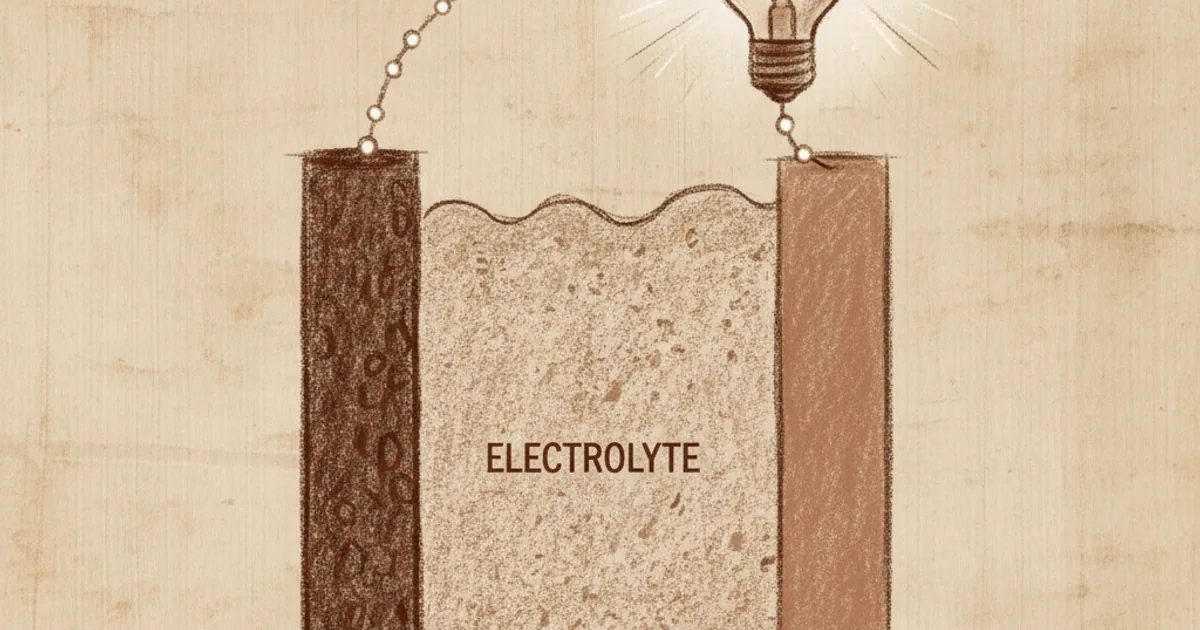
A battery is two materials that want to chemically react, but can only do so if electrons flow through a wire you provide.
That's the whole trick. You set up a chemical reaction that wants to happen — one material wants to lose electrons, another wants to gain them — and then physically separate the two materials so that the only way electrons can get from one side to the other is through an external wire. When you connect that wire, electrons flow through whatever you've wired up (a lightbulb, a phone, a car motor) and back to the other material.
That flow of electrons is the current. The energy comes from the chemical reaction. Everything else is engineering.
The three essential parts
Every battery has three core components:
Anode (negative terminal). A material that wants to lose electrons during discharge. In a typical lithium-ion battery, this is graphite (with lithium atoms tucked between the layers).
Cathode (positive terminal). A material that wants to gain electrons during discharge. In lithium-ion, often a lithium cobalt oxide or lithium iron phosphate.
Electrolyte. A material between them that lets ions (charged atoms) flow back and forth, but not electrons. This is what forces electrons to go around the external circuit rather than just shorting across the battery.
When the battery discharges:
- At the anode, atoms lose electrons (become positively charged ions) and dissolve into the electrolyte.
- Those ions migrate through the electrolyte to the cathode.
- The freed electrons can't follow through the electrolyte, so they flow through your external circuit (powering whatever's connected).
- At the cathode, electrons and ions recombine, completing the reaction.
When you recharge a rechargeable battery, you force electrons backward by applying an external voltage, reversing the whole process.
A simple example: the lemon battery
You can make a basic battery with two different metals (say zinc and copper) stuck into a lemon. The acidic lemon juice is the electrolyte. Zinc wants to lose electrons; copper wants to gain. Connect them with a wire and a few microamps of current flow.
Why does it work? Zinc's atoms more readily release electrons than copper's. When zinc is in an acidic solution, it dissolves as Zn²⁺ ions, leaving behind two electrons per atom. Those electrons accumulate on the zinc until something carries them away. If you connect a wire to copper sitting in the same acid, the electrons travel through the wire to the copper, where they combine with hydrogen ions (H⁺) in the acid to form hydrogen gas.
The voltage you get depends on which metals you use. The bigger the difference in "electron-releasing eagerness" (technically called electrochemical potential), the higher the voltage. Zinc-copper gives about 1.1 V; zinc-silver gives about 1.5 V; lithium-fluorine would give about 6 V if it weren't insanely reactive.
Real batteries
A real battery uses the same logic but with materials chosen for practical considerations: high voltage, high energy storage per kg, long cycle life, safety, cost.
Lead-acid (1859, still used in cars). Anode: lead. Cathode: lead dioxide. Electrolyte: sulphuric acid. ~2 V per cell. Heavy, but cheap and reliable, especially for high-current applications like starting engines.
Nickel-cadmium (1899, mostly obsolete). Anode: cadmium. Cathode: nickel oxide hydroxide. Electrolyte: potassium hydroxide solution. ~1.2 V. Tolerates extreme conditions but suffers "memory effect" if not fully discharged.
Nickel-metal hydride (1989). Replaced NiCd in most uses by being cadmium-free (less toxic). Still used in some hybrid cars.
Alkaline (1959, the typical disposable AA/AAA). Anode: zinc powder. Cathode: manganese dioxide. Electrolyte: potassium hydroxide. ~1.5 V. High energy density for a disposable, common in remote controls and flashlights.
Lithium-ion (1991). The dominant modern rechargeable. Multiple variants:
- Lithium cobalt oxide (LCO): high energy density, used in phones and laptops. Less safe, shorter life.
- Lithium iron phosphate (LFP): lower energy density, much safer, longer life. Increasingly used in cheaper EVs.
- Nickel-manganese-cobalt (NMC): balanced energy/safety/life. Most premium EVs.
All use a lithium-containing cathode and a graphite anode, with lithium ions shuttling between them through an organic electrolyte. ~3.6-3.7 V per cell — higher than other chemistries.
How lithium-ion is different
Most older batteries had electrodes that dissolved and re-formed during discharge and charge. This caused gradual structural damage and limited cycle life.
Lithium-ion uses intercalation — lithium ions tucking themselves between the layers of a layered crystal structure (graphite for the anode, layered metal oxides for the cathode). The host materials barely change as ions move in and out. This dramatically extends cycle life.
During discharge:
- Lithium atoms in the graphite anode lose electrons, become Li⁺ ions, and exit the graphite.
- The Li⁺ ions migrate through the electrolyte to the cathode.
- Electrons flow through the external circuit.
- At the cathode, Li⁺ ions intercalate into the layered metal oxide, accepting an electron in the process.
During charging, all of this reverses with the help of an external voltage source.
Lithium is favored because:
- Lightest metal: high energy per kg.
- Highly electropositive: high voltage per cell.
- Small ion: fits well into layered hosts.
Together these give lithium-ion ~3-5x the energy density of older rechargeable chemistries.
What capacity and voltage mean
Two numbers matter for any battery:
Voltage (V). How much "push" each electron gets. Determined by the chemistry — fixed for a given cell type. Lithium-ion is ~3.7 V; alkaline is 1.5 V; lead-acid is 2.0 V. You stack cells in series to add voltages — an EV battery pack often has hundreds of 3.7 V cells in series to reach 400-800 V.
Capacity (Ah or mAh). How many electrons total. Determined by how much active material you have. A AAA battery might be ~1000 mAh; a phone battery ~4000 mAh; a car battery ~50,000 mAh; an EV battery ~75,000,000 mAh (75 kAh).
Energy = voltage × capacity, measured in watt-hours (Wh). A phone battery: 3.7 V × 4 Ah = 14.8 Wh = 53 kJ. An EV battery: 400 V × 200 Ah = 80,000 Wh = 80 kWh = 288 MJ. (Direct comparison to a gasoline tank: 50 L of gasoline holds about 1,500 MJ. EVs win because electric motors are ~3x more efficient than internal combustion engines, partly closing the gap.)
Why batteries degrade
Several mechanisms gradually erode a lithium-ion battery's capacity:
SEI growth: when the battery first operates, electrolyte molecules near the anode break down and form a protective "solid electrolyte interphase" layer. This is necessary to prevent further electrolyte breakdown. But the SEI keeps slowly thickening, consuming a bit of lithium each time and increasing resistance.
Lithium plating: at high charge rates or low temperatures, lithium can deposit as metallic lithium on the anode surface instead of intercalating into the graphite. This lithium is irreversibly lost and can also form spikes (dendrites) that puncture the separator — potentially causing shorts.
Cathode degradation: the layered cathode structure can lose oxygen and crack under cycling, especially at high voltages (>4.2 V).
Electrode cracking: graphite anodes expand ~10% when lithium intercalates. Repeated expansion-contraction causes cracking, exposing fresh surfaces to the electrolyte and consuming more lithium in SEI formation.
Electrolyte degradation: especially at high temperatures, the electrolyte slowly decomposes.
The combined effect: most lithium-ion batteries lose ~20% capacity after 500-1000 full-charge cycles. Tips that slow degradation: avoid charging to 100% routinely; don't operate at high temperatures; don't deep-discharge below 20% repeatedly. Most EVs and high-end consumer devices manage these constraints automatically through their charging software.
The cost story
Like solar, batteries have undergone dramatic cost declines:
- 2010: ~$1,100 per kWh of lithium-ion battery storage.
- 2015: ~$370 per kWh.
- 2020: ~$130 per kWh.
- 2023: ~$140 per kWh (slight uptick due to lithium price spike).
- 2025: ~$110 per kWh.
The trajectory is similar to solar — about 19% cost reduction per doubling of cumulative production. This decline is what made electric vehicles competitive with internal combustion (EV cost is dominated by the battery) and what makes grid storage economically viable.
Battery storage on the grid is rapidly scaling up. By the late 2020s, batteries are being deployed at gigawatt scale to balance solar/wind output, replacing the role natural gas "peaker plants" used to play.
Beyond lithium-ion
Several technologies aim to surpass or replace lithium-ion:
Solid-state batteries: replace the liquid electrolyte with a solid (ceramic or polymer). Promise higher energy density, faster charging, better safety. Several major manufacturers have prototypes; commercial scale is still pending.
Sodium-ion: uses abundant sodium instead of lithium. Lower energy density but much cheaper raw materials. Already deployed in some Chinese vehicles and grid storage; could replace lithium-ion in cost-sensitive applications.
Lithium-sulphur: theoretically much higher energy density. Cycle life challenges have prevented commercialization.
Flow batteries: store energy in tanks of liquid electrolyte pumped through cells. Lower energy density but easy to scale, long cycle life. Used in some stationary applications.
Hydrogen fuel cells: not really a battery, but a competing energy storage option. Hydrogen made from electricity, stored in tanks, then converted back to electricity in a fuel cell. Round-trip efficiency is lower than batteries (~30-40% vs ~85-95%) but useful for long-duration storage and aviation.
If you'd like a guided 5-minute course on battery chemistry and what's coming, NerdSip can generate one.
The takeaway
A battery uses two materials separated by an electrolyte that lets ions through but blocks electrons. The materials are chosen so that a chemical reaction wants to happen, but can only do so if electrons flow through an external circuit — which is where your device gets its power. Modern lithium-ion batteries shuttle lithium ions between layered electrodes, achieving high energy density through clever intercalation chemistry. They've dropped ~90% in cost since 2010, enabling electric vehicles and grid storage. The basic physics has been understood since the 1800s; the relentless engineering improvement is what's changing the world.

Comments 0
No comments yet. Be the first to share your thoughts.