Subject
Where energy comes from, how we move it around, and why it's never really created or destroyed. Solar, nuclear, batteries, fossil fuels — the physics under the headlines.
Richard Feynman, in his famous Lectures on Physics, opened the chapter on conservation of energy with this:
"It is important to realize that in physics today, we have no knowledge of what energy IS."
That's coming from one of the great physicists of the 20th century. So what's going on?
Energy isn't a substance. You can't hold a kilogram of energy. It isn't stuff that flows from one place to another in the way water flows through a pipe. Energy is something more abstract: a number you can compute about a system that stays the same when nothing enters or leaves.
That's basically it. We have rules for computing energy (so much for a moving object, so much for a stretched spring, so much for a chemical bond), and when we add them all up, the total doesn't change unless something interacts with the outside. That conserved quantity is what we call energy.
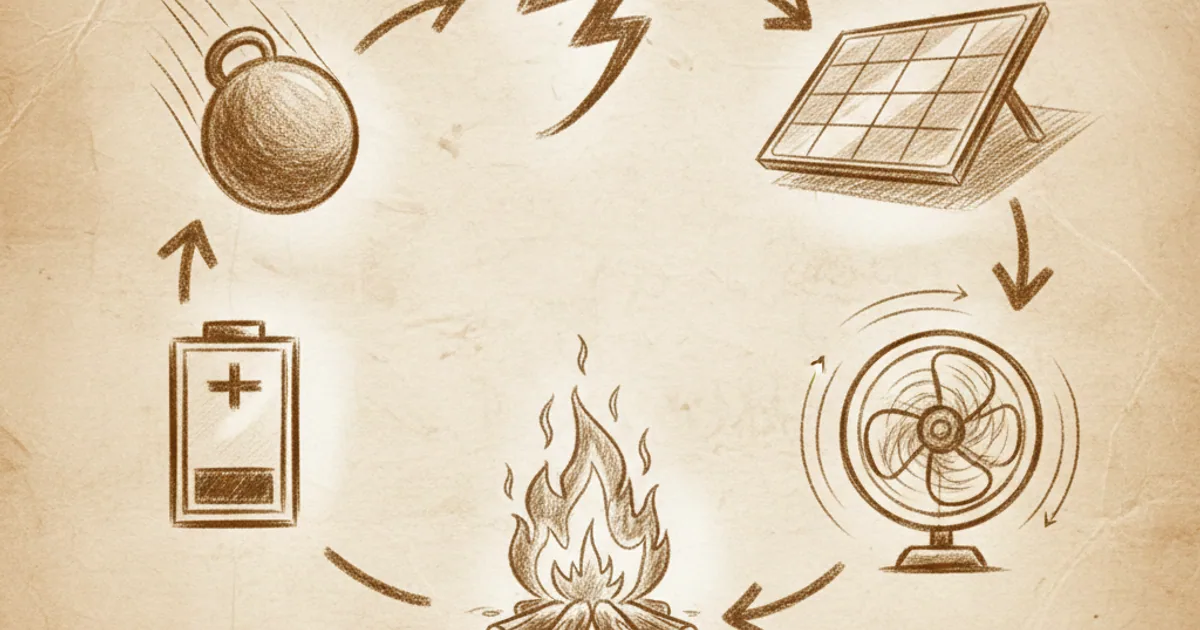
What makes energy useful as a concept is that we can convert it between forms, and the conservation rule still works. The major forms:
Kinetic energy. Energy of motion. A moving object has KE = ½ mv². A 1 kg object moving at 1 m/s has 0.5 joules. Double the speed, quadruple the energy.
Potential energy. Energy stored in position. Lift a rock and you've added gravitational PE (= mgh — mass × gravity × height). Stretch a spring and you've added elastic PE. The rock or spring has energy because of where it is, not what it's doing.
Chemical energy. Stored in molecular bonds. Burn gasoline and the chemical PE in the bonds becomes thermal energy + light. Food works the same way: bonds in glucose become motion of muscle fibres.
Thermal energy. The kinetic energy of atoms and molecules jiggling around. Heat is thermal energy flowing from hotter to colder objects. (See heat vs temperature.)
Nuclear energy. Stored in the strong force holding atomic nuclei together. Released in fission (splitting heavy nuclei) and fusion (combining light ones). Per gram, nuclear energy is about a million times more concentrated than chemical.
Electromagnetic energy. Carried by photons — light, radio waves, X-rays. Equal to ℎ × frequency for each photon. Carries energy across space without a medium.
Mass-energy. Einstein's E = mc² tells us mass IS energy in a very concrete sense. A gram of any matter contains ~9 × 10¹³ J — about 25 million kilowatt-hours. Nuclear reactions release a tiny fraction of this; conventional fuels release a far tinier fraction.
These forms interconvert. A waterfall is gravitational PE becoming kinetic energy becoming thermal energy (water heating slightly when it hits bottom) plus sound. A flashlight is chemical PE → electrical → light. A muscle is chemical PE → mechanical → thermal.
The total energy in a closed system stays constant. This is the first law of thermodynamics, also called the conservation of energy.
Energy doesn't appear out of nothing. It doesn't disappear into nothing. It just changes form.
This is one of the most thoroughly tested laws in physics. Every measurement, every experiment, every engineering calculation depends on it. Despite millennia of attempts, nobody has built a perpetual motion machine, and we're confident no one will.
Why is energy conserved? The deep answer involves a theorem from mathematician Emmy Noether: every continuous symmetry of physics corresponds to a conservation law. The fact that the laws of physics don't change over time — what worked yesterday works today — is the symmetry, and energy conservation is its consequence. If the laws DID change with time, energy wouldn't be conserved. They don't, so it is.
In everyday language, we say energy is "lost" — energy lost to friction, lost in transmission, lost as waste heat. This is colloquial. The energy isn't lost; it's just degraded into a less useful form, usually thermal.
When you brake your car, the kinetic energy of motion becomes thermal energy in the brake pads — they heat up. The energy isn't gone; it's just spread out into the molecular jiggle of the brakes and air around them. It's so spread out you can't easily get it back.
This is the second law of thermodynamics: energy spontaneously flows from concentrated forms to dispersed forms (low entropy to high entropy). High-grade energy (concentrated, organized) tends to become low-grade energy (dispersed, thermal) over time. You can't reverse this without doing work.
So the relevant question isn't "where did the energy go?" but "is it still in a useful form?" Often it isn't, and that's what "losing energy" means in practice.
A common confusion: energy vs power.
Energy is total quantity. Joules (J), or in larger units, kilojoules (kJ), megajoules (MJ), or kilowatt-hours (kWh).
Power is rate — energy per unit time. Watts (W = J/s). A kilowatt (kW) is 1000 joules per second.
A 60-watt lightbulb uses 60 joules per second. Run it for 10 seconds, it uses 600 J. Run it for an hour (3600 seconds), it uses 216,000 J = 216 kJ = 0.06 kWh.
Common energy-and-power values to anchor intuition:
These numbers wildly vary by country, lifestyle, and what you count. But they give you the orders of magnitude.
You eat food. Your body breaks down chemical bonds in glucose, fat, and protein. The released energy:
Calories on food labels are kilocalories (kcal) — slightly confusing but historical. 1 kcal = 4,184 J. A daily 2,000 kcal diet = 8.4 MJ.
Walking burns about 200 kcal per hour. Running ~600. Sitting and thinking ~100. The brain uses about 20% of your total energy despite being only 2% of your body weight — neurons are expensive cells.
Global energy use is dominated by:
The energy use of modern civilization is staggering by historical standards. A typical EU citizen uses ~100x the per-capita energy that pre-industrial humans used. Most of that "extra" comes from fossil fuels.
The push to "renewable" energy is really about energy sources that don't deplete on human timescales and don't release stored CO₂ into the atmosphere. Solar, wind, hydro, geothermal, and nuclear (fission and someday fusion) all qualify. The transition is one of the largest engineering projects in human history.
A few common confusions:
Energy is NOT a fluid. It doesn't "flow" in the strict sense. The "energy flow" metaphor is useful but the reality is that energy is a property of a system, not a separate thing.
Energy is NOT a form of money. You can't trade joules between forms 1:1. The second law means converting between forms always loses some to thermal energy you can't easily recover.
"Energy fields" in pseudoscience aren't real physics. Healing crystals, chakras, "energy alignment," and similar concepts use "energy" in a way unrelated to the physical quantity. Don't be fooled by the borrowed word.
Mass and energy aren't quite the same. E = mc² says they're equivalent in a fundamental sense, but in everyday physics we still talk about mass and energy as separate properties. Only in nuclear reactions and high-energy physics does mass-energy conversion become measurable.
If you'd like a guided 5-minute course on energy and where it comes from, NerdSip can generate one.
Energy is a number we can compute about systems that stays the same when nothing leaves or enters — the conservation of energy is one of physics' deepest laws. It comes in many forms (kinetic, potential, chemical, thermal, nuclear, electromagnetic) that all interconvert. Power is the rate of energy transfer; energy is the total. The joule is the unit. Civilization runs on energy at staggering scales, mostly fossil fuels at present but with major transitions underway. Feynman's admission that "we don't know what energy IS" reflects something real — energy is more a bookkeeping rule than a substance — and the bookkeeping has worked for every measurement we've ever made.
A short editorial reading list. Pick whichever fits how you like to learn.


Comments 0
No comments yet. Be the first to share your thoughts.