
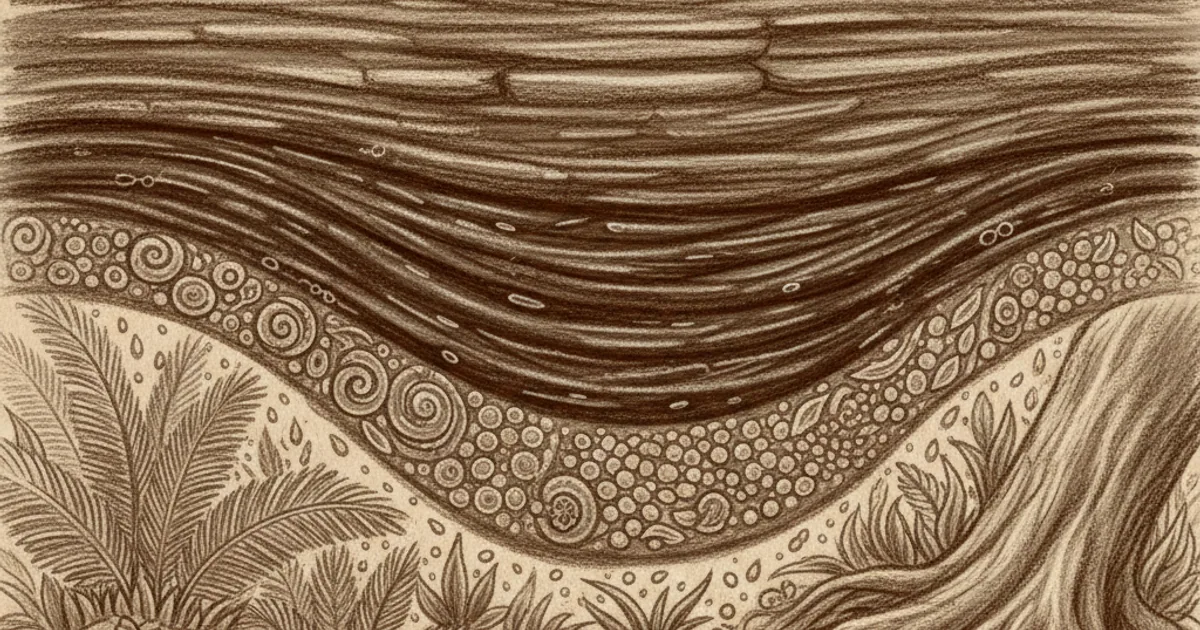
What "fossil" actually means
The word "fossil" in fossil fuels isn't metaphorical. Coal, oil, and natural gas really are made from the remains of organisms that lived hundreds of millions of years ago, transformed by heat and pressure over geological time.
Every time you burn a litre of gasoline, you're releasing solar energy that was captured by photosynthesis in algae or plants long before dinosaurs existed — energy that's been locked in chemical bonds for the entire history of complex life on Earth. The CO₂ released to the atmosphere had been removed from the air by those same ancient organisms hundreds of millions of years ago.
The transformation from living biomass to extractable fuel takes a specific combination of circumstances and an enormous amount of time. Here's how each kind forms.
Coal: ancient swamp forests
Coal mostly traces back to the Carboniferous period, roughly 360 to 300 million years ago. The name "Carboniferous" literally means "coal-bearing" — that's how thoroughly coal layers from this period dominate the geological record.
The setup:
Lush coastal swamps. During the Carboniferous, large parts of the equatorial continents were warm, humid, swampy forests dominated by giant ferns, club mosses, and early trees — many of them species that no longer exist. Some grew to 30+ metres tall, with thin trunks and shallow root systems.
Massive plant biomass. These swamps produced more plant material than decomposers could keep up with. Dead trees and ferns fell into stagnant water, where oxygen was low.
Slow decay. In water-logged, low-oxygen conditions, fungi and bacteria struggle to break down plant material. Plant biomass accumulated as peat — partially decomposed organic mat. (You can still see this happening in modern peat bogs in Ireland, Russia, and other wet temperate regions.)
A key factor: during the Carboniferous, lignin (the structural polymer that gives wood its strength) was a relatively new evolutionary invention. Fungi hadn't yet evolved efficient enzymes to break it down. Lignin from dead trees just sat there, contributing to the massive biomass buildup. By the time fungal lignin-degraders evolved (probably in the Permian period), the conditions for coal formation had largely passed. This is why so much coal comes from this particular ~60 million-year window.
Burial. Sediment from rivers, sea-level changes, and tectonic activity buried the peat under layers of mud, sand, and more peat — eventually under hundreds of metres of rock.
Heat and pressure. As the peat was buried deeper, temperature and pressure increased. Water was squeezed out. Volatile compounds (methane, water vapor, CO₂) were driven off. The remaining material became progressively more carbon-rich.
The transformation produces a sequence:
- Peat (~50% carbon): the starting material. Still found near surface.
- Lignite (~60-75% carbon): "brown coal", soft and crumbly, lowest-grade coal.
- Sub-bituminous (~75-85% carbon): intermediate.
- Bituminous (~85-90% carbon): the most common, used in power plants and steel-making.
- Anthracite (~90-95% carbon): hardest, highest-grade, burns cleanest, rarest.
Higher rank = older, deeper burial, more heat exposure. Anthracite from very old, deeply-buried deposits in Pennsylvania, Wales, or China; lignite from younger or shallower deposits in places like Germany, Australia, North Dakota.
Not all coal is Carboniferous. Some major deposits formed in the Permian (280 mya), Cretaceous (100 mya), or even later. But the Carboniferous remains the canonical period.
Oil and gas: marine microorganisms
Oil and natural gas come from a very different source: marine plankton, algae, and microorganisms that lived in ancient oceans and lakes.
The story:
Vast plankton blooms. Over millions of years, ancient oceans hosted huge populations of single-celled algae and bacteria. When these organisms died, they sank to the sea floor.
Anoxic burial. In normal ocean conditions, dead organic matter is recycled — bacteria and scavengers break it down within weeks. But in areas with limited oxygen at the bottom (stagnant basins, restricted seaways, oxygen minimum zones), organic matter accumulates. Combined with continuous burial by clay and silt, this preserves the organic material as fine-grained organic mud.
Source rock: the result, after sediment accumulates and compacts, is organic-rich shale — a dark, fine-grained sedimentary rock with up to ~5-10% organic carbon by weight. Examples include the Eagle Ford and Bakken shales in the US.
Burial to "the kitchen". As the source rock gets buried by more sediment over tens of millions of years, temperatures and pressures rise. Between roughly 60-150 °C (typically 2-5 km depth), the organic molecules in the shale crack into smaller hydrocarbon molecules — this depth range is called the oil window. Most of the world's oil formed here.
Hotter still: gas window. If burial continues past ~150 °C (deeper than ~5 km), more cracking occurs, producing smaller and smaller molecules. This is the gas window — the deepest source rocks produce only methane (natural gas).
Migration. Newly formed oil and gas are mobile fluids. They get squeezed out of the source rock and move through porous rocks (sandstone, fractured limestone) until they either reach the surface (forming oil seeps and tar pits) or get trapped underneath an impermeable layer.
Trap. Most extractable oil and gas sits in reservoirs — porous rock formations where the oil/gas accumulated under an impermeable seal (often a layer of shale or salt). The Saudi Ghawar field, Texas Permian Basin, North Sea reservoirs all fit this pattern.
Drilling. Petroleum geology is the art of finding these traps. Sophisticated seismic imaging, well logging, and geological modeling are used to locate reservoirs before drilling.
The hydrocarbons in oil and gas range from light methane (CH₄, natural gas) through propane and butane, gasoline-range molecules (C₅-C₁₂), diesel-range (C₁₂-C₂₀), to heavy oils and asphalt (C₂₀+). All variations of carbon-hydrogen chains. Refining is the process of separating them into useful fractions.
A unifying view
Coal, oil, and gas all share a fundamental story:
- Organisms photosynthesized: captured solar energy and atmospheric CO₂ into chemical bonds.
- Some of their biomass was buried before it could decompose, taking the carbon out of the air-cycle.
- Heat and pressure transformed the buried biomass into fuel-grade hydrocarbons or carbon over geological time.
- The carbon stayed buried for tens to hundreds of millions of years.
- We're now extracting and burning it, releasing the long-stored solar energy as useful work, and the long-stored carbon back into the atmosphere as CO₂.
When you fill a car or run a coal plant, you're effectively reversing photosynthesis on a geological-scale timescale. The energy released in burning is essentially the same energy ancient organisms captured from sunlight; the CO₂ released is the same CO₂ they removed from the air.
The climate connection
This is where fossil fuels intersect with the climate story. The atmosphere over geological time has had widely varying CO₂ levels. During the Carboniferous, when much of today's coal was forming, atmospheric CO₂ dropped substantially because so much carbon was being buried. The planet entered a cool, glaciated period as a result.
We've been doing the opposite — taking buried carbon and putting it back into the atmosphere — for about 200 years, at increasing rates. Atmospheric CO₂ has gone from a pre-industrial baseline of ~280 ppm to over 420 ppm in 2024, a roughly 50% increase. The carbon coming out of fossil fuels is the same carbon (chemically) that was in the air before — but the timing is wrong. Releasing 300 million years of buried carbon over 200 years is a fast change relative to the climate system's ability to adapt.
(See the greenhouse effect explained for the physics of how this CO₂ warms the planet.)
How long fossil fuels will last
A common question with a slippery answer.
Proven reserves (economically extractable at current prices with current technology):
- Oil: ~50 years at current consumption.
- Natural gas: ~50-60 years.
- Coal: ~140 years.
But these numbers grow over time. New discoveries, improved extraction technology (hydraulic fracturing made vast shale gas resources economical), and rising prices all expand reserves. The world has not been "running out" of fossil fuels — proven reserves have grown faster than consumption for most of the past century.
Total geological reserves (including currently uneconomic) are much larger. We probably have several hundred years of coal, several hundred years of unconventional oil and gas (shale, tar sands, methane hydrates).
The binding constraint isn't depletion — it's the atmosphere's capacity to absorb CO₂ without unacceptable climate effects. To keep warming to 1.5-2 °C, scientific consensus says we need to leave most known fossil fuel reserves in the ground. That's a political and economic challenge, not a geological one.
What "renewable" really means
"Fossil fuels" are sometimes called "non-renewable energy" but the more precise distinction is timescale.
- Renewable energy (solar, wind, hydro): tied to ongoing solar input. Renewable on human timescales (hours to years).
- Nuclear energy: tied to once-fissioned material. The U-235 we use is non-renewable, but fast-breeder reactors could extend it dramatically.
- Fossil fuels: renewable on geological timescales (10⁷-10⁸ years), but for practical purposes finite.
- Biomass and biofuels: renewable on human timescales (years), but with significant land-use trade-offs.
The "fossil" in fossil fuel is the key. We're using up a stored bank of ancient sunlight that took hundreds of millions of years to accumulate, in a few hundred years. From a planetary perspective, fossil fuels are a one-time gift from prehistoric biology — and the bill is now coming due in the form of climate change.
If you'd like a guided 5-minute course on how fossil fuels form and what comes next, NerdSip can generate one.
The takeaway
Coal, oil, and natural gas are the buried, transformed remains of organisms — terrestrial plants for coal (mostly from Carboniferous swamps ~300 million years ago), marine plankton and algae for oil and gas. Heat, pressure, and geological time turn organic matter into the fuels we extract today. Burning them releases energy that was originally captured from sunlight by photosynthesis hundreds of millions of years ago, and returns the long-buried carbon to the atmosphere as CO₂. The amount we still have in the ground is large; the amount we can safely burn without destabilizing the climate is much smaller. We're effectively running 300 million years of photosynthesis backward in 200 years, which is the heart of the climate challenge.

Comments 0
No comments yet. Be the first to share your thoughts.