
The core idea
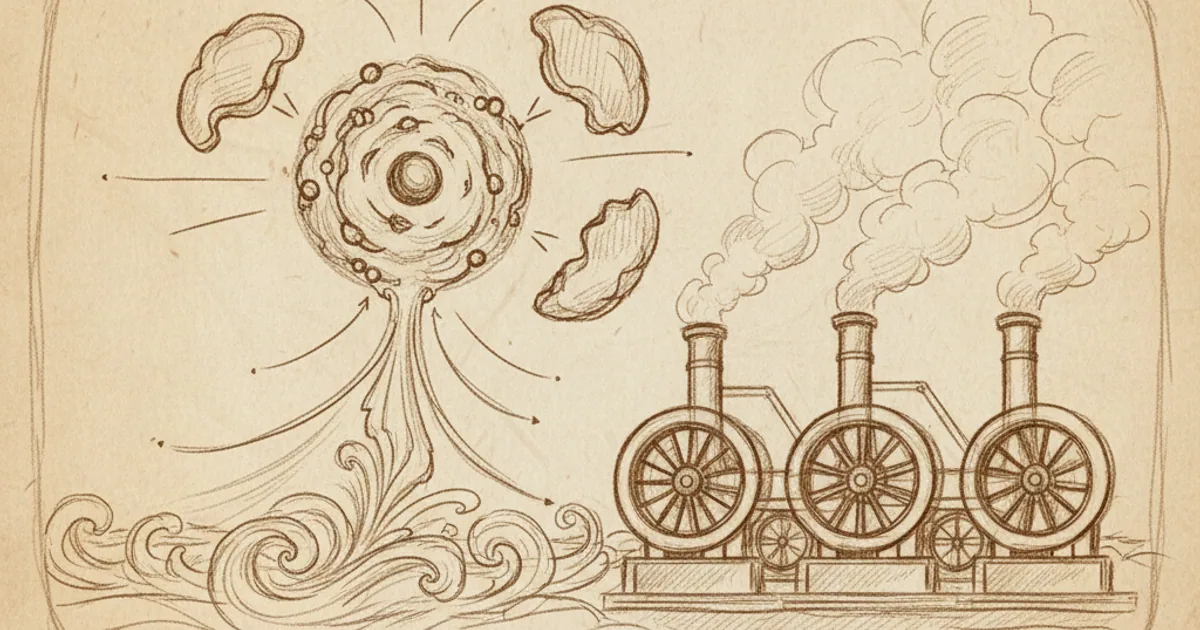
A nuclear reactor is a really fancy way to boil water.
That's not a joke. Once you have heat, the rest of a power plant is standard 19th-century technology: heat → steam → turbine → generator → electricity. Coal plants do it. Natural gas plants do it. Concentrating solar thermal does it. Nuclear plants do it too. The only difference is the heat source.
In a nuclear reactor, heat comes from fission — splitting heavy atoms apart. Specifically, atoms of uranium-235 (the only naturally occurring isotope that easily fissions) or plutonium-239 (which is made from uranium-238 in the reactor itself).
When a uranium-235 atom absorbs a neutron, it becomes briefly unstable, then splits into two smaller atoms plus two or three free neutrons plus a burst of energy. The energy per split is small — about 200 mega-electron-volts, or 3 × 10⁻¹¹ joules. But there are a LOT of atoms in a kilogram of uranium, and 200 MeV per atom is enormous compared to the few eV released by chemical reactions like burning gasoline.
A kilogram of uranium-235, fully fissioned, releases about 80 TJ of energy.
That's roughly 2.5 million times more energy than burning a kilogram of coal. Per gram, it's about 25 million times more than gasoline. Nuclear is staggeringly energy-dense.
The chain reaction
Each fission of U-235 releases 2-3 neutrons. If, on average, one of those neutrons hits another U-235 atom and causes another fission, the reaction is self-sustaining — a controlled chain reaction.
This is the key insight. The Italian physicist Enrico Fermi achieved the first controlled chain reaction in 1942, under a squash court at the University of Chicago, with a pile of graphite and uranium. The "Chicago Pile-1" is the ancestor of every reactor since.
Three possible regimes:
- Subcritical: fewer than one neutron per fission causes another fission. Reaction dies out.
- Critical: exactly one. Reaction continues steadily.
- Supercritical: more than one. Reaction grows exponentially. Used briefly in bombs and avoided in power plants.
A reactor runs in a slightly-supercritical state when starting up (to increase power), shifts to critical for steady operation, and goes subcritical when shutting down. Engineers manage this with control mechanisms.
What's inside
A pressurized water reactor (PWR — the most common type) has:
Fuel rods. Long tubes filled with ceramic uranium pellets. Each pellet is about the size of a gum eraser and contains about as much energy as a ton of coal. Hundreds of pellets per rod, hundreds of rods per fuel assembly, ~150-200 assemblies per reactor.
Moderator. Slows down the neutrons released by fission. Fast neutrons mostly bounce off uranium without splitting it; slow ("thermal") neutrons are much more likely to cause fission. The moderator is usually water (the same water that becomes steam), or sometimes graphite or heavy water (deuterium oxide) in other reactor types.
Control rods. Made of materials that absorb neutrons (boron, cadmium, hafnium). Lowered into the core to slow or stop the chain reaction; raised to allow it. The control rods are the throttle.
Coolant. Carries heat from the fuel rods to the steam generators. In a PWR, this is water at 325 °C and very high pressure (150 atmospheres) — the pressure keeps it liquid despite the high temperature. The coolant water is also the moderator.
Steam generator. Heat from the primary coolant transfers to a separate water loop, which boils into steam.
Turbine and generator. Steam spins a turbine connected to an electrical generator — basically a giant electromagnet rotating inside coils of wire. Output: AC electricity at grid frequency (50 or 60 Hz).
Condenser. Spent steam is cooled back to water (usually with a third loop using river, lake, sea, or cooling-tower water) and recycled.
Containment building. Reinforced concrete and steel structure surrounding the reactor. Designed to contain radioactive material in the event of any accident. The containment is what kept Three Mile Island's 1979 partial meltdown from being far worse.
Why uranium is special
Most heavy atoms can be made to fission with enough energy, but few will sustain a chain reaction at practical conditions.
U-235 is special because:
- It's naturally occurring (0.72% of natural uranium).
- It's fissionable by thermal neutrons (the easy, low-energy kind).
- It releases enough neutrons per fission to keep a chain going.
Most natural uranium is U-238, which doesn't easily fission. U-238 can absorb a neutron to become plutonium-239 (which IS fissionable), so reactors slowly breed plutonium as they operate, and some of that fissions too. Specially designed "breeder reactors" optimize this conversion.
Commercial reactors use enriched uranium — natural uranium concentrated from 0.72% U-235 to 3-5% U-235. The enrichment process (centrifuges separating slightly heavier U-238 from slightly lighter U-235) is one of the more sensitive parts of the nuclear industry, because the same technology can also produce ~90% enriched uranium for weapons.
Some reactor designs use natural uranium (Canadian CANDU reactors, with heavy water as moderator) or higher enrichment (research reactors, some submarines, some advanced designs).
What about waste?
Spent fuel is removed from a reactor after ~3-6 years. It's intensely radioactive when removed — initially a person standing nearby unshielded would receive a lethal dose in seconds. Most of the radioactivity decays in the first decade, but small amounts of long-lived isotopes (especially plutonium and minor actinides) remain dangerous for tens of thousands of years.
The waste handling sequence:
- Cooling pools: spent fuel sits in deep water pools at the plant for ~5-10 years to cool down (both thermally and radioactively).
- Dry cask storage: after cooling, fuel is moved to thick concrete-and-steel casks on site or at central facilities. Passively safe — no power needed.
- Reprocessing: in some countries (France, UK, Russia, Japan), spent fuel is chemically processed to recover unfissioned uranium and plutonium for reuse. Reduces waste volume but is expensive and creates proliferation risks.
- Final disposal: the long-term plan in most countries is deep geological repositories — burying waste in stable rock formations hundreds of metres underground. Finland's Onkalo facility is the first one nearly operational; the US Yucca Mountain project has been politically stalled for decades; most countries are still figuring it out.
The total volume of high-level waste produced by all civilian nuclear power since the 1950s would fit in a single warehouse-sized building. Compared to the volumes of waste from fossil fuels (CO₂ in the atmosphere, ash, sulphur, mercury) or even solar panel manufacturing, it's small. But the long-lived radioactivity creates a unique containment challenge.
Safety, in numbers
The headlines are scary; the numbers tell a different story.
Per terawatt-hour of electricity produced, deaths attributed to each energy source (Our World in Data, including accidents AND air pollution effects):
- Coal: ~25 deaths per TWh.
- Oil: ~18 per TWh.
- Natural gas: ~3 per TWh.
- Hydropower: ~1.3 per TWh (mostly from dam failures).
- Wind: ~0.04 per TWh.
- Nuclear: ~0.03 per TWh.
- Solar: ~0.02 per TWh.
Nuclear has caused fewer deaths per unit of electricity than wind and is comparable to solar. This includes Chernobyl (50 direct deaths plus an estimated 4,000-200,000 indirect, depending on methodology) and Fukushima (1 confirmed radiation-related death plus ~2,000+ from evacuation stress).
Nuclear's safety reputation is harmed by the visibility of rare severe accidents, not by their frequency. Fossil fuels kill many more people through air pollution every year — but quietly, distributed over many places, without making headlines.
Modern reactor designs
Reactor technology has evolved through "generations":
Generation I (1950s-60s): early prototypes. Generation II (1970s-90s): most currently operating reactors. Light water reactors (PWR, BWR). Generation III (2000s-present): improved Gen II with passive safety features. Reactors like the AP1000, EPR, ABWR. Generation IV (in development): includes high-temperature gas reactors, molten salt reactors, sodium-cooled fast reactors. Promise improved efficiency, less waste, and inherent safety.
Small Modular Reactors (SMRs): smaller designs (50-300 MW each) that could be factory-built and shipped to sites, reducing cost and construction time. Several designs in advanced licensing stages.
Fusion: combines hydrogen isotopes (deuterium + tritium) to make helium plus energy. The Sun does this naturally. Replicating it on Earth requires temperatures of ~100 million °C and confinement using magnetic fields (tokamaks like ITER) or laser-driven implosion (NIF). Net-positive energy yield was first achieved at NIF in 2022, but commercial fusion is still 15-30 years away by most estimates, and "still 30 years away" has been a running joke in the field for decades.
Why nuclear is hard to scale
Despite the impressive energy density and low-carbon credentials, nuclear has struggled to grow:
High capital costs. A new reactor costs $5-15 billion. Construction takes 5-10 years (sometimes longer with delays). This makes nuclear capital-intensive in an era of cheap capital but slow regulatory approval.
Long approval timelines. Regulatory processes are extensive, partly because of the consequences of accidents and partly because the industry has built relatively few new plants in decades, making each one a fresh project rather than a standardized product.
Political resistance. Many countries have phased out or de-emphasized nuclear (Germany, Italy, Belgium, Spain) for political reasons not entirely tied to engineering risk assessments.
Skilled workforce shortage. As nuclear deployment slowed in many countries, expertise concentrated in a few firms and aged out. Restarting requires rebuilding.
Public perception. Nuclear accidents make vivid headlines; routine fossil fuel deaths don't. This affects political willingness to build.
Solving climate change probably requires nuclear playing a role alongside renewables and storage. Several countries (China, France, India, South Korea) are continuing or accelerating nuclear build-out. The next few decades will test whether nuclear can scale fast enough to be a major contributor.
If you'd like a guided 5-minute course on nuclear physics and how reactors work, NerdSip can generate one.
The takeaway
A nuclear reactor uses uranium-235 fissioning in a controlled chain reaction to produce heat, which boils water into steam, which spins a turbine connected to a generator. Per gram, nuclear fuel is millions of times more energy-dense than chemical fuels. The process produces low-carbon electricity but generates long-lived radioactive waste and carries the risk of rare-but-severe accidents. Statistically it's one of the safest energy sources we have, but its high cost, slow construction, and political baggage have constrained its growth. Fusion — combining light atoms instead of splitting heavy ones — would change the picture but isn't yet commercial.

Comments 0
No comments yet. Be the first to share your thoughts.