
The headline
An electromagnetic wave is a self-propagating oscillation of electric and magnetic fields, traveling through space at the speed of light. The fields oscillate perpendicular to each other and to the direction of propagation. No material medium is required — the wave is the fields themselves, not a disturbance of anything else.
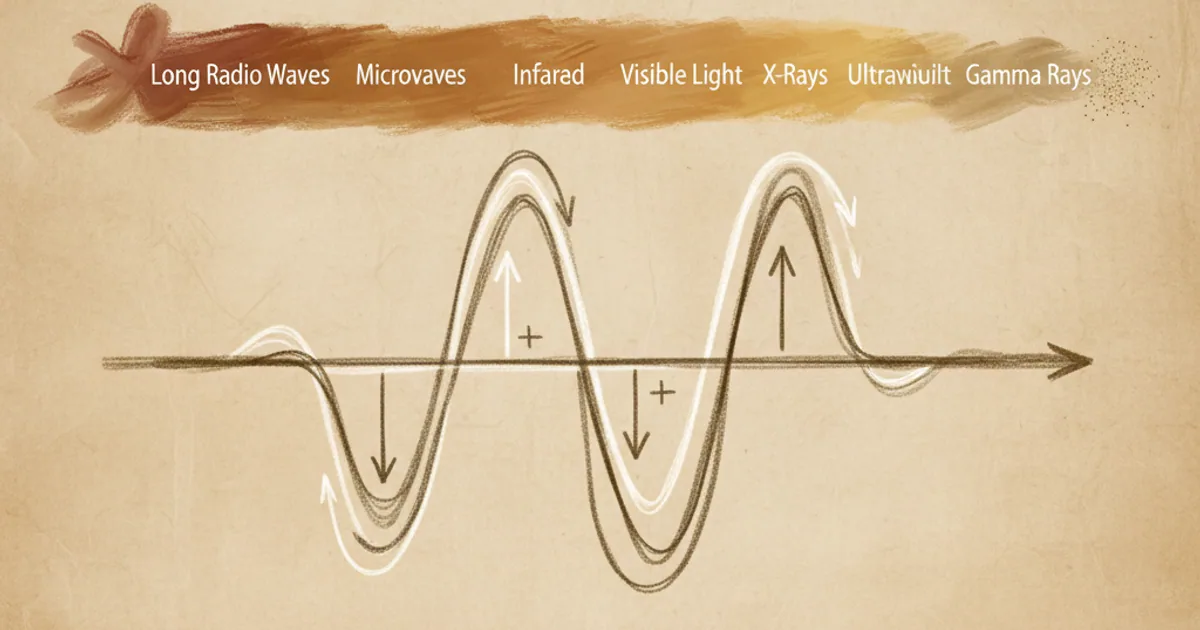
Visible light is one narrow band of electromagnetic waves. Radio, microwaves, infrared, ultraviolet, X-rays, and gamma rays are all the same physical phenomenon at different wavelengths. Together they form the electromagnetic spectrum, spanning more than 20 orders of magnitude.
This was one of the great unifications in physics. The recognition that light, radio, X-rays, and other "different" things are really one phenomenon followed from James Clerk Maxwell's equations in the 1860s, with each new band of the spectrum confirmed experimentally over the following century.
How an electromagnetic wave works
In a region of empty space, a changing electric field produces a changing magnetic field; a changing magnetic field produces a changing electric field. Each one regenerates the other.
If you set up an oscillation in one place (e.g., an oscillating current in an antenna), the electric and magnetic fields it produces start oscillating in step. Those changing fields produce more changing fields in the surrounding region, which produce more, and so on — and the wave propagates outward from its source at the speed of light.
Key properties:
Speed: in vacuum, c ≈ 299,792,458 m/s. In matter, slower (the wave interacts with the matter's charges).
Wavelength (λ): the distance over which the field completes one full oscillation cycle. From kilometres for low-frequency radio to picometres for gamma rays.
Frequency (f): how many oscillations per second, in hertz. From hundreds of kHz (radio) to ~10²⁰ Hz (gamma rays).
Relationship: c = λ·f. Wavelength times frequency equals the speed of light in vacuum.
Polarization: the direction the electric field oscillates. Linearly polarized waves oscillate in one direction; circularly polarized waves rotate. Most natural light is unpolarized (random mix); reflected light, polarized sunglasses, and some technologies use polarization deliberately.
Energy: per photon, E = h·f, where h is Planck's constant (~6.626 × 10⁻³⁴ J·s). Higher frequency = more energy per photon.
The spectrum, band by band
The electromagnetic spectrum is conventionally divided into bands by wavelength/frequency. Each band has different sources, detectors, and effects on matter.
Radio waves (roughly 3 kHz to 300 GHz in ITU usage)
(In the broader ITU/engineering sense, "radio" covers the whole frequency range from a few kHz up to 300 GHz, with "microwaves" being a subset above ~300 MHz. This article splits them informally by typical applications.)
Very long wavelengths. Generated by oscillating currents in antennas, lightning, or astronomical sources. Detected by antennas tuned to specific frequencies.
Uses:
- AM radio (medium wave, ~550-1700 kHz, λ ≈ 200-550 m)
- FM radio (~88-108 MHz, λ ≈ 3 m)
- VHF/UHF TV broadcasting (~50-700 MHz)
- Amateur radio bands across the range
- Time signals (60 kHz in the UK; 77.5 kHz in Germany; 60 kHz in the US)
- AM/SW broadcasting can travel global distances via ionosphere reflection.
Photons are low-energy individually; radio doesn't damage tissue at normal exposure levels. Cell phones use higher-frequency bands (typically 600 MHz to 6 GHz).
Microwaves (1 mm to 1 m, 300 MHz to 300 GHz)
Generated by special tubes (magnetrons, klystrons), solid-state oscillators, masers (the original cousin of lasers).
Uses:
- Microwave ovens (typically 2.45 GHz — chosen primarily because it's an internationally allocated ISM band for unlicensed use, with a useful balance of food penetration depth and water-absorption heating)
- Satellite communications (1-40 GHz)
- Cellular networks (typical bands: 600 MHz-6 GHz; mmWave 5G: 24-100 GHz)
- Wi-Fi (2.4 and 5 GHz mainly; 6 GHz Wi-Fi 6E and beyond)
- Bluetooth (2.4 GHz)
- Radar (various bands)
- Cosmic microwave background (peak around 160 GHz — the leftover radiation from the early universe)
Infrared (700 nm to 1 mm)
Generated by thermal motion of molecules (every warm object emits IR), plus specific sources for technology.
Uses:
- Thermal imaging (warm objects appear bright)
- Remote controls (TV, etc. typically use 940 nm IR)
- Fiber optic communications (typically 1310 or 1550 nm)
- Spectroscopy for chemistry
- Astronomy of cold objects (interstellar dust, protostars)
- Heat lamps and IR saunas (warming effect from molecular vibrations)
- Night-vision technology
You don't see IR but you feel it as heat on your skin. The peak emission wavelength of a body at temperature T is given by Wien's law (λ_peak ≈ 2898/T µm·K) — humans at 310 K peak around 9 μm.
Visible light (~380-750 nm)
The narrow band our eyes evolved to detect. Generated by hot objects (the Sun, incandescent bulbs), electronic transitions in atoms (LEDs, fluorescent lights), chemical reactions (fire, bioluminescence), lasers, and others.
Visible light is divided by colour:
- Violet/blue: 380-490 nm
- Green: 490-580 nm
- Yellow/orange: 580-620 nm
- Red: 620-750 nm
The range our eyes detect (visible light) is mostly the range the Sun emits strongly at Earth's surface, which is no coincidence — our visual system evolved to use the available light. Plants also evolved to absorb mostly red and blue (peak photosynthesis wavelengths) and reflect green, which is why most plants are green.
Why is visible light called "visible"? Because our eyes have pigment molecules (rhodopsin, cone opsins) tuned to respond to photons in this range — high enough energy to trigger a chemical change in the pigment, low enough not to damage the molecule on contact.
Ultraviolet (~10-380 nm)
Higher frequency, more energy per photon than visible. Subdivided into UVA (315-400 nm, the most-penetrating, causes tanning and aging), UVB (280-315 nm, causes sunburn and most vitamin D synthesis, plus skin cancer risk), and UVC (10-280 nm, mostly blocked by atmosphere; sterilizing).
Uses:
- Sterilization (UVC kills bacteria and viruses)
- Sunlight (UVB triggers vitamin D synthesis in skin)
- Detection of fluorescent materials
- Some industrial curing processes
- Astronomy of hot objects
UV is energetic enough to break some chemical bonds — including DNA bonds, which is why excessive sun exposure causes DNA damage and skin cancer risk. The ozone layer absorbs most UVC and much UVB before it reaches the surface.
X-rays (~10 pm to 10 nm)
Generated by accelerating electrons rapidly (e.g., decelerating them in a target — bremsstrahlung) or by inner-electron transitions in heavy atoms. Discovered by Wilhelm Röntgen in 1895.
Uses:
- Medical imaging (X-rays pass easily through soft tissue, less easily through bone, giving the characteristic bone-on-shadow images)
- Crystallography (X-ray diffraction reveals atomic structures)
- Security scanners (airports, package screening)
- Industrial inspection (weld quality, internal defects)
- Astronomy of very hot sources (black hole accretion, neutron stars)
X-rays ionize atoms (knock electrons out) on contact with matter. This is what enables imaging (different tissues absorb different amounts), but also poses radiation risk — high doses damage DNA and cause cancer. Medical doses are kept as low as practical for the diagnostic information needed.
Gamma rays (<10 pm)
Highest energy per photon. Generated by nuclear processes — radioactive decay, nuclear fusion, particle annihilation. Astronomical gamma rays come from supernova remnants, neutron stars, black hole environments, and gamma-ray bursts.
Uses:
- Cancer treatment (focused gamma beams kill tumor cells)
- Sterilization of medical equipment
- Nuclear medicine imaging (PET scans use 511 keV gamma rays from positron annihilation)
- Geological dating and prospecting
Gamma rays are highly penetrating and damaging. Thick lead or concrete is needed for shielding. Gamma-ray bursts from cosmic sources, if they occurred too close to Earth, could pose extinction-level risk — though none currently known is close enough to worry about.
Why these bands look so different
The same physics — oscillating electric and magnetic fields — produces phenomena ranging from radio waves passing through walls to gamma rays splitting atomic nuclei. Why are they so different?
Because the energy per photon (E = hf) scales with frequency:
- Radio photons: ~10⁻²⁵ to 10⁻²² J. Far too small to affect chemistry. Pass through most matter.
- Infrared photons: ~10⁻²¹ to 10⁻¹⁹ J. Enough to vibrate molecules (heat).
- Visible light photons: ~10⁻¹⁹ J. Enough to excite electrons in pigments. Trigger vision and chemistry.
- UV photons: ~10⁻¹⁸ J. Enough to break some chemical bonds.
- X-ray photons: ~10⁻¹⁵ J. Enough to ionize atoms.
- Gamma photons: ~10⁻¹³ J and up. Enough to break atomic nuclei.
The classical "wave" picture is the same across all bands. The "particle" (photon) picture matters more at higher frequencies where individual photons have significant energy. The wave-particle duality plays out across the spectrum: radio behaves wavily; gamma rays behave more like particles in their effects on matter.
How antennas work
An antenna is a conductor (usually a metal rod or array) connected to an oscillating circuit. The oscillating current accelerates charges back and forth in the antenna, and those accelerating charges radiate electromagnetic waves outward.
In reverse, an antenna in the path of an electromagnetic wave has its electrons pushed back and forth by the wave's electric field, producing a small oscillating current that a receiver can detect and amplify.
Antenna size is typically related to wavelength — efficient antennas are usually a fraction of a wavelength long (often half-wave or quarter-wave). This is why FM radio antennas (1.5 m for half-wave at 100 MHz) are large compared to Wi-Fi antennas (~6 cm for half-wave at 2.4 GHz).
Modern phones contain many antennas tuned to different bands (cellular, Wi-Fi, Bluetooth, GPS, NFC) packed into very small spaces, using sophisticated design to keep them from interfering with each other.
Why light travels slower in matter
In vacuum, electromagnetic waves travel at c. In matter, they slow down — water slows visible light to about 0.75c; glass to about 0.67c; some materials more.
This isn't because the photons themselves slow down — they always travel at c between interactions. What happens is the wave is absorbed and re-emitted by atoms in the material. The net effect, averaged over the journey through the material, is a lower apparent speed.
The slowing causes refraction — bending when light enters or exits a material at an angle. This is what makes lenses focus, what makes objects in water look bent, and what produces rainbows (different wavelengths bend by slightly different amounts in water droplets).
The ratio c / (speed in material) is the material's refractive index. Air: ~1.0003. Water: ~1.33. Common glass: ~1.5. Diamond: ~2.4 (this high refractive index is part of why diamonds sparkle so much — light bouncing around inside the diamond).
Different wavelengths often have slightly different refractive indices in the same material — this is dispersion, and it's what causes a prism to split white light into a rainbow.
The cosmic background
Every direction of the sky carries a faint glow of microwaves — the cosmic microwave background (CMB) — leftover radiation from when the universe was hot enough to be opaque, about 380,000 years after the Big Bang. As the universe expanded and cooled, this radiation cooled with it, redshifting from visible light all the way down to microwaves at a temperature of about 2.725 K.
The CMB was discovered accidentally in 1964 by Arno Penzias and Robert Wilson at Bell Labs (they thought their radio telescope had pigeon problems before realizing the noise was cosmological). It's one of the strongest evidence for the Big Bang theory.
Detailed maps of the CMB (from satellites like COBE, WMAP, and Planck) show tiny temperature variations of about 1 part in 100,000 — the seeds of all the galaxy clusters and large-scale structure we see today.
If you'd like a guided 5-minute course on electromagnetic waves, NerdSip can generate one.
The takeaway
Electromagnetic waves are self-propagating oscillations of electric and magnetic fields, traveling at the speed of light in vacuum. They require no medium — the fields themselves are what oscillate. Visible light is one narrow band of a vast spectrum that ranges from radio waves (wavelengths longer than people) to gamma rays (wavelengths smaller than atoms). All bands obey the same Maxwell's-equations physics, but the energy per photon (E = hf) determines what they do when they hit matter — radio passes through, infrared warms, visible light triggers vision, UV breaks bonds, X-rays ionize, gamma rays disrupt nuclei. Every wireless technology, every form of optical observation, most medical imaging modalities (X-ray, CT, MRI, PET, SPECT, optical), and most of astronomy is electromagnetic waves doing their jobs. Ultrasound and a few newer modalities (e.g., magnetic particle imaging) are the main non-EM exceptions in medical imaging.

Comments 0
No comments yet. Be the first to share your thoughts.