
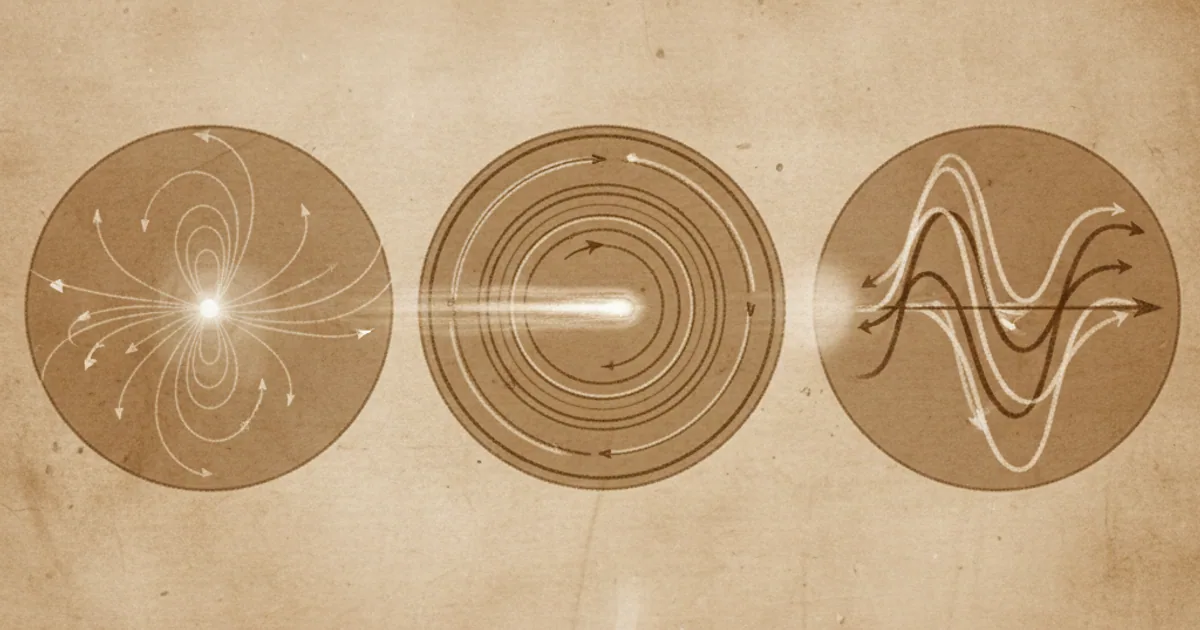
One force, many jobs
Look around. The light reaching your eye, the screen you're reading on, the Wi-Fi carrying these words from the server to your device, the wires in your walls, the magnets in your speakers, the radio waves bouncing off the ionosphere, the chemical bonds holding your body together — all of these are electromagnetism.
It's the same underlying force doing different jobs. Static charges, flowing charges, magnets, light, radio: physically distinct phenomena, but all manifestations of one unified field. This unification — recognized in the 1860s by James Clerk Maxwell and refined in 1905 by Albert Einstein — is one of the great triumphs of theoretical physics.
This article is the overview. The cluster covers the specifics: what electricity actually is, how magnets really work, how electric motors work, and what electromagnetic waves actually are.
Charges and fields
The starting point: electric charge. There are two kinds — positive and negative. Like charges repel; opposite charges attract. The proton is positive, the electron is negative, with exactly equal magnitudes of charge. Most matter is overall neutral because it has equal numbers of protons and electrons.
A charge in space produces an electric field — a region in which other charges feel a force. The field points away from positive charges and toward negative charges. The strength falls off with the square of the distance (Coulomb's law), similar to Newton's gravity except dramatically stronger.
How much stronger? Between two electrons, the electric repulsion is about 10⁴² times stronger than the gravitational attraction. Gravity dominates large-scale astronomy only because mass is always positive (so it always adds), while electric charges come in both signs (mostly cancelling out in bulk matter).
The electric field is invisible but very real. It carries energy, exerts force, and can propagate through space.
Moving charges: enter magnetism
A stationary charge creates only an electric field.
A moving charge creates an electric field PLUS a magnetic field. The faster it moves, the stronger the magnetic component.
This is the first hint that electricity and magnetism are linked. Magnetism isn't a separate phenomenon — it's what you see when electric charges are in motion.
A wire carrying current is filled with moving charges (electrons drifting through the metal). It produces a magnetic field that wraps around the wire in circles. Bend the wire into a loop, and you get a magnetic field through the loop — same shape as a bar magnet. Wind many loops into a coil (solenoid), and you get a strong magnet you can switch on and off with the current.
This is why an electromagnet works: current produces a magnetic field. Cut the current, the field vanishes.
Permanent magnets: even tinier currents
A bar magnet seems to be magnetic without anything obviously "moving." But at the atomic scale, electrons in the magnet's atoms have intrinsic magnetic moments — partly from their orbital motion around nuclei, partly from a quantum property called spin. In most materials, these tiny magnetic moments are randomly oriented and average to zero.
In ferromagnetic materials (iron, nickel, cobalt, and certain alloys), neighboring atomic magnetic moments tend to align with each other in microscopic regions called domains. When most of these domains line up in the same direction (sometimes after exposure to a strong external field), the material is magnetized — it has a net macroscopic magnetic field.
A permanent magnet is just a chunk of ferromagnetic material whose domains have been aligned and stay aligned at room temperature. The magnetism still comes from electron motion at the atomic scale — but it's the tiny motion inside atoms, not bulk current. Details in how magnets really work.
The two-way street
Maxwell's deep insight: changing magnetic fields produce electric fields, and changing electric fields produce magnetic fields.
This is the basis of electromagnetic induction (Michael Faraday's 1831 discovery): wave a magnet near a coil of wire, and current flows in the wire. The magnetic field changing in time produces an electric field that pushes the electrons around the loop. This is how generators work — spin a magnet near coils, and you get electricity. Almost all of the world's electricity, regardless of energy source, is generated this way.
The reverse is also true: a current in a coil, when changing, produces a changing magnetic field around it, which can induce current in a nearby coil. This is how transformers work — two coils sharing a magnetic field, with changing current in one producing current in the other.
Maxwell realized these two effects together produce something startling: a self-sustaining wave.
Electromagnetic waves: light's true identity
If a changing electric field produces a magnetic field, and a changing magnetic field produces an electric field, then in principle you could have a wave of alternating electric and magnetic fields, propagating through space, each one regenerating the other.
Maxwell worked out the math and predicted the existence of such waves. He calculated their speed from two known physical constants — the permittivity of free space (ε₀, related to electric forces in vacuum) and the permeability of free space (μ₀, related to magnetic forces).
The result: c = 1/√(ε₀μ₀) ≈ 299,792,458 m/s.
That number was the speed of light. (In the modern SI system, redefined in 2019, c is now exactly 299,792,458 m/s by definition, and ε₀ is a derived quantity rather than a measured one — but the relationship still holds.) Maxwell had derived it from purely electrical and magnetic measurements, with no reference to optics at all.
The conclusion was unavoidable: light IS an electromagnetic wave. Visible light is just a narrow band of the broader electromagnetic spectrum. Radio, microwaves, infrared, visible light, ultraviolet, X-rays, and gamma rays are all the same kind of wave — just at different frequencies.
Detail in what electromagnetic waves actually are.
Maxwell's equations
The mathematical statement of the unified theory is Maxwell's four equations:
Gauss's law: electric field lines start on positive charges and end on negative ones. The total electric flux through any closed surface equals the enclosed charge (divided by ε₀).
Gauss's law for magnetism: magnetic field lines never end (they form closed loops). There are no magnetic monopoles — no isolated north or south poles.
Faraday's law: a changing magnetic field through a loop induces an electromotive force around the loop. Changing B produces E.
Ampère-Maxwell law: electric currents and changing electric fields both produce magnetic fields curling around them. Changing E produces B.
Each equation is concise. Together they describe every classical electromagnetic phenomenon. They're widely considered among the most beautiful equations in physics — compact, symmetric, and predictive across an enormous range of scales.
In modern notation, they fit on a t-shirt:
∇·E = ρ/ε₀ ∇·B = 0 ∇×E = -∂B/∂t ∇×B = μ₀(J + ε₀∂E/∂t)
(You can buy the t-shirt.)
The forces holding matter together
Beyond the obvious applications (wires, magnets, antennas), electromagnetism is also the force responsible for almost all of chemistry and material science.
- Chemical bonds between atoms are electromagnetic interactions between electrons and nuclei.
- The strength of solids comes from electromagnetic forces between atoms.
- Friction, viscosity, surface tension are bulk manifestations of electromagnetic interactions between neighboring molecules.
- The fact that you can't push your hand through a table is the electromagnetic repulsion between electrons in your hand and electrons in the table (plus the Pauli exclusion principle from quantum mechanics).
- Light interacting with matter (absorption, reflection, refraction, why grass is green and the sky is blue) is electromagnetic.
Outside of nuclear physics, almost every interaction you've ever experienced is electromagnetic. Gravity holds you to the Earth; everything else is electromagnetism.
Einstein's unification
In 1905, Einstein's special relativity made the unity of electromagnetism explicit. The mathematical separation between "electric field" and "magnetic field" turns out to depend on the observer's frame of reference. A static charge produces only an electric field as seen by an observer at rest relative to it. The SAME charge produces both electric and magnetic fields as seen by an observer moving past it.
So electric and magnetic fields are not separate things at all — they're components of a single object (the electromagnetic field tensor) that mix into each other when you change reference frames.
Special relativity essentially fell out of taking Maxwell's equations seriously and asking what they require of space and time. The constancy of the speed of light in all reference frames was already in Maxwell's equations — Einstein's contribution was to take this seriously and rebuild the rest of physics around it.
Quantum electromagnetism
In the 20th century, electromagnetism was further refined into quantum electrodynamics (QED) — the quantum theory of how charged particles and electromagnetic fields interact.
In QED, electromagnetic interactions are mediated by exchange of photons — quantized excitations of the electromagnetic field. Two electrons repel each other by exchanging virtual photons; an atom absorbs light by absorbing a photon; a hot object emits light by emitting photons.
QED is one of the most accurate theories in all of science. Its predictions for the magnetic moment of the electron match experiments to about 12 decimal places. Richard Feynman, Julian Schwinger, and Sin-Itiro Tomonaga shared the 1965 Nobel Prize for developing QED.
For the everyday-to-engineering scale, classical electromagnetism (Maxwell's equations) is essentially right. QED matters when you're dealing with individual photons, atomic-scale phenomena, or extreme precision measurements.
What we use it for
A short list of technologies that are electromagnetism doing its job:
- Electric power grids: AC current from generators delivered over high-voltage lines via transformers.
- Electric motors and generators: Lorentz force converting between electrical and mechanical energy.
- Radio, TV, Wi-Fi, cellular: electromagnetic waves carrying information.
- Lasers: stimulated emission of coherent light.
- Computer chips: transistors switching electric currents using electromagnetic field effects.
- Magnetic data storage: hard drives using magnetic domains to store bits.
- MRI scanners: nuclear magnetic resonance in strong magnetic fields.
- Microwave ovens: 2.45 GHz electromagnetic waves heating water through dielectric loss.
- Fiber optics: light pulses carrying internet traffic through glass fibers.
- Particle accelerators: electromagnets steering and accelerating charged particles.
- Speakers and microphones: converting between sound waves and electrical signals via magnets and coils.
- LEDs and displays: electrical energy producing photons.
- Solar panels: photons producing electrical energy.
Every one of these is engineered electromagnetism. Modern civilization is, in a real sense, the systematic application of Maxwell's equations.
If you'd like a guided 5-minute course on electromagnetism, NerdSip can generate one.
The takeaway
Electromagnetism is the force between electrically charged objects. Static charges produce electric fields; moving charges produce magnetic fields; changing electric and magnetic fields produce each other and propagate as electromagnetic waves at the speed of light. Maxwell's four equations unified electricity and magnetism into one framework in the 1860s and predicted that light itself is an electromagnetic wave. Einstein's 1905 special relativity made the unity explicit by showing electric and magnetic fields are different views of one underlying object. Quantum electrodynamics extends the theory to its modern, extraordinarily precise form. Most of modern technology — power grids, motors, radio, computing, lasers, medical imaging — is engineered electromagnetism.

Comments 0
No comments yet. Be the first to share your thoughts.