
The simple definition
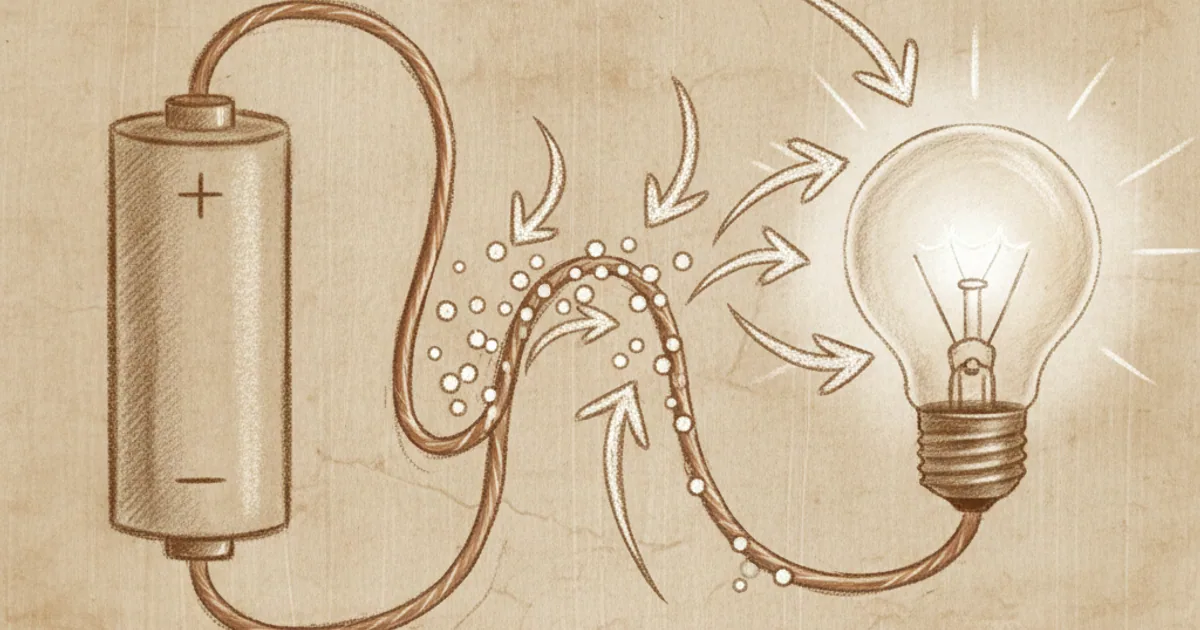
Electricity is the flow of electric charge.
In almost all practical cases, that means electrons moving through a conductor — usually a copper or aluminum wire. Other carriers exist (ions in solution, holes in semiconductors), but household and industrial electricity is overwhelmingly about electrons drifting through metal wires.
That's the answer. The rest of this article is unpacking what's going on, why the simple description is misleading in some ways, and what voltage and current and resistance actually mean.
Charge: what's flowing
Electric charge is a fundamental property of certain particles. The two relevant ones:
- Electrons (negative charge, magnitude e = 1.602176634 × 10⁻¹⁹ coulombs exactly, as fixed by the 2019 SI redefinition).
- Protons (positive charge, magnitude e — exactly equal in magnitude to the electron's charge but opposite in sign).
In metals, atoms are arranged in a regular lattice, with most electrons tightly bound to their atoms — but a small fraction of "conduction electrons" are free to move. In copper, this is about one electron per atom. These free electrons are what we call "the electrons" in a wire.
When you connect a battery to a wire, those free electrons drift through the metal under the push of the electric field. The drift speed is surprisingly slow — typically less than a millimeter per second in a household wire under normal load. The electrons travel through the wire like fish through a slow-moving stream.
So how does an electrical signal travel so fast? Through the field, not the electrons. The electric field propagates along the wire at close to the speed of light. The field pushes electrons everywhere in the wire at essentially the same time. The whole "water in a pipe" analogy is apt: push one end of a long full pipe, and water flows out the other end almost instantly, even though no single water molecule traveled the length. The pressure (voltage) propagates fast; the individual molecules (electrons) move slowly.
Current: the rate of flow
Current is the rate at which charge flows past a point. Measured in amperes (A, or "amps"):
1 ampere = 1 coulomb per second = about 6.24 × 10¹⁸ electrons per second.
To give a sense of scale:
- A small LED draws around 0.02 A (20 milliamps).
- A typical light bulb (60 W incandescent at 120 V): 0.5 A.
- A typical phone charger: 1-2 A.
- An electric kettle: 10-15 A.
- A car starter motor: 200+ A (briefly).
- An electric arc-welding machine: 100-500 A.
- A lightning bolt: 30,000 A (peak, briefly).
A 1 A current flowing for 1 hour delivers 3,600 C of charge — about 2.2 × 10²² electrons. Electrons are small.
By convention, current is described as the direction POSITIVE charge would flow, even though in metals it's electrons (negative charge) actually moving. This is a historical artifact from Benjamin Franklin guessing wrong about which way charge moved. It's harmless once you know about it, but it does mean current in a wire runs OPPOSITE to electron motion. Almost all engineering and education uses the conventional (positive-flow) direction.
Voltage: the push
Voltage is the energy difference per unit charge between two points in a circuit. Measured in volts (V):
1 volt = 1 joule per coulomb.
A 12 V car battery means: each coulomb of charge moving through the battery gains 12 joules of energy. The same coulomb, falling back through a load (light, motor) connected across the battery, releases those 12 joules as light, heat, or motion.
A few intuitive analogies:
- Water pressure: a water tank elevated 10 m above ground has potential energy per kg of water proportional to height. Connect a pipe to the bottom and water flows out under pressure. Voltage is the electrical analog of water pressure — it's not the flow itself, it's the energy available to drive flow.
- Hill height: imagine charges as marbles, and voltage as the height of a hill. A high hill (high voltage) means marbles roll down with more kinetic energy. Connect points at different "heights" (voltages) and current flows from high to low — if there's a complete circuit path.
Common voltage values:
- USB-A charger: 5 V; modern USB Power Delivery negotiates 5/9/12/15/20 V (and up to 48 V in newer specs).
- AA battery: 1.5 V.
- Conventional car 12 V system: 12 V (around 12.6 V fully charged). Many modern vehicles add 48 V auxiliary systems; hybrid and electric vehicles also have high-voltage DC traction packs (typically 300-800 V).
- US household outlet: 120 V (RMS).
- European household outlet: 230 V (RMS).
- Local distribution lines: 11-33 kV.
- High-voltage transmission: 110-765 kV.
- Lightning bolt: ~100 MV (during strike).
Voltage is always between TWO points. "The voltage is 12 V" is shorthand for "between these two points, the voltage difference is 12 V." A wire by itself has no voltage; voltage is the difference between locations.
Resistance: the slowdown
Resistance is how much a material opposes current flow. Measured in ohms (Ω):
1 ohm = 1 volt per ampere.
A resistor with 1 Ω resistance lets 1 A flow per 1 V applied. Higher resistance = less current for the same voltage.
Resistance comes from electrons bumping into the lattice of atoms in the conductor as they drift. Each collision converts a tiny bit of electrical energy into heat. This is why wires get warm under load, and why a hair dryer or heating element gets hot — they're resistors converting electrical energy to heat by design.
Properties affecting resistance:
- Material: copper has low resistance; aluminum slightly higher; iron more; nichrome (heating element wire) much more. Insulators (rubber, plastic, glass) have enormous resistance.
- Length: longer wire = more resistance (proportional).
- Cross-section: thicker wire = less resistance (inversely proportional).
- Temperature: most metals' resistance INCREASES with temperature; semiconductors and some materials' resistance DECREASES.
Some materials at very low temperatures become superconductors — zero resistance, currents flow forever once started, with no energy loss. Practical applications include MRI machines (superconducting magnets), particle accelerators, and some high-precision laboratory equipment.
Ohm's law
The single most useful equation in electricity:
V = I × R
Voltage equals current times resistance. Or rearranged: I = V/R (current equals voltage divided by resistance), or R = V/I (resistance equals voltage divided by current).
This lets you predict any of the three from the other two. A 9 V battery across a 100 Ω resistor: I = 9/100 = 0.09 A. Same battery across 10 Ω: I = 0.9 A (10x as much current, much more heat dissipation).
Ohm's law works for most everyday electrical materials at normal currents. It breaks down for some "non-ohmic" devices (diodes, transistors, anything semiconductor-based, or at extreme temperatures), but for routine circuit analysis, it's a fundamental workhorse.
Power: energy per second
Electrical power — how fast energy is being delivered or consumed:
P = V × I
Power equals voltage times current. Measured in watts (W).
A 60 W light bulb on a 120 V circuit draws 60/120 = 0.5 A. A 2,000 W kettle on 230 V draws ~8.7 A. A laptop charger labeled "65 W, 20 V" delivers 65/20 = 3.25 A at its output.
Power dissipated in a resistor specifically: P = I²R = V²/R. This is why high currents in low resistance wires generate a lot of heat (I²R losses). Power transmission systems use very high voltages partly to minimize I, because I² makes heating losses much worse with high current.
AC vs DC
Two regimes:
DC (direct current): charges flow in one direction. Batteries, solar cells, fuel cells produce DC. Most electronics (phones, laptops, LEDs) run on DC internally. Conventional cars use a 12 V DC subsystem; modern hybrids and EVs add 48 V and high-voltage (hundreds of volts) DC packs. Logic circuits operate on DC.
AC (alternating current): charges oscillate back and forth, typically at 50 Hz (Europe) or 60 Hz (US). The voltage rises and falls sinusoidally. Most household power is AC.
Why AC dominates power grids:
- Transformers: AC voltage can be stepped up or down easily with simple iron-and-copper transformers. DC transformation requires more expensive electronic converters.
- Long-distance transmission: high-voltage AC has much lower losses than high-voltage DC over moderate distances. Transformers step up to 110-765 kV for transmission, then down to household 120/230 V.
- Historical: Edison vs Westinghouse/Tesla, the "War of Currents" in the 1880s-90s. Westinghouse/Tesla won; AC became the standard.
Modern qualifications:
- HVDC (high-voltage DC) is used for very long transmission lines (>800 km roughly). It actually has lower losses than HVAC over very long distances, but requires expensive converter stations at each end.
- DC microgrids are growing in popularity for solar+battery systems, electric vehicles, and data centers, because so many modern loads are already DC.
Most electronics internally rectify the incoming AC to DC and run on DC. Your laptop charger contains a transformer/rectifier converting 120 V AC at 60 Hz into ~20 V DC.
Why electric shocks are dangerous
The current matters more than the voltage for danger to people:
- <1 mA: barely perceptible.
- 1-5 mA: tingling, mild shock.
- 5-30 mA: painful, possible muscle contraction. Below 30 mA mostly survivable but uncomfortable.
- 30-100 mA: severe muscle contraction, can't let go of wire, potential heart fibrillation.
- >100 mA: high risk of ventricular fibrillation (lethal).
- >500 mA: respiratory paralysis, severe burns.
For comparison: a 120 V outlet driving current through a person's body (resistance ~1,000-10,000 Ω depending on skin moisture, contact area, internal path) can deliver 12-120 mA — well into dangerous territory.
This is why ground-fault circuit interrupters (GFCIs) and residual-current devices (RCDs) trip at very small leakage currents (typically 5-30 mA) — to break the circuit before harm can occur.
High voltage isn't dangerous if no current flows. Static electricity sparks can be 10,000+ V but only deliver microamps for microseconds. Power lines at 100,000 V are extremely dangerous because they can drive substantial current through any conducting path.
What about static electricity?
Rub a balloon on your hair. Pull off a wool sweater in a dry room. Touch a metal doorknob after walking across a carpet. Static electricity is real electricity, just not flowing.
Specifically: two materials in contact can exchange electrons (some materials grab electrons more strongly than others). After separation, one material has excess electrons and the other has too few. These charged objects have potential to drive a brief current if connected to ground or each other.
The discharge is brief because the total charge involved is small (typically tiny fractions of a microcoulomb). High voltage (thousands of volts) but very low energy (millijoules) — startling but harmless to people.
Lightning is static electricity on a much larger scale. Charge accumulates in clouds and on the ground; when the voltage difference is enough to ionize the air between them, a sudden discharge equalizes the charge — with up to ~30 kA peak current and ~1 GJ of energy. Very dangerous.
If you'd like a guided 5-minute course on electricity basics, NerdSip can generate one.
The takeaway
Electricity is the flow of electric charge, usually electrons through a metal conductor. Voltage is the energy per unit charge driving the flow; current is the rate of flow; resistance opposes the flow. Ohm's law (V = IR) links them. The drift speed of electrons in wires is slow (sub-mm/s), but the electric field propagates near light-speed — so signals travel fast even though individual electrons crawl. AC alternates direction; DC flows steady. The world's power grids run on AC partly because transformers can change AC voltages easily, allowing high-voltage transmission and lower-voltage distribution. Modern electronics convert AC to DC internally because logic circuits and semiconductors run on DC.

Comments 0
No comments yet. Be the first to share your thoughts.