
The category
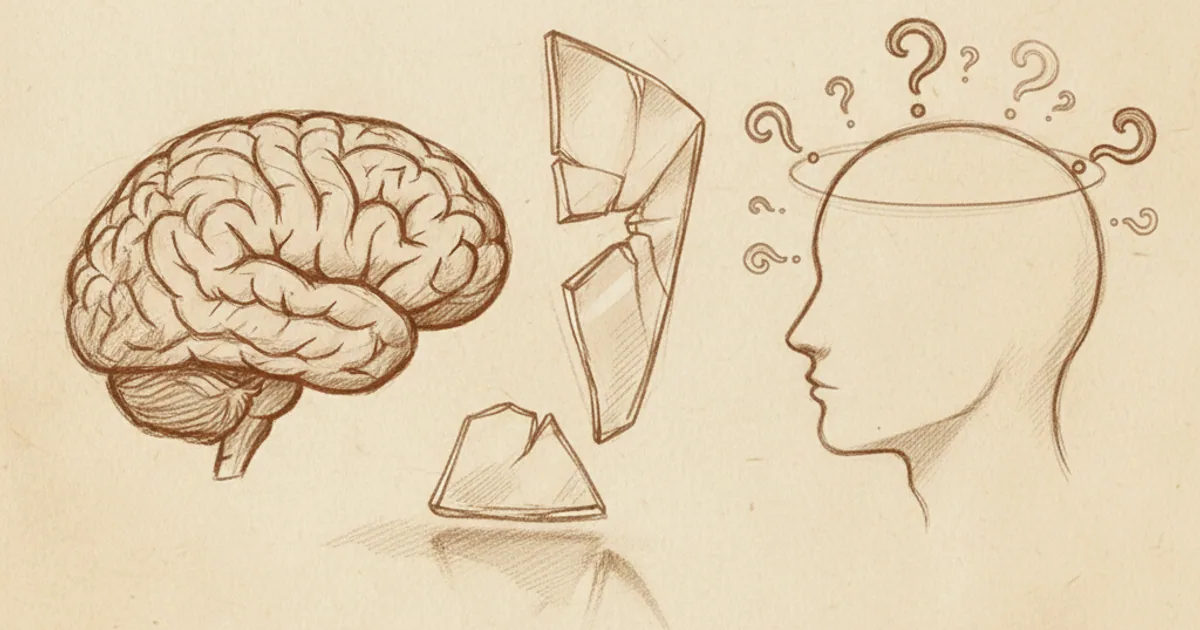
We're all carrying around some folk science that's wrong. Repeated by parents, teachers, well-meaning friends, films, advertising. Some of it sticks for decades. Some has been believed for centuries.
These aren't quirks — they're systematic. Once a misconception is in cultural circulation, it's surprisingly hard to dislodge. Brains are good at remembering things, including things that are wrong.
This cluster cleans up a few of the most widely-repeated. The deeper articles cover the left-brain right-brain myth, the 10% of the brain claim, the 5-second rule, and glass-as-a-slow-liquid. This overview is the tour.
Why misconceptions stick
Several mechanisms keep wrong ideas alive:
They sound plausible. "We only use 10% of our brain" feels right because we're often not using our full capacity. The metaphor maps onto subjective experience even when the literal claim is false.
They serve narratives. "Left-brain logical, right-brain creative" is a more useful character archetype than "most cognition involves both hemispheres in complex distributed ways." The simple version gets told more often because it's more useful for the story.
They come from misreadings. Often the original research was nuanced, but a simplified version stuck. The 10% brain myth seems to trace back to misreadings of early neuroscience and self-help books from the early 20th century, plus a misquoted Einstein attribution.
They're partially true. Some misconceptions are wrong in the strict version but capture a real phenomenon. There IS hemispheric specialization in the brain; it just doesn't map onto "creative vs logical." Saying the simpler thing is more memorable than explaining the actual structure.
Authority figures repeat them. When a teacher or doctor or parent says something, you remember it. When you later read a contradiction, the older memory is more deeply consolidated.
Confirmation bias. Once you believe the claim, you notice supporting evidence and dismiss contradicting evidence. Each retelling reinforces it.
A short tour of believed-but-wrong claims
Here's a quick run of common ones, each with the correction. The articles linked below go into more detail for the four major ones.
"We only use 10% of our brain." Wrong. We use all of it, just not all at once. Brain scans show activity in every region over a day. See the article.
"Left-brain people are logical, right-brain people are creative." Wildly oversimplified. Hemispheric specialization is real but doesn't track personality. See the article.
"The 5-second rule — food dropped briefly is still safe." Bacteria transfer happens essentially instantly. The longer food sits, the more transfer, but there's no safe window. See the article.
"Glass is a slow-flowing liquid — that's why old windowpanes are thicker at the bottom." No. Glass is an amorphous solid. Old windowpanes were thicker on one side because of how they were made; the makers put the thicker side at the bottom for stability. See the article.
"Lightning never strikes the same place twice." It does. The Empire State Building is struck 25+ times per year. Anything tall and pointed gets struck repeatedly.
"Deoxygenated blood is blue." No. It's just darker red. The blueness of veins under skin is an optical effect of how skin filters light, not the color of the blood itself.
"You can see the Great Wall of China from space." Only marginally, and not from the Moon. From low Earth orbit it's barely visible — many other human structures are equally or more visible.
"Goldfish have 3-second memories." False. Goldfish can be trained to perform sequences of actions, suggesting weeks of memory at minimum.
"Different parts of your tongue taste different things (the 'tongue map')." Wrong. All taste receptors are spread across the whole tongue. The map came from a 1901 misinterpretation of a German paper.
"Bulls hate the color red." Bulls are colorblind for red. The bull is reacting to motion, not color. The matador's cape could be any color and provoke the same response.
"Vikings wore horned helmets." They didn't. The horned-helmet image is from 19th-century romantic depictions of Vikings in opera costumes and theatrical productions.
"Napoleon was short." He was about 5'7" (170 cm) by modern measure — average for his time. The "short" reputation came from British propaganda and confusion between French and English measurement units.
"Humans have 5 senses." We have many more — proprioception (where your limbs are), balance, temperature, pain, hunger/thirst, time-passing sense, sense of being watched (debated). The "5 senses" framing comes from Aristotle and is genuinely outdated.
"Sugar makes children hyperactive." Multiple studies have failed to find an effect. Parents reliably report it, but in double-blind tests, kids given sugar vs sugar-free placebos don't differ in activity level. Parental observation suffers from expectation bias.
"You only need to drink 8 glasses of water a day." Not particularly well-supported. Most people get enough water from food and other beverages. Specific recommendations vary by individual and climate. Listen to your thirst, drink more when active or in heat.
"Cracking your knuckles causes arthritis." No. Long-term studies show no association.
"Bats are blind." They aren't. Most bats see fine and use echolocation as an additional sense, not because they have to.
"Hair and nails keep growing after death." They don't. The surrounding skin retracts as the body dehydrates, making them look longer.
"The Coriolis effect determines which way toilet water spins." No. The Coriolis effect is far too weak at toilet scale. Toilet bowl spin is determined by the shape of the bowl and how water enters.
"Mount Everest is the closest point on Earth to space." It's the highest mountain above sea level, but because Earth bulges at the equator, the summit of Chimborazo in Ecuador is actually further from Earth's centre. So Chimborazo is closer to space, geographically.
There are hundreds more. The Wikipedia "List of common misconceptions" is genuinely fascinating reading.
Why this matters
Beyond winning bar arguments, misconceptions matter when they affect:
Medical decisions. Believing wrong things about vaccines, drugs, diet, exercise affects what you do with your health.
Educational decisions. Believing in "learning styles" (a major debunked claim — see how your brain learns) leads to wasted instructional effort.
Public policy. Wrong beliefs about climate, epidemics, immigration, economics drive policy preferences that have real effects.
Personal investment. Wrong financial beliefs (the importance of timing markets, the value of various scams) cost money.
The point of debunking isn't smugness. It's calibration — knowing what's actually true is the foundation of every good decision.
How to update your beliefs
A few habits that help:
Cite specific sources. "I heard somewhere..." is a weak basis. If you can't recall where, treat the claim as provisional.
Be willing to be wrong. When you encounter contradicting evidence, the productive response is to think about whether the new evidence might be right, not to dig in defending the old belief.
Distinguish "consensus" from "I've heard a lot." Many misconceptions are widely repeated but not actually scientific consensus. Wikipedia, peer-reviewed sources, and authoritative organizations (NIH, NASA, etc.) are better signals than what your friends say.
Notice motivated reasoning. If you really want a claim to be true (or false), you'll defend it more strongly than the evidence warrants. Catching yourself in this is most of intellectual hygiene.
Update gradually. Strong beliefs deserve strong updates. Weak beliefs deserve weak updates. Most updates should be in proportion to the evidence.
If you'd like a guided 5-minute course on common misconceptions and how to update beliefs, NerdSip can generate one.
The takeaway
We carry around bits of folk science that turn out to be wrong, and the most widely-believed ones tend to stick because they sound plausible, serve narratives, get repeated by authority figures, and confirm what we expected. Some have been debunked for decades but still appear in textbooks and conversations. Knowing the common ones is good defence — both against forming wrong beliefs and against being persuaded by arguments built on top of them. The articles in this cluster cover the most-repeated. The skill is bigger than any specific debunking: it's the habit of asking "wait, is that actually true?"

Comments 0
No comments yet. Be the first to share your thoughts.