
The myth
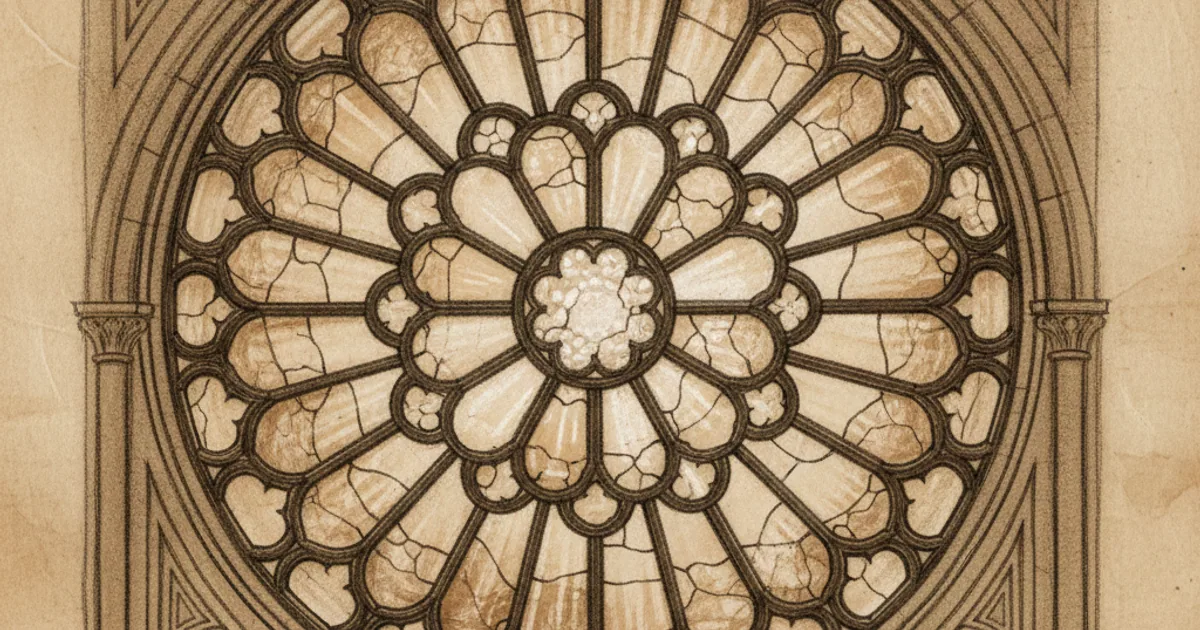
You may have heard this one: medieval cathedral windows are thicker at the bottom than the top because glass is actually a very slow-flowing liquid. Over centuries, gravity pulls the molecules downward, causing the panes to sag.
The conclusion drawn: glass is "liquid that just moves really slowly." Sometimes the more lyrical version: "glass flows like cold honey, on a millennial timescale."
This is one of the most pleasingly poetic things people believe about physics. It's also wrong.
Why old windows are uneven
Medieval and early-modern glassmakers had no way to make perfectly flat sheets. They used two main techniques:
Crown glass. A blob of molten glass at the end of a blowpipe is spun rapidly. Centrifugal force flings it outward into a disc, like a frisbee. The result is a circular sheet, thicker near the centre (where the pontil rod was attached) and thinner at the edges. Cut into rectangular panes, the thickness varied.
Cylinder glass. A blob is blown into a cylinder, which is then slit longitudinally and flattened. The thickness varies along the cylinder's length due to the blowing process.
Both methods produced sheets that were not uniformly thick. When glaziers installed the panes, they generally put the thicker edge at the bottom for structural stability — a heavier bottom is more stable than a heavier top.
So yes, many old windows are thicker at the bottom. But this is the glaziers' installation choice, not centuries of sag.
The smoking gun: in some old windows, the thicker side is at the top, on the sides, or oriented inconsistently. If gravity were slowly pulling the glass down, every old window would be thicker at the bottom. They aren't.
What glass actually is
Glass is an amorphous solid. Let's unpack that.
In most solids (metals, salts, ice, sugar crystals), atoms are arranged in regular repeating patterns — a crystal lattice. The atoms aren't moving around; they're vibrating in place, but their positions are fixed in the lattice.
In a liquid, atoms have no long-range order. They jostle around, swap positions, flow under stress. There's local structure but no large-scale repeating pattern.
Glass has the disordered molecular arrangement of a liquid, but the atoms don't move around. They're fixed in their disordered positions, vibrating in place. It's solid in every practical sense — it doesn't flow, it doesn't deform under gravity at normal temperatures, it has a definite shape.
The disorder gives glass several distinctive properties:
- Transparency. No crystal grain boundaries to scatter light, so visible light passes through.
- Brittleness. No grain structure to absorb crack energy, so cracks propagate easily.
- Sharp fracture. Breaks at conchoidal (curved) surfaces rather than along crystal planes.
- No specific melting point. Crystals melt at a specific temperature; glass softens gradually over a temperature range (the "glass transition").
That last property is the source of the "glass is a liquid" confusion. Glass really does sit on a kind of continuum with the liquid form it was made from. But at room temperature, it's stationary on any reasonable timescale.
How slow is "slow flow"?
Suppose glass DID flow, just very slowly. How slowly?
Physicists have estimated this. Edgar Dutra Zanotto (American Journal of Physics, 1998) calculated that for cathedral window glass at typical European temperatures, the flow rate would be many orders of magnitude slower than required to produce measurable sag over a thousand years.
The number: the viscosity of glass at room temperature is so high that the flow needed to thicken the bottom of a window by 1 mm over 1000 years would require the age of the universe times trillions of years. It's not just slow — it's essentially infinite.
Glass at room temperature has a viscosity around 10²⁰ Pa·s. Honey is about 10. Water is about 10⁻³. The ratios are astronomical. For practical purposes, "infinite viscosity" is the right description.
You can sometimes see flow in ancient glass — but only when it's been exposed to high temperatures (volcanic eruptions, fires) or in obsidian, where the glass was at high temperatures for extended periods after formation.
The "glass transition"
Heat glass enough and it does start to flow. The temperature at which this begins is the glass transition temperature (T_g), and for most window glass it's around 500-600 °C.
Below T_g, the glass is solid. Above T_g, it softens and gradually becomes more liquid-like. Glassblowers work above this temperature, where the glass is plastic enough to shape but not so hot it can't hold form.
What's distinctive about glass is that this transition is gradual, not sharp. Crystals melt at one specific temperature. Glass softens over a range of temperatures, getting more flowable as it warms. This is why glassblowers can keep working a piece for some time as it gradually cools — there's a workable temperature range.
The same principle in reverse: when molten glass cools, it doesn't suddenly crystallize at one temperature. It just gets more and more viscous, smoothly, until it's effectively solid. This is why fast cooling produces glass — the molecules don't have time to arrange into crystals.
Other amorphous solids
Glass isn't unique. Other amorphous solids include:
Most plastics. Polystyrene, polyethylene, etc. have amorphous regions (and sometimes crystalline regions) — they soften over temperature ranges rather than melting sharply.
Hard candies. Sugar amorphous solid at room temperature. Heat it enough and it flows.
Some metals when rapidly cooled. "Metallic glasses" — alloys cooled so fast that crystal structure doesn't form. These have unusual mechanical properties.
Volcanic obsidian. Naturally formed amorphous solid silica from rapidly-cooled lava.
Asphalt. Highly viscous amorphous material. Above room temperature it DOES flow noticeably, which is why asphalt roads develop ruts.
The continuum from "obviously solid" to "obviously liquid" is broader than the everyday categories suggest. Many real materials sit in between.
A note: the "amorphous solid" debate
Some physicists use the term "glass" for any rapidly-cooled non-crystalline material. Some define it more narrowly as silica-based amorphous solids. Some philosophers of science have argued that the classification scheme is partly conventional rather than purely physical.
What's NOT controversial: at room temperature, window glass doesn't flow on any timescale that matters for buildings or people.
If you'd like a guided 5-minute course on the physics of glass and other amorphous materials, NerdSip can generate one.
The takeaway
Glass is an amorphous solid — its molecular arrangement is disordered like a liquid's, but at room temperature the molecules are stationary. Old cathedral windows are uneven because the manufacturing process produced uneven sheets, and glaziers installed them with the thicker side at the bottom for stability. The "glass is a slow liquid" claim is pleasingly poetic but contradicted by physics — calculations show the supposed flow would take many orders of magnitude longer than the age of the universe to produce measurable sag. Glass is its own category of material, neither liquid nor crystalline, and the everyday classification system isn't quite up to it.

Comments 0
No comments yet. Be the first to share your thoughts.