
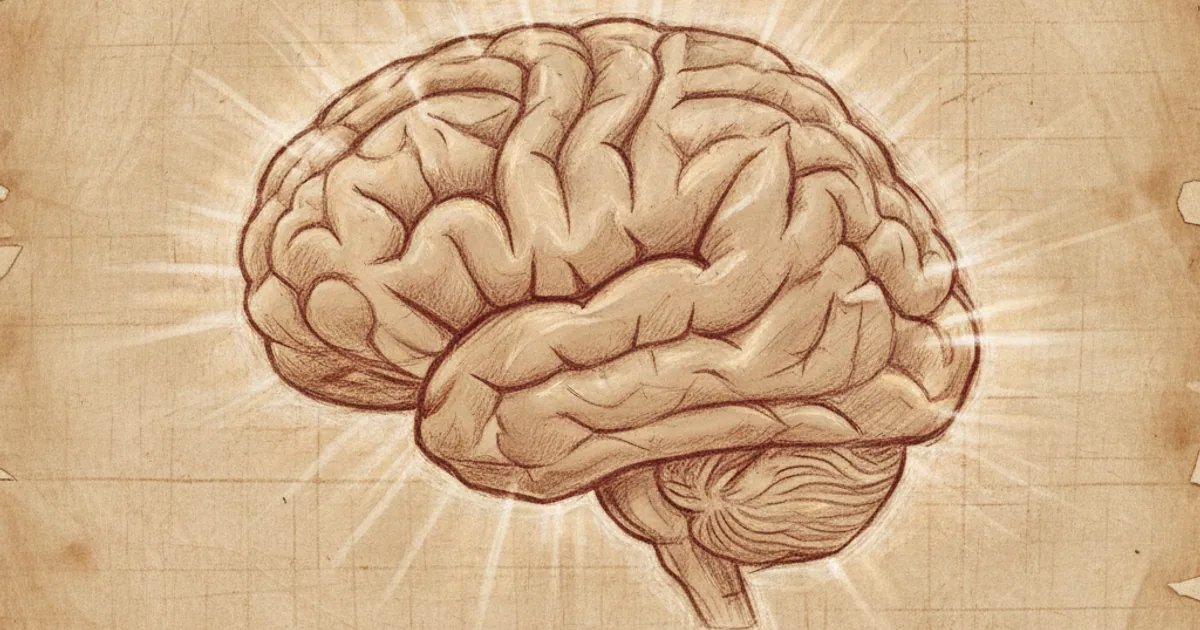
The claim
"We only use 10% of our brain — imagine what you could do if you accessed the other 90%."
The line shows up in self-help books, motivational speeches, movies (Lucy, Limitless), and casual conversation. It's appealing — there's an untapped reservoir of cognitive power waiting to be unlocked. With the right book, course, supplement, or training, you could be smarter, more creative, maybe even psychic.
It's almost entirely wrong.
What neuroscience actually shows
You use 100% of your brain. Just not all at once for any single task.
Different mental activities engage different brain regions. Reading this article right now is recruiting your visual cortex (seeing the letters), language areas (parsing meaning), working memory (holding the sentence in mind), prefrontal cortex (thinking about what you're reading). Right now, those areas are active.
When you stop reading and stand up to walk, different regions kick in: motor cortex, cerebellum, brainstem balance circuits. Those are now busy.
Over the course of a normal day — reading, talking, walking, eating, sleeping, dreaming — every region of your brain is active at some point. The brain is never idle in big chunks. There's no 90% reserve sitting dark.
This is shown by:
- fMRI scans. Magnetic resonance imaging shows blood flow and oxygen use in real time. Different tasks light up different regions, but over a series of tasks, every region lights up.
- PET scans. Positron emission tomography shows glucose metabolism — the brain's primary fuel. Every healthy region uses glucose continuously.
- Stroke and injury data. Damage to small brain regions reliably produces specific deficits — strokes that destroy 1% of the brain can leave a person unable to speak, recognize faces, or move part of their body. If 90% were idle, this wouldn't happen.
The brain consumes about 20% of the body's energy despite being only 2% of body weight. Evolution doesn't fund 90% idle tissue. The metabolic cost would have been selected against.
Where the myth comes from
The exact origin is murky. Several plausible threads:
Early neuroscience overlooked function. Around 1900, scientists could identify functions for some brain regions (motor control, vision) but not others (much of the prefrontal cortex, association areas). It was tempting to say "we don't yet know what 90% of the brain does" — which got distorted in popular retellings to "we don't use 90% of our brain."
Glial cells. The brain has both neurons (the active signaling cells) and glial cells (support cells). Glial cells outnumber neurons in some regions. Some interpretations counted only neurons as "useful," leading to a percentage that looked like under-utilization.
Self-help books. Dale Carnegie's How to Win Friends and Influence People (1936) and others quoted approximate-sounding figures about untapped potential. The "10%" figure crystallized somewhere in this literature.
Misattributed Einstein quote. A persistent rumor attributes the claim to Einstein. There's no evidence he ever said it. The quote appears nowhere in his writings.
William James. The Harvard psychologist William James, around 1900, wrote that humans "make use of only a small part of our possible mental and physical resources" — a true and useful statement about under-development of skills, NOT a claim about literal brain percentages. This got distorted over decades.
By the mid-20th century, the "10%" figure was widely repeated in popular culture, untethered from any specific source. By the late 20th century, it was a fixture of pop psychology, surviving repeated debunkings.
Why it persists
A few reasons:
It's appealing. The promise of untapped potential is more interesting than "you're using everything you have." Self-help and entertainment industries naturally amplify it.
It's vague. "10%" is precise enough to sound scientific but vague enough that it's hard to refute concretely. What 10%? Of what? Cells? Volume? Capacity? The imprecision makes the claim slippery.
It's repeated by movies. Lucy (2014, directed by Luc Besson) is built entirely on the premise that you can access more of your brain and get superhuman abilities. Limitless (2011) similarly. People who see these films might dismiss the specific superpower claims but absorb the "10% is real" premise.
Mistaken authority. When a doctor, teacher, or motivational speaker says it confidently, listeners accept it. The chain of repetition keeps it alive.
Confirmation bias. Once you believe it, you can rationalize almost any cognitive limitation as "well, I'm not using my full potential." The unfalsifiable nature is part of the appeal.
What's actually under-developed
The "10% myth" usually comes packaged with a real grain of truth: most people don't develop their cognitive abilities anywhere near their potential.
That's true, but it's not because 90% of your brain is dormant. It's because:
- You haven't learned skills that would use specific neural pathways more efficiently.
- You haven't built habits that take advantage of well-understood cognitive techniques (spaced repetition, retrieval practice, etc. — see active recall).
- You sleep poorly, which impairs memory consolidation. (See why we need sleep.)
- You under-exercise, which reduces blood flow to the brain.
- You don't deliberately practice the things you want to be good at.
Improving cognitive function is real and possible — through these legitimate means, the kind of small daily habits that actually make you sharper. None of them involves accessing dormant brain tissue.
What movies (and pseudoscience) get wrong
A few things:
"Imagine if you used all of it." You DO use all of it. Just not on every task.
"Unlock psychic abilities, telekinesis, levitation." None of these have been demonstrated in any rigorous test, and there's no neurological evidence they're stored somewhere in the brain waiting to be activated.
"Drugs/pills/training that unlock more brain." Stimulants (caffeine, modafinil, methylphenidate) increase wakefulness and focus. They don't unlock idle brain regions; they modulate normal function. Brain training apps have mostly shown improvements only on the specific exercises practiced, not on general intelligence.
"Geniuses use more of their brain." Geniuses don't use more. They use their brain in different ways — patterns of connectivity, faster information transfer in specific networks, more efficient organization. Not more raw percentage activated.
The takeaway
We use 100% of our brain, just not all of it for any single task. fMRI and PET imaging show every region is active for something over normal use. Stroke data confirms that even small regions have important functions. The brain's huge energy cost (20% of total body energy for 2% of body mass) rules out evolutionary tolerance of 90% idle tissue. The 10% myth probably comes from a mix of early-neuroscience uncertainty, motivational-speaking distortions, and movie-driven repetition. There's no dormant 90% to unlock; what IS available is the legitimate improvement of your existing cognitive function through sleep, exercise, deliberate practice, and good study technique.

Comments 0
No comments yet. Be the first to share your thoughts.