
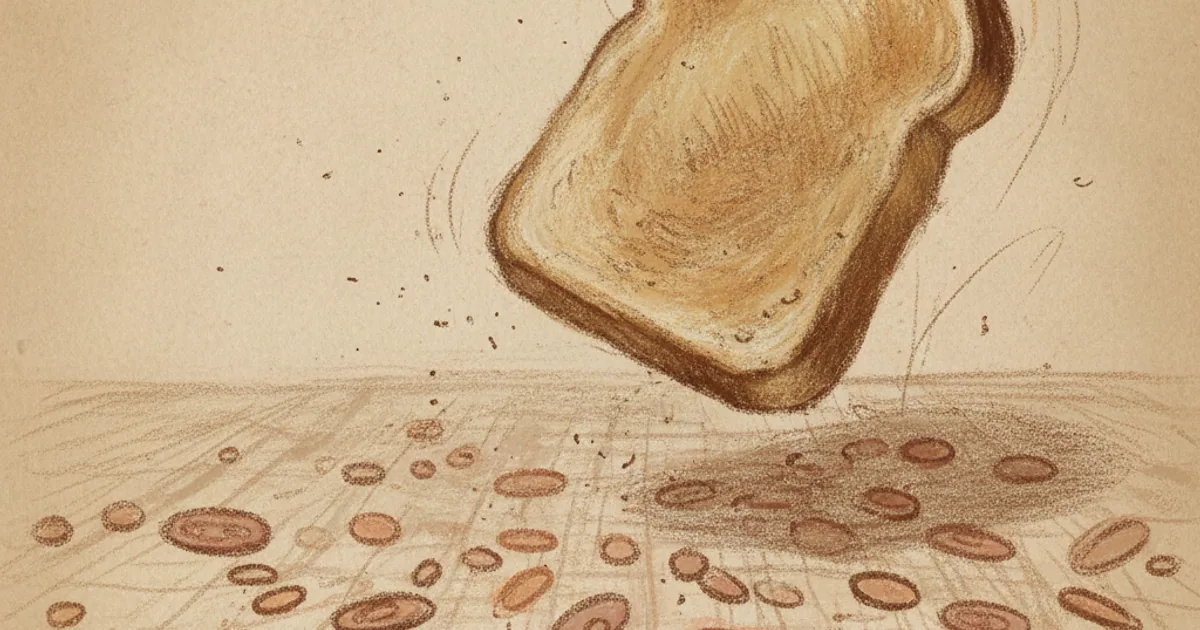
The rule
You drop a piece of food on the floor. You pick it up quickly — within 5 seconds — and eat it anyway. Folk wisdom says this is safe; the food hasn't had enough time to "get dirty."
In some countries it's the 3-second rule; in others the 10-second rule. The exact number is a cultural variable. The implied principle is universal: there's a safe window before bacteria contaminate dropped food.
This is wrong in detail, partially right in spirit, and worth understanding for the underlying microbiology.
What experiments actually show
The most thorough study (Schaffner et al., Rutgers University, published in Applied and Environmental Microbiology in 2016) tested four foods (watermelon, bread, buttered bread, and gummy candy) dropped on four surfaces (stainless steel, ceramic tile, wood, and carpet) for four contact times (less than 1 second, 5 seconds, 30 seconds, and 300 seconds).
Each combination was tested 20 times. Researchers measured how much bacteria transferred.
Key findings:
Transfer is essentially immediate. Even at less-than-1-second contact, measurable bacteria transferred. There's no "before bacteria arrive" window.
Longer contact = more transfer. Bacterial load picked up did increase with time. So picking food up faster picks up less. But the increase is gradual; there's no magic threshold.
The food matters most. Watermelon (high moisture) picked up the most bacteria — moisture lets bacteria detach from the surface and stick to food. Dry foods (gummy candy, bread) picked up much less.
The surface matters too. Tile and stainless steel (smooth) transferred more bacteria than carpet (textured). Wood was intermediate. Counterintuitively, the cleaner-looking surfaces are often the bigger transfer risk per unit time.
Earlier studies (Clemson University, 2007; and an actual high school science fair experiment that went viral) reached similar conclusions: bacteria transfer fast, increase gradually with time, and depend strongly on food and surface.
The kernel of truth
The 5-second rule isn't entirely wrong. Less time DOES mean less bacteria. A piece of bread picked up in 1 second has noticeably less bacteria on it than the same piece left on the floor for 30 seconds.
What's wrong is the idea of a "safe window" — a duration below which bacteria don't transfer at all. There isn't one. The transfer-vs-time curve is continuous from zero.
So the rule is really: "the faster you pick it up, the less bacteria you get." Not "below 5 seconds is bacteria-free."
Does it actually matter?
A more important question: does the bacteria you'd pick up actually make you sick?
Floor bacteria in a typical home are usually:
- Soil bacteria (mostly harmless).
- Skin bacteria from people who walk through (mostly harmless).
- Food residue bacteria (depends on what's been spilled).
- Trace amounts of fecal bacteria from shoes (concerning but usually below infectious dose).
Most of the time, the bacteria on your home floor aren't pathogenic. Eating a small dose of them is unlikely to make you sick — your immune system handles trace exposures continuously.
When the 5-second rule becomes risky:
- Floor contaminated with raw meat juice. Salmonella, Campylobacter, E. coli can be present and infectious.
- Bathroom floor. Higher levels of fecal bacteria.
- Public floors with high foot traffic. Especially restaurants, transit stations, hospitals.
- Immunocompromised people. Doses that don't bother healthy adults can cause illness in those with weakened immunity.
For most home situations with dry food on a clean floor, the risk of actual illness is low. For wet food, raw-meat-contaminated surfaces, or vulnerable individuals, it's higher.
What changes with the surface
Carpet is interesting. Carpet transfers about 10 times less bacteria than tile because much of the bacterial mass gets caught in the carpet fibres rather than transferring to food. Counterintuitively, dropping food on carpet might be safer than on tile.
But carpet has its own problems — it accumulates more bacteria over time because vacuuming doesn't kill them. And dropped food can leave residue that breeds more bacteria over the medium term.
Tile and stainless steel transfer the most because they're flat, smooth surfaces where bacterial cells aren't trapped by texture. Almost all the bacteria on the contact area transfer to the food.
Wood is intermediate. The grain creates some texture that holds bacteria back, but smooth wood floors transfer almost as much as tile.
What about pets?
Dogs have a habit of pre-cleaning dropped food before humans can react. Dog mouths have their own microbiome which is different from human and floor microbiomes. Whether the bacteria left in dog saliva are more or less dangerous than floor bacteria depends on the dog's health.
For most household dogs eating typical pet food: dog saliva is mostly harmless to humans. For dogs that recently ate raw meat, scavenged garbage, or have dental disease: risk goes up.
When the rule actually fails dangerously
A few scenarios where "the 5-second rule" produces real harm:
Babies and immunocompromised people. Tiny doses of bacteria that don't bother healthy adults can make these populations sick. Don't apply the rule for them.
Cross-contamination from raw foods. If chicken juice has been on the floor, even briefly, you can pick up salmonella or campylobacter. The 5-second rule is irrelevant; you're now eating off a contaminated surface.
Sticky/wet foods. Watermelon, cheese, peanut butter pick up dramatically more bacteria than bread or candy. The 5-second margin matters less for these — you're picking up much more bacteria per second.
Public floors. Hospitals, schools, restaurants, public transport. Much higher and more diverse bacterial loads. Don't eat anything from these floors regardless of timing.
What food safety experts actually say
Food safety professionals don't endorse the 5-second rule, but they're often more relaxed than the public assumes. Their actual advice:
- For most home situations, dropped food is low-risk if picked up promptly and the floor isn't visibly dirty.
- For wet foods, raw-meat-contaminated surfaces, or vulnerable people, throw it out.
- Cooking the food after dropping (e.g., dropping a vegetable while cooking) eliminates most bacterial concerns since cooking kills bacteria.
- The bigger food safety issues are temperature abuse (food left in the danger zone 4-60 °C for too long), cross-contamination during prep, and inadequate handwashing — not occasional dropped food.
If you want to be safe, throw out dropped food. If you don't, picking it up faster does pick up less bacteria — just don't believe there's a magic safe window.
If you'd like a guided 5-minute course on food safety and what the actual hazards are, NerdSip can generate one.
The takeaway
The 5-second rule is a folk approximation of a continuous reality: bacteria transfer to dropped food essentially immediately, but the amount increases with time. There's no safe window. The more important variables are what's on the floor (most home floors are low-risk; raw-meat-contaminated surfaces aren't), what the food is (wet > dry for transfer), what the surface is (smooth > textured for transfer), and who's eating it (healthy adults > immunocompromised). For most home situations, the risk is low regardless of the exact timing. For high-risk situations, the rule is irrelevant — throw it out.

Comments 0
No comments yet. Be the first to share your thoughts.