
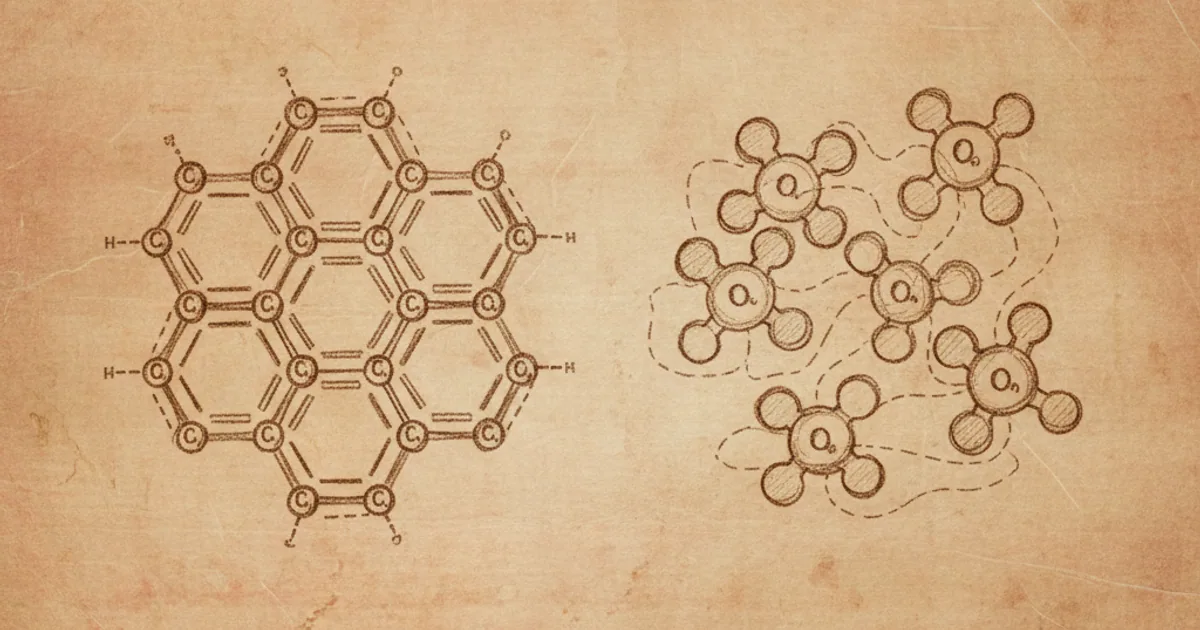
A molecule that breaks rules
Water is the most familiar liquid in our lives, which makes it easy to forget that it's also one of the strangest. By the standard chemistry rules — based on molecular weight, polarity, and basic intermolecular forces — water shouldn't behave the way it does.
The puzzle pieces:
- Boiling point. Water boils at 100°C. Methane (CH₄), about the same molecular weight, boils at −161°C. Hydrogen sulfide (H₂S), water's chemical cousin, boils at −60°C. Water's boiling point is 160°C higher than its closest relative would predict.
- Density anomaly. Solid water (ice) is less dense than liquid water. Almost every other substance is the opposite. (See why ice floats.)
- Surface tension. Highest of any common liquid. Insects walk on it.
- Specific heat. Holds enormous amounts of heat. Why oceans moderate climate.
- Solvent capacity. Dissolves more substances than any other natural liquid. Called the "universal solvent" for good reason.
Every one of these has the same single explanation: hydrogen bonds.
What hydrogen bonds are
A water molecule is H₂O — two hydrogen atoms covalently bonded to an oxygen atom. But the bonds aren't symmetric. Oxygen pulls the shared electrons toward itself more strongly than hydrogen does. The result: the oxygen end of the molecule is slightly negative, and the hydrogen end is slightly positive.
This makes water a polar molecule.
Two important geometric facts:
- The molecule is bent (the H-O-H angle is about 104.5°), not straight. So the polarity doesn't cancel out — one side is negative, the opposite side is positive.
- Each oxygen has two "lone pairs" of electrons not used in bonds. These lone pairs are also negative-leaning.
Put these together, and water has roughly two negative regions (the lone pairs on oxygen) and two positive regions (the hydrogens). Total: a molecule that can interact with up to four neighbours simultaneously through electrostatic attraction.
These weak inter-molecular attractions — between a positive hydrogen on one molecule and a negative oxygen lone pair on another — are hydrogen bonds. They're much weaker than covalent bonds (about 10% as strong) but stronger than other intermolecular forces.
In liquid water, every molecule is constantly making and breaking hydrogen bonds with its neighbours, on a timescale of picoseconds. The result is a kind of soft, dynamic network. That network is what makes water unusual.
How hydrogen bonds explain each anomaly
Why water boils so hot. To boil something, you have to give individual molecules enough kinetic energy to escape the liquid into a gas. In a non-hydrogen-bonded liquid, only weaker forces (van der Waals) hold the molecules together. Water molecules have to break their hydrogen bonds with neighbours before they can leave. That takes far more energy — hence the high boiling point.
If water lacked hydrogen bonding, it would boil at −80°C or so. Earth would have no oceans, just steam. Life as we know it couldn't exist.
Why ice is less dense than water. As water cools toward 0°C, hydrogen bonds become more long-lived. Below 4°C, molecules start arranging into a regular crystal lattice. This lattice has each water molecule bonded to four neighbours at fixed angles — an open hexagonal structure that takes more space than the random packing of liquid water. Solidified water is therefore 9% less dense than liquid water. The full story is covered in why ice floats.
Why water has such high surface tension. Surface tension comes from molecules at the surface having fewer neighbours to interact with than molecules in the bulk. Hydrogen-bonded water molecules at the surface pull more strongly on the molecules just below them, creating a kind of "skin." This is why a paperclip can be made to float on water if placed carefully, and why insects can walk on ponds.
Why water dissolves so much. Water's polarity lets it surround both positive ions (with its negative-oxygen ends) and negative ions (with its positive-hydrogen ends). Salt (Na⁺ Cl⁻) dissolves because water molecules wrap around each ion, pulling it into solution. The same logic applies to many polar molecules — sugars, alcohols, many drugs, and most things your body needs to transport.
Non-polar molecules (oils, fats) don't dissolve in water because they can't interact strongly with water's polarity. The water molecules prefer to stay hydrogen-bonded to each other than to mix with the non-polar substance. "Like dissolves like" is the rule of thumb.
Why water has high specific heat. It takes a lot of energy to warm water because much of the added energy goes into briefly breaking and reforming hydrogen bonds rather than into raising the molecules' kinetic energy. Result: water absorbs huge amounts of heat per degree of temperature rise. This is why oceans moderate climate — they store enormous heat in summer and release it in winter, smoothing seasonal extremes.
It's also why you sweat. Water has the highest latent heat of vaporization of any common liquid — evaporating it cools the source dramatically. See latent heat for more.
Why life uses water
The properties above add up to a substance that:
- Stays liquid over a wide useful temperature range (0–100°C).
- Dissolves the polar molecules biology runs on (proteins, sugars, salts).
- Resists temperature extremes (high specific heat protects cells).
- Provides surface tension for capillary action (water rising in plants).
- Floats as ice (protects aquatic life under polar caps).
Every known form of life uses water as its medium. It's not a coincidence — astrobiologists look for water on other planets precisely because so many of life's required chemical processes depend on water's unique properties.
If you'd like a 5-minute personalized course on water's chemistry and why it matters for life, NerdSip can generate one.
What hydrogen bonds do elsewhere
Hydrogen bonds aren't unique to water; they appear anywhere a slightly-positive hydrogen sits near a slightly-negative N, O, or F. They're central in:
- DNA. The two strands of DNA's double helix are held together by hydrogen bonds between complementary bases. Strong enough to be stable; weak enough to be unzipped during copying.
- Proteins. Protein folding is driven largely by hydrogen-bond patterns inside the molecule. The shapes that enzymes adopt are determined by where hydrogen bonds form and don't.
- Cellulose. Plant cell walls are made of cellulose chains held together by hydrogen bonds, which is why wood is strong.
Hydrogen bonding is one of biology's most-used motifs. Water just shows it off most spectacularly.
The takeaway
Water is bent, polar, and able to form four hydrogen bonds per molecule. That one feature explains its high boiling point, the floating of ice, its surface tension, its solvent power, its high specific heat, and pretty much every other anomaly. Without hydrogen bonds, water would be an unremarkable gas at room temperature and life as we know it wouldn't exist. With them, it's the medium for all biology and one of the most chemically interesting molecules nature uses.

Comments 0
No comments yet. Be the first to share your thoughts.