
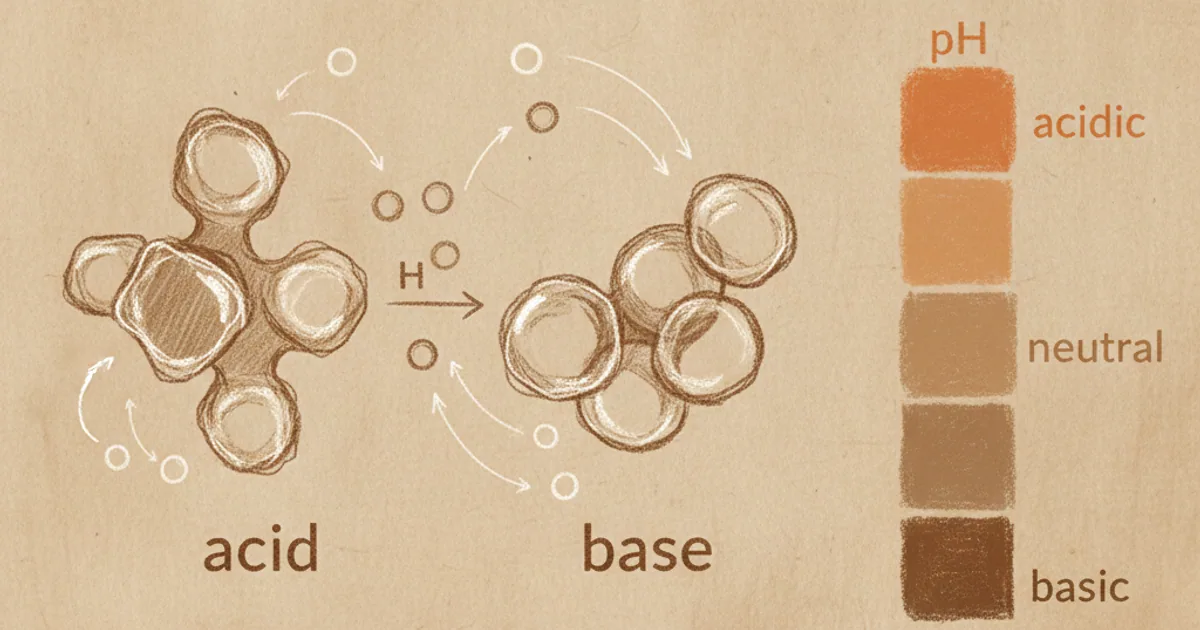
What an acid is
The simplest definition (Brønsted-Lowry, 1923, still the workhorse): an acid is a substance that donates hydrogen ions (H⁺) when dissolved in water.
A hydrogen ion is just a proton — a hydrogen atom missing its electron. It's tiny, highly charged, and very reactive.
When you drop hydrochloric acid (HCl) into water, it splits:
HCl → H⁺ + Cl⁻
The H⁺ floats around in the water as a "free" proton (it actually attaches to a water molecule to form H₃O⁺, but informally we just say "free H⁺"). The presence of these extra H⁺ ions is what makes the solution acidic.
What a base is
A base is a substance that accepts H⁺ ions from water — or, equivalently, donates hydroxide ions (OH⁻).
When sodium hydroxide (NaOH, drain cleaner) is dropped into water:
NaOH → Na⁺ + OH⁻
The OH⁻ floats around. It can absorb H⁺ ions from the water:
H⁺ + OH⁻ → H₂O
Bases pull H⁺ out of the water, leaving fewer H⁺ ions overall. That's what makes the solution basic (or alkaline — same thing).
How acids and bases neutralize
If you mix equal amounts of acid and base, the H⁺ from the acid and the OH⁻ from the base combine to form ordinary water:
H⁺ + OH⁻ → H₂O
This is neutralization. The result is water plus whatever counter-ions were there — typically a salt. For HCl + NaOH, you get water plus Na⁺Cl⁻, which is table salt.
This reaction releases heat (it's exothermic). It's why mixing concentrated acid and base can be dangerous — enough to boil the solution.
The pH scale
The concentration of H⁺ in solutions varies enormously. To make the numbers manageable, chemists use pH, the negative logarithm of H⁺ concentration:
pH = −log₁₀[H⁺]
In words: pH 7 means H⁺ concentration of 10⁻⁷ moles per litre, pH 6 means 10⁻⁶ (ten times more H⁺), pH 5 means 10⁻⁵ (100× more), and so on.
The full scale typically runs 0 to 14:
- pH 0: strong acid (lots of H⁺). Stomach acid is around here.
- pH 1-3: strong to moderate acids. Vinegar (pH 2-3), lemon juice (pH 2).
- pH 4-6: mildly acidic. Coffee (pH 5), most fruits.
- pH 7: neutral. Pure water at room temperature.
- pH 8-10: mildly basic. Seawater (pH 8), baking soda (pH 8-9).
- pH 11-14: strong bases. Bleach (pH 12-13), drain cleaner (pH 14).
Pure water at room temperature has very few H⁺ ions (around 10⁻⁷ M), giving pH 7. But "pure water" is rarely actually 7 in practice — dissolved CO₂ from air pushes natural rainwater to around pH 5.6.
Strong vs weak
A strong acid fully ionizes in water — every molecule splits into H⁺ and an anion. HCl, H₂SO₄, HNO₃ are strong acids.
A weak acid only partially ionizes — at any moment, only a fraction of the molecules are split. Vinegar (acetic acid) is weak. Citric acid (in citrus fruits) is weak. Carbonic acid (formed when CO₂ dissolves in water) is very weak.
The same distinction applies to bases. NaOH and KOH are strong bases. Ammonia (NH₃) is a weak base.
Crucially: strong is not the same as concentrated. Concentrated vinegar (high concentration of a weak acid) can be more corrosive than dilute hydrochloric acid (low concentration of a strong one). Both factors matter for what a solution actually does.
Where acids and bases show up in everyday life
Your stomach maintains a pH of 1-2 to digest food and kill bacteria. The lining is protected by mucus and constant cell renewal.
Your blood is tightly buffered to pH 7.35-7.45 by a system of carbonates and proteins. Deviations of even 0.1 are medical emergencies. The buffer system works by both acid and base components being present, so adding small amounts of either gets neutralized.
Soap is mildly basic. It works partly by saponifying fats (turning them into water-soluble compounds via base chemistry).
Acid rain is rain that has absorbed atmospheric sulfur dioxide or nitrogen oxides, forming sulfuric or nitric acid. It can drop pH to 4 or below, damaging forests, lakes, and limestone buildings.
Antacids (Tums, Rolaids, etc.) are bases — usually calcium carbonate or magnesium hydroxide — designed to neutralize stomach acid when you have heartburn.
Pool chemistry balances chlorine (an acid in water) with sodium carbonate or bicarbonate to keep pH around 7.4-7.6, comfortable for swimmers and effective at killing microbes.
Photography in the film era used acid baths (for fixing) and basic developers — different chemistries for different steps.
Why pH matters biologically
Most enzymes work best at specific pH values, and even small changes can dramatically reduce activity. This is one reason your body works hard to maintain blood pH within a tight range.
The pH gradient inside cells does real work. Mitochondria, the energy producers, pump H⁺ ions across an inner membrane to create a proton gradient. The energy stored in that gradient drives ATP synthesis. Life literally runs on acid-base chemistry at the cellular level. (See how cells actually work for the bigger picture.)
Skin's pH (around 5) creates a slightly acidic environment that discourages bacterial growth. Soap that's too basic strips this protection; many "pH-balanced" cleansers try to stay near the natural skin pH.
If you'd like a 5-minute personalized course on acid-base chemistry, NerdSip can generate one with quizzes.
Lewis acids and bases (an aside)
A more general definition of acids and bases — used in advanced chemistry — comes from Gilbert Lewis. A Lewis acid is anything that accepts a pair of electrons; a Lewis base donates a pair.
This covers all Brønsted acids and bases (H⁺ is a Lewis acid because it has an empty orbital; OH⁻ is a Lewis base because it has a lone pair) plus many other substances that don't involve H⁺ at all. For instance, BF₃ (boron trifluoride) is a Lewis acid, even though it has no H to donate.
In daily life, the Brønsted picture is enough. Lewis acids and bases come up when you study organometallic chemistry, catalysis, and many reactions in organic chemistry.
The takeaway
An acid donates H⁺ ions to water; a base accepts them. The pH scale (negative log of [H⁺]) measures how many H⁺ ions are floating around: low pH = lots of H⁺ = acidic; high pH = few H⁺ = basic; pH 7 = neutral. Mixing acid and base neutralizes them to water. The same mechanism powers digestion, blood chemistry, cleaning products, swimming pool maintenance, and the ATP synthesis your cells run on. Once you see the single H⁺-transfer mechanism, acid-base chemistry becomes obvious.

Comments 0
No comments yet. Be the first to share your thoughts.