Subject
Atoms, bonds, acids, colours — how the matter around you actually works at the molecular level, in plain English.
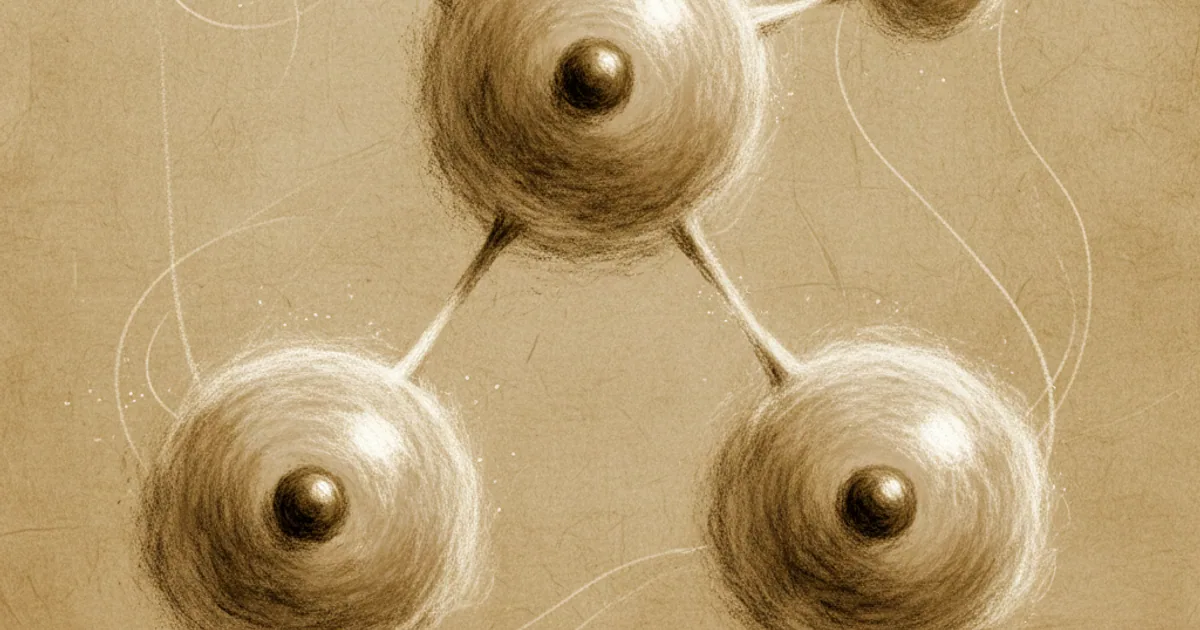
If a future civilization rebuilding from scratch could only inherit one sentence about science, Richard Feynman said it should be this: "all things are made of atoms — little particles that move around in perpetual motion, attracting each other when they are a little distance apart, but repelling upon being squeezed into one another."
That sentence gets you most of chemistry, all of materials science, and a good deal of biology and physics. Everything you see, touch, breathe, eat, or are — made of atoms. The rest of this article is just adding detail to that single statement.
The other articles in this cluster zoom in on specific phenomena: why water is so chemically weird, what makes gold yellow, how acids and bases work, and why things have colour.
An atom has three components:
The number of protons defines the element. Hydrogen has 1 proton. Carbon has 6. Oxygen has 8. Iron has 26. Gold has 79. Uranium has 92. If you change the proton count, you have a different element.
The number of neutrons can vary while keeping the same element. Carbon-12, carbon-13, and carbon-14 are all carbon (6 protons each) but with 6, 7, and 8 neutrons respectively. These are isotopes. Some are stable; some are radioactive (carbon-14 is famous for radiocarbon dating).
The number of electrons in a neutral atom equals the protons. Atoms with different electron counts (extra or missing electrons) are called ions and have net charge.
An atom is about 10⁻¹⁰ metres across — a tenth of a nanometre, or roughly one ten-billionth of a metre.
The nucleus is much smaller — about 10⁻¹⁵ metres, a hundred thousand times smaller than the atom itself. If you scaled an atom up to the size of a football stadium, the nucleus would be a marble at the centre and the electrons would be specks in the seating. Almost the entire atom is empty space.
What feels "solid" about matter is the electron clouds of atoms repelling each other electromagnetically. When you push a table, you're not feeling its substance — you're feeling the resistance of electron clouds against your hand's electron clouds. The atoms themselves never come anywhere close to touching.
Atoms form molecules by interacting through their outermost electrons. The inner electrons sit close to the nucleus and rarely participate. The outer ones are what chemistry runs on.
There are three main flavours of chemical bond:
Covalent bonds. Two atoms share electrons. This is most of organic chemistry — carbon shares electrons with hydrogen, oxygen, nitrogen, etc., forming complex molecules. The hydrogen in H₂O is covalently bonded to oxygen; both ends share electrons.
Ionic bonds. One atom transfers an electron to another. Sodium gives up an electron, becoming Na⁺; chlorine accepts the electron, becoming Cl⁻. The opposite charges attract, holding the ions together. Salt (NaCl) is an ionic compound. Ionic bonds are strong and brittle.
Metallic bonds. Many atoms in a metal share a "sea" of electrons that's not localized to specific pairs. The shared electrons make metals conductive (they can move) and ductile (the atomic arrangement can shift without bonds breaking).
These three flavours plus weaker interactions (hydrogen bonds, van der Waals forces) cover almost all of chemistry. Once you know an element's outer-shell electron count, you can predict what bonds it likes to form.
The periodic table organises the elements by proton count and electron-shell structure. Each row corresponds to a new electron shell being filled. Each column groups elements that have similar outer-shell configurations.
This is why columns matter:
The pattern is just "what do the outer electrons want?" Elements in the same column behave similarly because they have the same answer.
Atoms bond because the resulting molecule is more stable than the unbonded atoms — the electrons settle into lower-energy configurations. The "lowest energy state wins" rule explains why some bonds happen and others don't.
A noble gas has a stable outer shell. It has no incentive to bond. Helium does almost nothing.
A sodium atom has one outer electron that's just barely held. A chlorine atom has 7 outer electrons and would love to have 8. Sodium donates, chlorine accepts; both end up with full shells. Stable. The configuration is lower in energy than the separate atoms — energy is released as the bond forms.
For covalent bonds (sharing rather than transferring), the same energy logic applies. Two hydrogen atoms each have 1 electron and would each "like" 2 for a full first shell. By sharing both electrons, both atoms simultaneously have an effective shell of 2. The shared configuration is lower in energy than two separate hydrogens. H₂ forms.
This bookkeeping — "what would put the outer electrons in the lowest-energy configuration?" — is most of what chemists do.
A chemical reaction is just atoms rearranging their bonds. The atoms involved don't change (transmutation requires nuclear reactions, not chemical ones). Their connections do.
When you burn methane (CH₄ + 2O₂ → CO₂ + 2H₂O), no atoms appear or disappear. The carbon stops being attached to hydrogens and ends up attached to oxygens; the oxygens shift from being bonded to each other to being bonded to carbon and hydrogen. Heat and light are released because the new bond configuration has lower energy than the old one — the energy difference comes out as light and heat.
This is why "conservation of mass" applies to chemical reactions. The same atoms are present before and after.
The "wanting" of an atom for a particular outer-shell configuration sounds vague but is rigorously calculable through quantum mechanics. Electrons in atoms occupy specific orbitals with specific energies, and the rules about which combinations are stable come from solving the quantum-mechanical equations for the system.
In practice, chemists usually work with the simplified "shell model" — outer electrons want to be 8 (or 2 for hydrogen and helium), and bonds form to make that happen. Underlying it is a much more sophisticated quantum picture, but the shell model gets you remarkably far with intuition alone.
If you'd like a personalized 5-minute course on atoms, bonding, and the periodic table, NerdSip can generate one.
Atoms are nuclei with proton-defined identity, surrounded by electron clouds. They bond by sharing, transferring, or pooling outer electrons in ways that lower their combined energy. The periodic table organizes elements by what their outer electrons want. Almost all of chemistry — from the colours of metals to the structure of proteins to how soap works — is consequences of these few rules. Once you have the basic picture, the world becomes more comprehensible at a molecular level.
A short editorial reading list. Pick whichever fits how you like to learn.


Comments 0
No comments yet. Be the first to share your thoughts.