
The quiet exception that runs the planet
If you melt a candle, the solid wax sinks. If you melt iron, the solid sinks. Mercury, gold, lead — all the same. The frozen version of almost everything is denser than the liquid version, so it sinks.
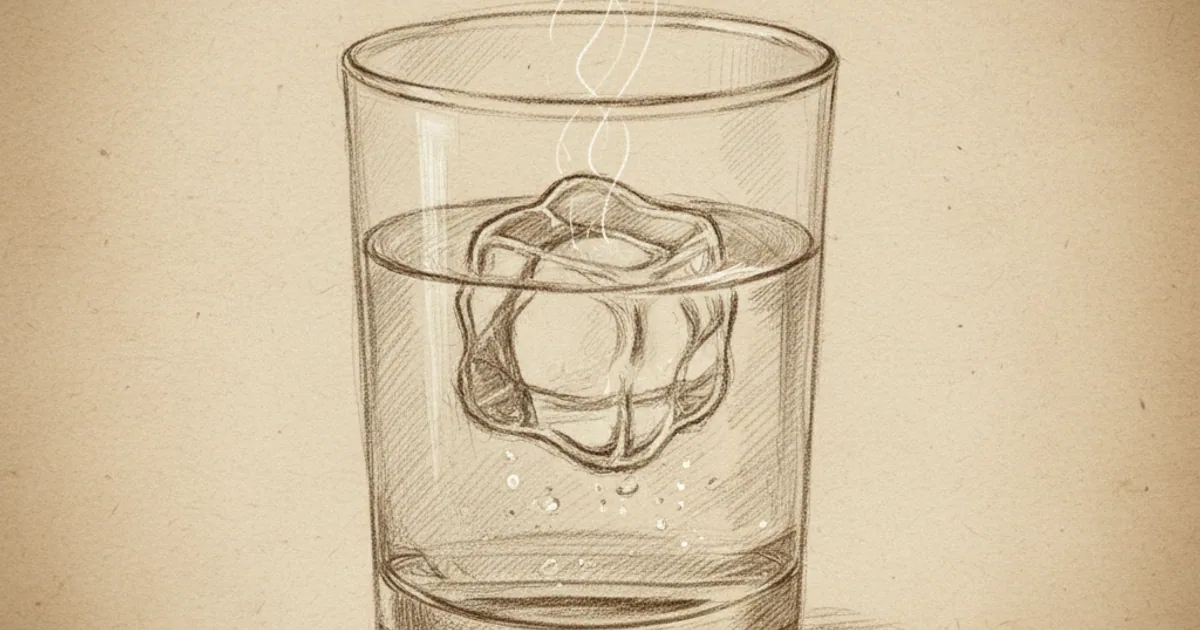
Water doesn't behave this way. Freeze water, and the ice floats. This single fact — a 9% drop in density between liquid and solid — is the reason fish survive winter, the reason your driveway gets a frost-heave crack, and the reason a glass of iced tea has its ice on top instead of buried at the bottom.
What's happening at the molecular level
A water molecule is an H₂O — two hydrogens stuck to one oxygen at a 104.5° angle. The oxygen has a slight negative charge; the hydrogens are slightly positive. That asymmetry lets each water molecule stick to its neighbours via a weak attraction called a hydrogen bond.
In liquid water at room temperature, those hydrogen bonds are constantly forming and breaking. Molecules slide around, packing fairly tightly because they're free to take whichever positions happen to fit.
As you cool water down, the molecules move less, and the hydrogen bonds last longer. At 4°C, you reach a sweet spot: molecules are slow enough to bond a lot, but the lattice hasn't fully formed. This is water's maximum density — about 1.00 g/cm³.
Cool it further, and something strange happens. Hydrogen bonds start holding molecules in a specific arrangement — a six-sided lattice where each water sits at a fixed distance from its neighbours. This open hexagonal structure takes more space than the liquid jumble it replaced.
By the time you hit 0°C and the lattice locks into ice, the bulk density has dropped to about 0.917 g/cm³. The crystal is 9% less dense than the liquid it came from. So it floats.
Why the maths matter
That "9%" is not a small thing. It's the difference between a lake freezing top-down (what actually happens) and a lake freezing bottom-up (which would kill most life in it).
When a pond cools toward winter, water on the surface gets colder and denser, sinks, displaces warmer water upward — until everything reaches 4°C. Then cooling continues, but now the colder water at the surface is less dense than the 4°C water beneath. It floats on top. Eventually it freezes into ice — which also floats — and the floating ice acts as a lid.
That lid insulates the liquid water below. Even in a brutal winter, the bottom of a lake stays around 4°C. Fish, frogs, plants, microbes — all keep going under the ice.
If water behaved like most substances, ice would sink as it formed. The next layer of water exposed to cold air would freeze and sink too. Lakes would freeze solid from the bottom up. Most freshwater life as we know it wouldn't exist.
Why pipes burst
The same 9% expansion is why pipes burst in winter.
Water in a pipe doesn't have anywhere to go when it freezes. It expands against the pipe walls, then against the still-liquid water further down the line. Pressure builds. The metal eventually fails — usually somewhere downstream from where the actual freeze happened, where pressure piled up against a closed valve or a turn.
It's not the cold that bursts the pipe. It's the expansion of the freezing water inside it.
The geological consequences
The freeze–thaw cycle slowly tears rock apart. Water seeps into cracks, freezes, expands by 9%, widens the crack, melts, refreezes deeper. Over centuries, this frost wedging turns continuous bedrock into rubble, builds talus slopes, and shapes mountain landscapes. It's also why potholes appear after a hard winter — water in the asphalt cracks, freezes, and lifts the road surface from below.
What else is weird about water
The density inversion isn't water's only oddity. Water has the highest specific heat of any common liquid (it takes a lot of energy to warm up, which is why oceans moderate climate). It has the highest surface tension of any common liquid (which is why insects can walk on ponds). And its boiling point of 100°C is absurdly high for a molecule that small — comparable molecules like methane and ammonia boil far below room temperature.
Every one of these anomalies traces back to hydrogen bonds. Water is sticky to itself in a way that few molecules are — the kind of genuinely surprising fact that quietly explains half the world once you notice it.
The takeaway
Water is the strange exception. The same molecular geometry that makes liquid water expand when it freezes also makes ice float, lakes stable for life, pipes burst, mountains crumble, and oceans store enormous heat. It's the most chemically unremarkable substance on Earth, behaving in some of the most peculiar ways — and a fair amount of life on the planet depends on those peculiarities.

Comments 0
No comments yet. Be the first to share your thoughts.